Major Patrick Ferguson moved his troops into the mountainous regions of the South to track down Patriot sympathizers. To track down such Patriot sympathizers, Ferguson sent a Whig prisoner into the inhabited mountains to carry forth a warning. He warned if there were continued support against British arms, that his army would march “…over the mountains, hang their leaders, and lay their country waste with fire and sword.”
Among those Patriot leaders there in the Tennessee mountains were Colonels Isaac Shelby, Samuel Phillips, John Sevier, William Campbell, Arthur Campbell, Charles McDowell, and Andrew Hampton. Troops were gathered and congregated on September 25 at Sycamore Shoals, an outpost on the Watauga River.
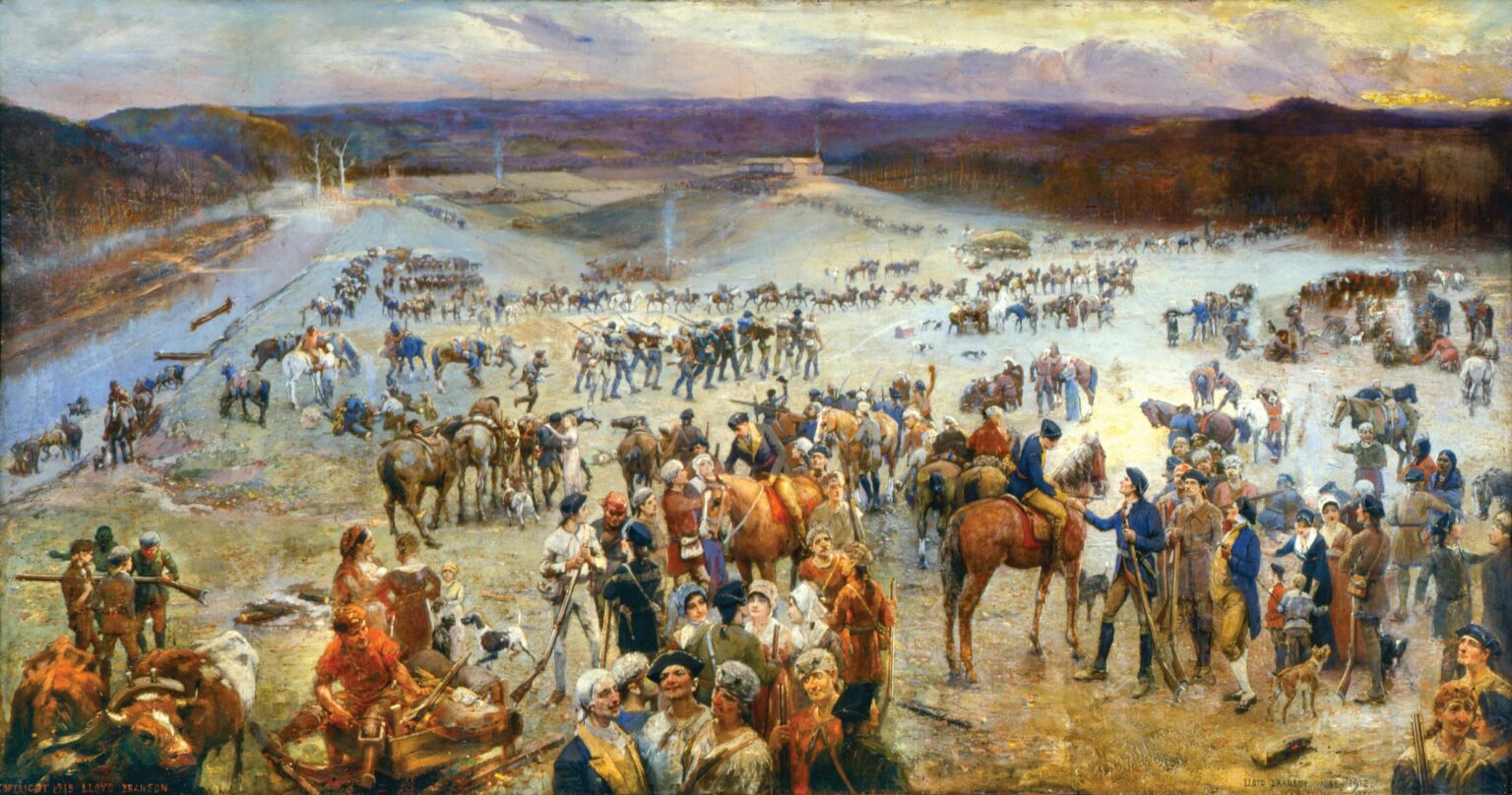
Gathering of Overmountain Men, Backcountry Militia and others at Sycamore Shoals, Tennessee, west of the Blue Ridge mountains. Led by Patriot militia commanders Isaac Shelby, John Sevier, and Charles McDowell, the group set out to find British Major Patrick Ferguson after he had threatened them and told them to stay home. The Patriots traveled over 100 miles before surrounding Ferguson and his Loyalists at Kings Mountain.
Minister Samuel Doak said to the gathered troops, “The enemy is marching hither to destroy your homes.…Go forth, then, in the strength of your manhood to the aid of your brethren, the defense of your liberty and the protection of your homes.”
Twenty-nine-year old Mary Patton was in the trade of making gunpowder; she had been trained in this occupation at her home in Ireland. Made at her own powder mill, she volunteered five hundred pounds of gunpowder for their expedition. Without powder, their rifles were of no use.

The men hiked approximately 330 miles along a wearisome wilderness road, abounding with mountains and valleys. Their path crossed the Blue Ridge Mountains through the present-day states of Tennessee, Virginia, North Carolina, and South Carolina. Nearing Ferguson’s force, the Overmountain Men stood at more than 1,000 strong.

During the last thirty-six hours, the riflemen from North Carolina, South Carolina and Washington County, Virginia, never alighted but once and then at Cowpens. They had little to eat but parched corn. A persistent rain made them wrap their guns and ammunition in sacks, blankets, and even their hunting shirts. It was necessary to keep their powder dry, even though their bodies were drenched by the cold downpour. When they did catch up with Colonel Ferguson, they went into the fight with neither rest nor refreshment.

In the early afternoon of October 7, 1780, the Overmountain men creep quietly toward Ferguson’s position. Captain John Ingle, my husband John’s great, great, great, great grandfather, of the 2nd North Carolina led a company of 82 men to the top. Fighting Indian style, they moved from tree to tree for cover, but always forward.
When the first shot rings out the Americans attack en masse from all sides. Ferguson deploys his Loyalist militia in the center of the hilltop. He remains mounted and personally leads the counterattack against the patriots surging from the southwest. After firing a volley and fixing bayonets, Ferguson’s men blunt the Overmountain men’s advance. But it is only on one side of the hill and the Overmountain men continue unabated to attack from the other sides using the undergrowth and woods to their advantage.
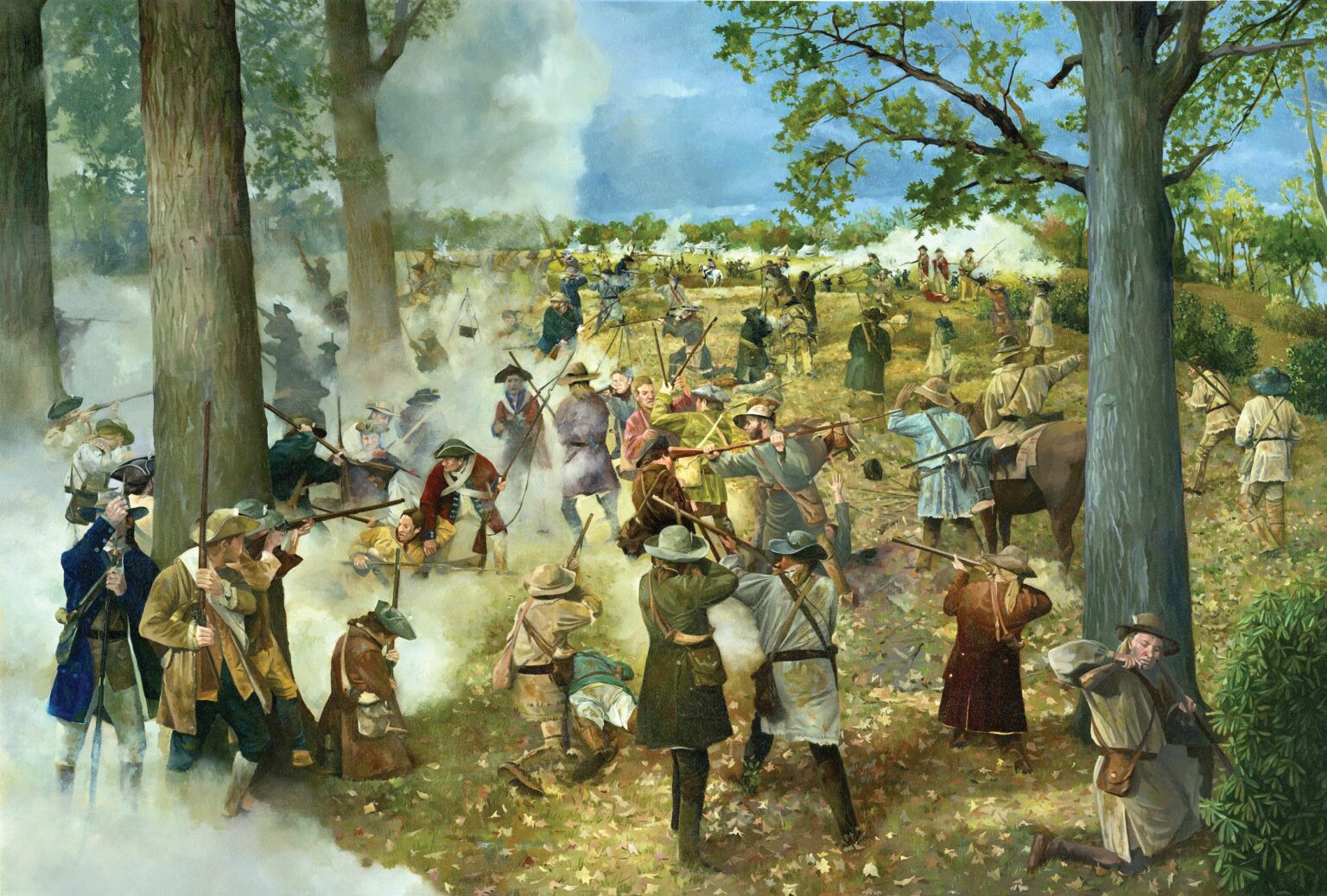
American Patriot militia gain the crest of Kings Mountain where Loyalist troops, including the King’s American Regiment wearing red coats, had circled their supply wagons for a defensive stand. The Loyalists, armed with muskets and bayonets, drove off several Patriot advances by charging with their bayonets, a weapon the Patriots lacked.
Many of the Overmountain Men and Back Country militia carried rifles, which proved superior on the rocky, wooded slope.One Loyalist later recalled that the Overmountain men looked “like devils from the infernal regions… tall, raw-boned, sinewy with long matted hair.” Ferguson and his men are surrounded, and their additional counterattacks fail to stop the Americans. The Overmountain men continue their yelling and whooping as they gain ground.

The only British regular in the Battle of Kings Mountain, Major Ferguson was hit by as many as eight bullets while rallying his troops. The 36-year-old Scotsman fell from his horse and was dragged across the battlefieldfell by a stirrup. His body was buried in a cairn at the site.
Unwilling to surrender to a “band of banditti,” Ferguson led a suicidal charge down the mountain and was cut down in a hail of bullets. After his death, some of his men tried to surrender, but they were slaughtered in cold blood by the frontiersmen, who were bitter over British excesses in the Carolinas. The Tories suffered 157 killed, 163 wounded, and 698 captured. Colonel Campbell’s force suffered just 28 killed and 60 wounded.
Twenty thousand shots fired in one hour and five minutes. Ferguson had boasted that “God and His angels” could not get him off the mountain. The words proved to be somewhat prophetic in that Major Ferguson was buried on the mountain.
Kings Mountain was a battle of militia–American Patriots against American Loyalists. Short and intense, it was the last desperate stand of British Major Patrick Ferguson and a turning point in the American Revolution.

Let’s remember this march for freedom.
 Sheila Ingle