Category Archives: Uncategorized

What is a Doodle Bug?

Sandy soil is the home of doodle bugs; they like underneath houses, where it is dry and soft. They construct traps to catch their food, like small insects and ants. These small, carnivorous worms or bugs are a favored- food of chickens.

They have heads that are all penchers. After they build those inverted come traps, they hide under them in the sand. When “food” drops into the cone, their penchers are on-ready.

When a chicken finds a doodle bug, it inhales the whole bug. In protest, the bug bites the chicken’s throat. When this happens, the chicken can’t swallow the bug. Hence, the name of these doodle bugs are also chicken chokers.

And you are thinking why in the Sam hill am I talking about doodle bugs and chicken chokers?

John and I were over at Brattonsville for the day this past Saturday; it was Children’s Day at the Farm. Children of all ages were planting seeds, petting sheep, plowed a garden behind two horses, etc. They had a fun day.

One of the interpreters watched the children and the chickens. When he came by our table, he and John started this conversation about doodle bugs. I needed an interpreter, so John filled me in. I was amazed at these creatures and their place in the food chain.

The two men went on to talk about playing with the doodle bugs as children. They would entice the bugs by putting a blade of grass in their traps. Of course, the bug grabbed the grass and entertained the boys. (In this digital world we live in, I would think that this would still be a good time,)

Oddly enough, I used to call one of my brothers “doodle bug.” It was purely a term of endearment and affection. Looking back with new information today, maybe I would have chosen another word.

Some of you might might remember that the Volkswagon Beetle of the 1960’s was called a doodle bug. I knew about that definition, also.

I can see John and his brothers playing with doodle bugs underneath their house. It gives me another picture of his growing-up years and his love for nature.

But I don’t think I will look for doodle bugs around our house; I am not on the friendliest of terms with bugs, doodle or otherwise.

“The books transported her into new worlds and introduced her to amazing people who lived exciting lives. She went on olden-day sailing ships with Joseph Conrad. She went to Africa with Ernest Hemingway and to India with Rudyard Kipling. She travelld all over the world while sitting in her little room in an English village.”
― Roald Dahl, Matilda

Women Writers and Storytellers

I have just finished rereading the third mystery novel by Patricia D. Cornwell. Her stories keep me turning the pages at a fast clip, and “All That Remains” did it again. There is no plodding plot, and the twists are probable.

A graduate of Davidson College with a degree in English, she published her first novel, “Postmortem,” in 1990, and her next novel will be released in November, 2014. As of last year, Cornwell’s books have sold some 100 million copies in thirty-six languages in over 120 countries. She’s authored twenty-six New York Times bestsellers.

An interesting fact about Patricia Cornwell I just found out is that she is a descendant of Harriet Beecher Stowe.

Others obviously are her followers, also; she is a master writer of crime novels. She leads her readers, as well as her characters, on time-sensitive chases to find criminals. It is in the microscopic details that Dr. Kay Scarpetta unties each crime.

Cromwell’s title of “queen of crime” is well-deserved. “Do no harm & leave the world a better place than you found it.”
said Cromwell, and her writing continues to roll out the red carpet to her readers.

Gwen Bristow was born in Manning, SC in 1903, and her protagonists are all strong and independent women who were not afraid of adventures.

The sassy heroine Celia Garth helps the Continental forces by spying for their cause working in a Tory dress shop in Charleston, SC during the Revolutionary War. Fear of the enemy stimulates

A New York City debutante marries a prairie trader in “Jubilee Trail,” and this is only the beginning of a saga about the old west.

Garnet, that debutante, is described by her father, “He thought about the people who had come before them. The Huguenots, the Scottish Dissenters, the English pirates who had stormed up and down the coasts of the American colonies until they got old and virtuous and finally settled down on shore. [He] thought sometimes that a good many of the people who were heroes after they were dead must have been great nuisances while they were alive.”

Who would ever have thought that heroes might have been nuisances at one time? Characters are thoughtful in their observations of others in her writing.

Bristow’s historical novels paint our country with defining strokes in its history. “You are not required to start over, but you are required to keep going., said Bristow. Her characters give readers a snippet of advice on how this is done.

If you haven’t read either of these authors, I recommend them both. Women’s History Month is a good time to start!

Women to Remember

This is Women’s History Month, and I thought I might share some stories about influential women in my life.

Last week, I shared Elizabeth Timothy’s story with you. When women had a secure place in society in their homes during the colonial period, she ran her husband’s newspaper after he died and then started her own business in Charleston in the 18th century.

I have a friend that encourages others to do the next thing and “party on.” It is good advice, and she follows it herself. Whether it is crawling on the floor happily playing with her grandchildren or sharing a cup of coffee and encouragement with a friend, she makes an average day a better day.

Eleanor Roosevelt said, “A woman is like a tea bag – you can’t tell how strong she is until you put her in hot water.” This is a vivid comparison, and I believe she knew whereof she spoke.

Mom was what I called her; she was my mother-in-law. In the midst of WW II, she raised four sons and worked in Union Mill. My father-in-law built the house they lived in, and he worked a different mill shift, so there would be supervision at home. Besides baking delicious biscuits, making beautiful quilts, knitting and crocheting gifts, canning vegetables from her garden, and making many of the family’s clothes, she was a good shot. One day she eased her .22 rifle to the head of a copperhead in her home and blew him to kingdom come, as the saying goes. She was a woman of many talents.

I fell in love with Louisa May Alcott’s books at an early age. This Pennsylvania-born women described a family that had high ideals and lived them out. Unbelievably, printed in 1868, “Little Women” is still read today. How she wrote this book in two six-week time frames is amazing to me. Her family perpetually was fighting poverty but was generous in sharing with those less fortunate, both in reality and in “Little Women.” They lived out what they believed. Louisa, aka Jo. passionately predicted at age 15, “I will do something by and by. Don’t care what, teach, sew, act, write, anything to help the family; and I’ll be rich and famous and happy before I die, see if I don’t.”

Discovering radium, which changed science, and then dying from its effects, Marie Curie proclaimed, “Nothing in life is to be feared. It is only to be understood.”

So if today is the day you find yourself in hot water, keep swimming.

Spartanburg County Historical Association

This week the Spartanburg County Historical Association will be hosting three diverse events.

1. February 27 – At Gerhard’s Cafe, join the SCHA to sample game fare prepared by local chefs and learn about the history of one of Spartanburg’s most unique restaurants! Cash Bar.

Spots are limited so purchase your ticket today!

SCHA Member Ticket ($30)

Non-Member Ticket ($35)

1. February 28 – Spartanburg Regional History Museum will host a Lunch & Learn — “A Clifton Mills Story” — at Chapman Cultural Center. Bring your lunch and learn about one family’s experience working in the Clifton Textile Mills from author Anne Phillips. Call (864) 596-3501 for details.

$5 at the door

3. March 1 – Interested in the food that backcountry settlers grew and ate during the 18th and 19th centuries? Come learn and sample backcountry foodstuffs at the Historic Price House!

This year’s event will also feature recipes from the kitchens of U.S. Presidents who were in office during the Prices’ lifetimes.  Guests can learn how our country’s “founding foodies” shaped American cuisine and taste dishes enjoyed by some of our first Chief Executives and their households, including Thomas Jefferson’s Macaroni & Spinach Bake, James Hemings’ Fritters a la Chantilly, and George Washington’s Chile-Spiced Pecans.

The price of admission includes a guided tour of Historic Price House.  Guided tours will be given every hour on the hour from 11 a.m. to 3 p.m.

$4/Child, $6/Adult (SCHA Members save $1 off each ticket)


One is on my list and wish I could attend more. How about yours? We are blessed to have so many people sponsoring and sharing about our city all the time.

“History is a cyclic poem written by time upon the memories of man.” Percy Bysshe Shelley


Julia Peterkin

ulia Mood was born in Laurens County on Halloween, 1880. Her mother died when she was two years old. Julia, as a teenager, attended Converse College, graduated at 14,  and received a Masters degree at an early age.

Julia moved to Fort Motte in Calhoun County to become a teacher. In 1903, she married William George “Willy” Peterkin, who was a rich cotton planter.

She wrote about everyday life and people, often the Gullah culture. She won the Pulitzer Prize for Literature for Scarlet Sister Mary.

One of the quotes from this book is “Everything has its way of speaking and telling things worth knowing. Even the little grass-blades have their way of saying things as plain as words when human lips let them fall…the choice bits of wisdom…were never written down in any books.”

This afternoon, at 4:00 on SCETV, there will be a special on the life of this South Carolina author, and I am going to watch it once again. It won’t be long before her alma mater and mine will be handing out the Julia Peterkin Award for Poetry in her honor.

Listen to her descriptive words again, “…the spring that bubbled…Weak. Small. Yet too strong for anybody to hold it back.  It was like life itself.”   (“Green Thursday” (Gullah stories), 1924)

If we continue to stretch and grow and bubble with life, though a tad small like a spring, we might change our course and eventually create a new way of moving.

Book Launch

Book Launch

A Respected South Carolina Lady

Eliza
Lucas Pinckney 1722-1793

     During the 18th Century, a
woman’s role in society was to be a wife and mother. There were a few women
that found their place in South Carolina history in a different way than
homemaker.

      Eliza Lucas was born on December 28, 1722
to Anne and Colonel George Lucas in Antigua, British West Indies. She
was the oldest. As was society’s way, her brothers were sent to London for
their education. But Eliza and her sister Polly were not left out; they also
received an English education, which was unusual. Eliza enjoyed music and
French, but she fell in love with botany.

     Because Colonel Lucas inherited three
plantations from his father in the Lowcountry, the family moved to South
Carolina in 1738. He was called back to Antiqua the following year, and Eliza
became the head of the household in her father’s stead. She sought his advice,
while at the same time reading through his library. Agriculture was her prime
interest.

     At age 17, Eliza was running the family’s
plantations, taking care of her ailing mother, teaching her younger sister, and
starting a new venture with indigo seeds sent by her father.

     Success wasn’t immediate. A rare
Charleston frost killed the first crop, and worms ate up the second. The third
year was promising, but a dishonest employee betrayed her. On the fourth year,
seventeen pounds of indigo were exported to England, and Eliza changed the
economy in South Carolina. She didn’t give up, and her determination to
keep-on-keeping-on is an example to all of us.

     Eliza’s father died in 1747, but she
continued with her new business. Historian Edward McCrady wrote, “Indigo proved
more really beneficial to Carolina than the mines of Mexico or Peru were to
Spain….The source of this great wealth…was a result of an experiment by a mere
girl.” (Perhaps you will agree with me that Eliza Lucas was hardly a mere
girl!)

     But it wasn’t all work for Eliza.
Charleston society beckoned her, and she became close friends with Charles and
Elizabeth Pinckney. Elizabeth thought of Eliza as a daughter, and the
relationship was warm. Because Charles Pinckney traveled so much, Eliza became
a regular visitor at the home. To no avail, Elizabeth fought a year-long battle
with illness and left Charles a widower at 45. Charles asked Eliza to marry
him, and the ceremony took place on May 27, 1744.

         Eliza Pinckney enjoyed
her new life and home at Belmont Plantation. She spent many days planting
magnolias and oaks. She continued her experiments with hemp and flax and
revived the silk industry in the Lowcountry.

     Even though the land and agriculture
appeared to call her by name, Eliza and Charles had three sons and one
daughter, and her devotion to her husband and family was the major calling on
her life. She believed what the Bible said about a woman’s influence in the
home.

     The Pinckney’s left South Carolina in 1753
for five years in England. Eliza took a gift to the Princess of Wales. It was a
handspun silk dress that Eliza had made.

     Unfortunately within months of their
return home, Charles died of malaria. Eliza grieved, but she continued to keep
busy. She wrote frequently to her sons at school in England and her new English
friends. She enjoyed visiting with her friends in Charlestown, also. Harriott
married, and soon Eliza became a grandmother with all its privileges.

     With war with England pending, C.C and
Thomas came home in 1769, and the whole family pledged its support to the
American Revolution. Eliza unselfishly gave to the cause, and the British
repaid in kind by destroying her property. Both Eliza and Harriott acted as
spies for General Francis Marion throughout the war.

     After the war, Eliza went permanently to
live with her daughter. She had the opportunity to influence her four grandchildren.
In 1791, mother and daughter entertained President George Washington with their
Southern hospitality. And when Eliza Lucas Pinckney died in 1793, President
Washington returned their graciousness by offering to be a pallbearer at
Eliza’s funeral.

     We can learn much from the life of Eliza
Pinckney. She was a determined woman who followed her dreams, and that
beautiful blue of our flag reminds us of her. This woman of substance had
visions far beyond her years or her time, and we are the benefactors. Her
influence was finally noted in 1989 when she was inducted as the first woman
into the South Carolina Business Hall of Fame.

    The Charleston
City Gazette
wrote in her obituary, “Her manners had been so refined by a
long and intimate acquaintance with the polite world, her countenance was so
dignified by serious contemplation and devout reflection…that it was scarcely
[possible] to behold her without emotions of the highest veneration and
respect.”

     Thank you, Eliza Lucas Pinckney, for your
sterling example. We salute you!

French Toast

It is Saturday morning, and my dad always fixed French Toast for breakfast on Saturday mornings. I can smell the bacon frying now, and the aroma almost sends me to my kitchen.  I can even see the butter melting in the midst of the syrup sliding off the toast.  Perhaps you have a similar memory.

Our memories from childhood continue to invade our adult years, don’t they? Most often from my generation they involve food events around a table, whether it is a simple Saturday breakfast or an elaborate Thanksgiving dinner. In looking back, it is the fellowship, not the food,  that I remember being the sweetest. Laughter and everyone talking at once were the main course of the menu.

Just the other day, I read and watched a video on the history of French Toast. This is a different recipe that my dad used of only milk and eggs, but I enjoyed reading the long history of this favorite of many generations. In fact, the allure is sending me to my kitchen after all, and maybe you might add it to your Saturday morning routine.  We never know how the simple traditions from our childhood will invade our present with smiles and memories.

Happy Saturday!

Who doesn’t like a nice big plate of French Toast? For me it brings back fond childhood memories of Saturday mornings — usually during the holidays when no one seemed to be in a hurry to change out of our pj’s to go anywhere. Truly, French toast a quintessential breakfast food, though I’ll eat it for any meal if given a chance — especially if it’s served with real maple syrup, a dab of melting butter, and maybe some fresh fruit or berries on the side.

But did you know that this delectable dish we call French Toast has been around for over  a thousand years? And it wasn’t always breakfast fare, in fact, it likely started out as a dessert.

The earliest documented recipe for French toast can be found in the Apicius — a collection of 4th and 5th century Roman recipes. The dish is simply titled, “Another Sweet.” Its translation reads:

“Break a slice of fine white bread, crust removed, into rather large pieces. Soak in milk and beaten eggs, Fry in oil, cover in honey, and serve.”

Bread was known as the staff of life. It was the dietary pillar of cultures around the world. But what was one to do when their bread went stale?

In an old nameless English cookbook from 1430, later compiled and published under the name “Two 15th Century Cookery Books,” We find a recipe for bread dipped in egg yolks, fried in butter, and sprinkled with sugar.

“Eyren” is an old plural form of the word “egg.”

The name of this dish is the French word, “Payn Perdeuz,” meaning “Lost Bread” or “Wasted Bread,” suggesting the recipe was intended for bread that had gone stale. This name seemed to stick for many years in the vocabulary of English cooks.

Karen Hess, who transcribed Martha Washington’s Book of Cookery, says,

“The English early took to pain perdu and made it their own; it was rarely omitted from a cookbook, usually listed under “made dishes”…or any dish that amused the cook or showed off her skill.”

Here is our take on an 18th-century recipe for Payn Perdue:

The Compleat housewife, Eliza Smith, 1739

Ingredients:

1 – Medium loaf of firm enriched bread. (The No-Knead “French” Bread in our most recent video would make a perfect choice. If you’re not up to making your own bread, Challah, Brioche, or a Country French loaf will work perfectly. Stale bread is better. You can leave it out overnight if you need to, out of reach of the critters)
8 – Egg yolks
1 Cup of Cream
1/4 Cup Sweet Sherry
1-1/2 Tablespoons Sugar
1/2 teaspoon Grated Nutmeg

3 – 4 Tablespoons Butter

For the sweet sauce (instead of maple syrup)

4 Tablespoons Butter, Melted
1-1/2 Tablespoon Sugar
2 Tablespoons Sweet Sherry

Instructions:

Take a sharp or serrated knife and slice off all the outer crust of the bread. Cut the remaining crumb into slices about 3/4″ thick.

In a bowl, mix the egg yolks, cream, sherry, and sugar. Season with grated nutmeg.

Dip the bread slices in the egg mixture, making sure you get the edges as well,  and set them on a plate for a while — 15 minutes should do, unless your bread is really stale, then it might take longer.

While the bread slices are sitting there soaking up the egg mixture, go ahead and mix the melted butter, sherry and sugar for the sweet sauce. Set this nearby for serving your toasts.

Melt 3 to 4 tablespoons of butter in a large skillet over medium heat. You may have to be very careful handling the bread at this point, depending on the type of bread that you use. When your butter has stopped bubbling and it’s quieted down just a bit, fry your payn perdue slices on both sides until they are a golden brown.

Pour the sweet sauce over your slices and serve.

Refined white sugar in the 18th century came in cone-shaped cakes, wrapped in blue paper. Sugar Nipperswere often employed to break it apart.

For authentic alternatives to our 18th century sweet sauce, you can also use honey, light molasses, maple syrup, or you can simply sprinkle it with sugar and a bit of ground cinnamon.

A sweet and sour alternative that is likewise very authentic, would substitute verjus for the sherry. Verjus is the unfermented juice of unripe grapes. It was commonly used in the 18th century for pickling and spicing up sauces in place of vinegar. It’s available online.

Camden, 2012

According to its web site, Historic Camden, “the oldest existing inland town in South Carolina, was part of a township plan ordered by King George II in 1730. The frontier settlement, initially named Fredericksburg Township (later Pine Tree Hill), took hold by the 1750’s as Quakers and Scots-Irish emigrants and settlers from Virginia put down roots.

Joseph Kershaw, a native of Yorkshire, England arrived in 1758 and established a store for a Charleston mercantile firm. He prospered, and by 1768, the town was the inland trade center in the colony. At his suggestion, the town became Camden, in honor of Lord Camden, a champion of colonial rights.

In May of 1780, the American Revolution returned to Charleston, and the town fell to the British. Lord Charles Cornwallis and 2500 British troops immediately marched to Camden and set up the main British supply post for the Southern Campaign. For eleven months, the citizens of Camden understood the atrocities of war.

Two battles were fought near by. The Battle of Camden, the worst American battle defeat of the Revolution, was fought on August 16, 1780 nine mile north of our museum. Nearby, General Nathaniel Greene and approximately 1,300 Americans engaged 950 British soldiers commanded by Lord Francis Rawdon on April 25, 1781. It was a costly British win and forced the Redcoats to evacuate Camden.”

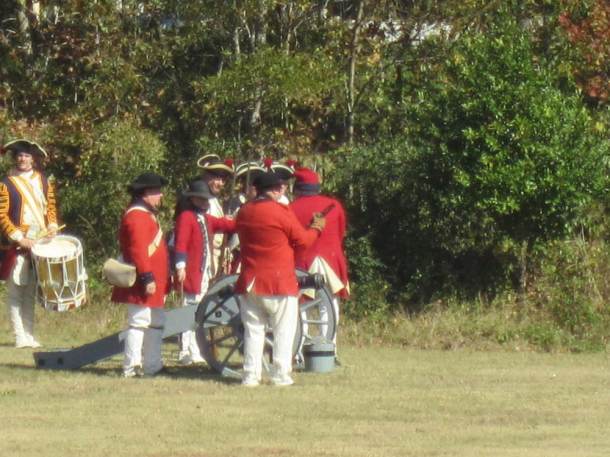
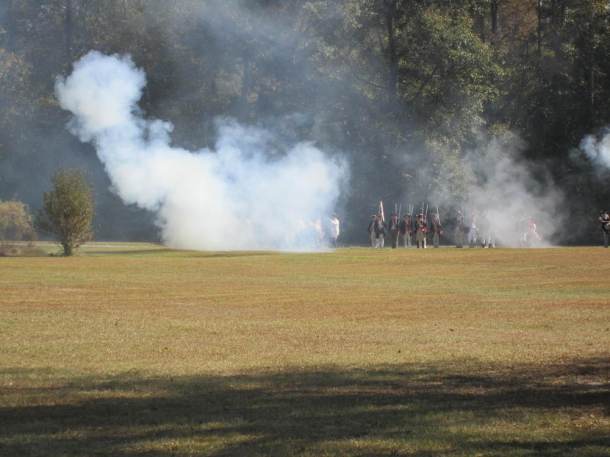
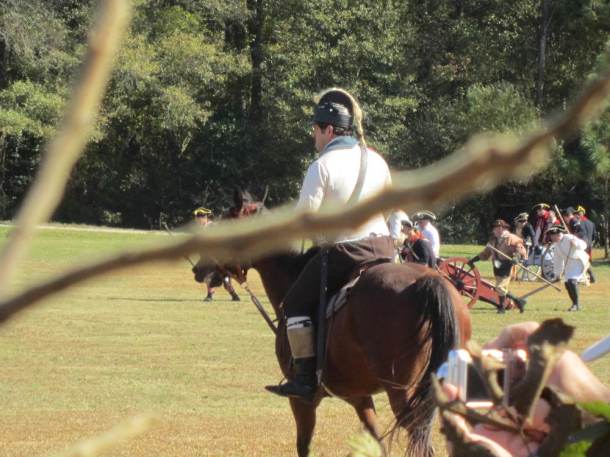
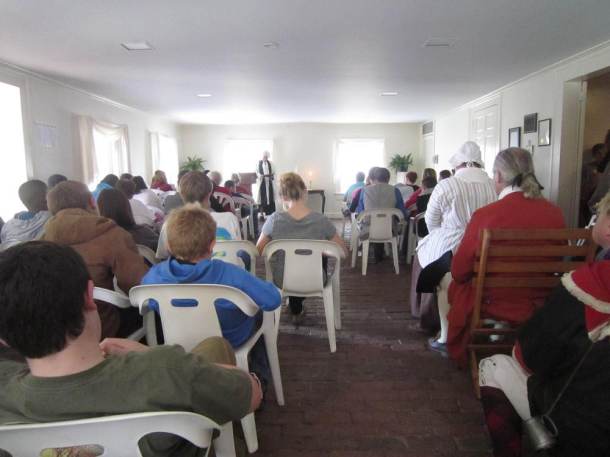
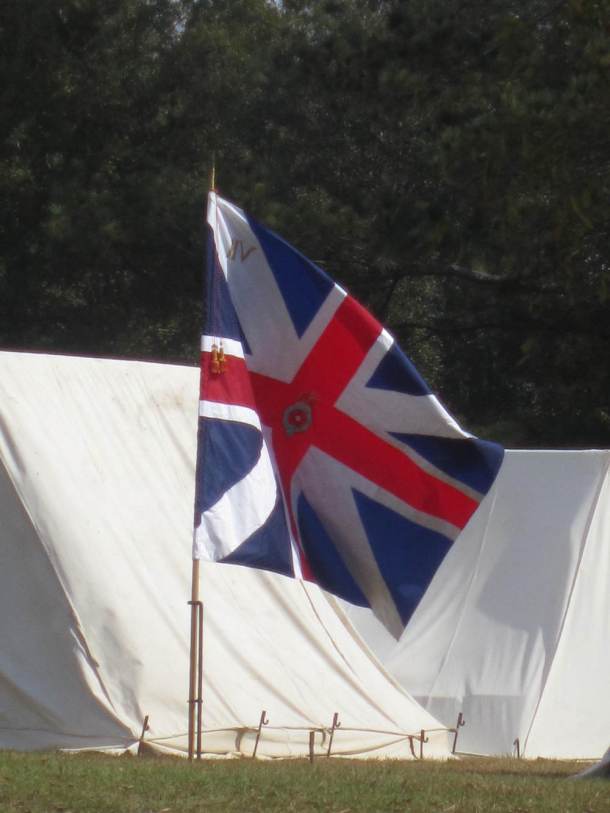
On November 4-5, 2012 Historic Camden celebrated its 42nd annual Revolutionary War Field Days. These are some pictures from the event.

We stayed once again at the beautiful Bloomsbury Inn in Camden, S.C. Katherine and Bruce Brown are the gracious innkeepers. This picture is a bit dark, but Katherine and I were enjoying a look at the old kitchen. She decorates this for the holidays, and their family enjoys this space. You will enjoy looking at the web site and joining them on Facebook. But most of all you will want to visit their historic home. You might have read the diary, written in book form called Mary Chestnut’s Civil War, and this was her home.

For you that enjoy coffee, you might want to try the Bloomsbury Inn coffee carried by our own Little River Coffee House in Spartanburg. It is delicious!

On the Bloomsbury Inn web site is a blog you will enjoy reading and a YouTube video that takes you on a tour of the house. For you that look for new recipes, Katherine kindly shares hers.

www.bloomsburyinn.com/

The pictures above tell the story, as the British soldiers await the American forces behind the gunfire they are hearing. They try to deter the rebel forces with their six pound cannons, but the Patriots resolutely continue to get closer and closer.  It was exciting to watch the fleeing British soldiers being followed by the cavalry. Steadily, the Americans pushed their enemies until the skirmish was won.

Colonial Cats, Mice, and Candles

Candles were essential in Colonial days. With no electricity, candles were a needed source of light. 

Once the sun set, it was a dark and shadowy world in colonial America. In most smaller homes, people saw only by the light of the fire on the hearth. Candles weren’t used  unless you really needed them. Even the well- to- do lived in comparative darkness. Candles were carried from room to room, and they were used in lanterns.

Most women used tallow (animal fat) from cattle or sheep to make their candles, and the smell was unpleasant. Bayberry was added to help the smell. The Moravians used beeswax, to make their candles, and they were popular for those who could afford to buy candles. Merchants from the Moravian settlement in North Carolina took their wares to Charlestown to sell in the stores.

Here is a video that will help you see the time that this one job took.

http://www.youtube.com/watch?v=kiBnf1dddAA&feature=related

There were many mice and rats that the colonists had to deal with when it came to their food supply, and believe it or not, these rodents even ate candles. So the women kept these precious candles in wooden boxes to protect them. Cats were a necessity in most households to keep those mice at bay. Some of the richer homes even had openings to the outdoors to encourage their cats to go in and out.

Candlelight gives us an ambiance in our homes today, and scented candles are easily bought. Maybe the reason we keep them in cabinets or drawers is to keep the mice away, and we didn’t even know this was an issue. 

My mother used to change her candles with the seasons – pink for spring, yellow for summer, burgundy for fall, and red at Christmas. She enjoyed the scented ones and would burn them periodically; they weren’t just for decoration.

I have a new candle that I am lighting each afternoon in our kitchen. Its scent is called Sweet and Spicy Pumpkin pie.  I believe it has influenced me to bake two pumpkin pies recently, but it has not encouraged me to adopt a cat!

Design a site like this with WordPress.com
Get started