Category Archives: Uncategorized

Gingerbread Cookies

Cooking in the 18th century was quite different than today. Enjoy this video of a precious cook that enjoys gingerbread cookies.

Doesn’t this make you want to go to the kitchen on this windy fall day to bake some cookies to enjoy with a cup of tea? My grandmother taught me to dip my gingerbread cookies into the hot tea; it softens the hard cookies, and they melt in your mouth. Yes, I believe I will have two!

Festifall at Walnut Grove, 2012

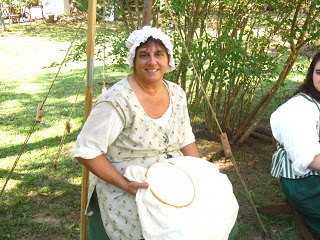
 On Saturday and Sunday, October 6-7, we spent our days at Walnut Grove Plantation for Festifall. One of the most popular vendors was the toy maker. I bought a new linen cap that his wife made, and John bought the game of graces, a windmill, and a game seamen used to play called Shut the Box.

There was curiosity at the hay bale that intrigued these young ladies. Behind them you can see the musician playing a fife, what we would call a flute today.

 All around  the camp, the women had their hand work in their laps. Knitting, crocheting, sewing, and spinning was everywhere. We saw skeins of yarn, mainly yellow, brown, blue, and red, that had been hand dyed. These colors were popular during colonial times because the available plants and nuts to make them were in the yards and herb gardens.

Her smile about reading my book made my day!

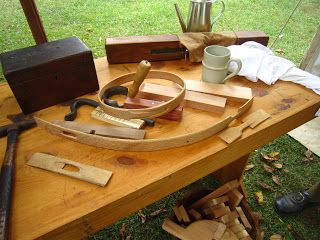
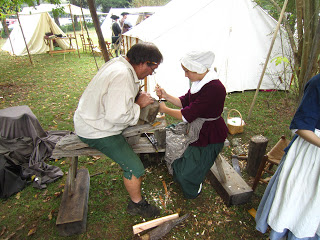
This man was taking a break from his woodworking. He had a display full of both small and large pieces. Surrounded by spoons of various sizes and shapes, boxes, and small pieces of furniture, you can see the dough bowl he was working on.

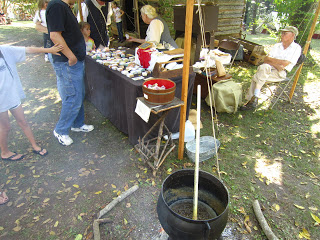
Soap making was essential to colonial life. This lady showed both the process and the finished product. The iron pot was at a slow boil. Did you know that women made soap out of ashes?

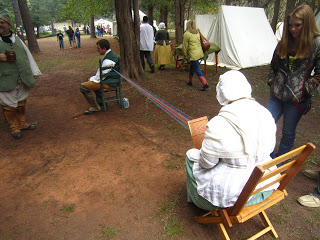
 During these Colonial times, weaving was often men’s work. It took a lot of strength to pull the warp of yarn tight. As you can see, this couple had several small looms threaded to make sashes or belts.

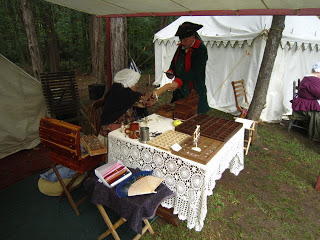
 This silversmith was casting a pewter spoon when we saw him. Pouring molten metal into a mold was the first step. Letting it cool down for a few seconds, he then broke the mold and snipped off the drips around the edges.

I was totally surprised to learn that candle wicking was popular during these times. About thirty years ago, my mother and I made a lot of decorative pillows for our beds. Twisting the special thread around a needle either two or three times made a knot that became part of a pattern. It is like whitework embroidery. The ladies would have used the thread similar to the braided, cotton thread for candle wicks.

On Sunday, we arrived at the end of one of the church services. Some of the adults were standing, and most of the children had found a bench to sit on. It was a small group of all ages. What was so strange was to hear the pastor lead in a prayer that asked for blessing for the king of England and his family.

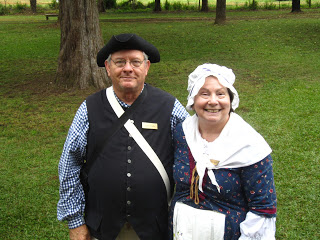
 A friend from Musgrove Mill offered to take our picture. A former pastor I knew used to say, “A little powder and paint helps a woman to look like what she ain’t.” I could have used a little lipstick.

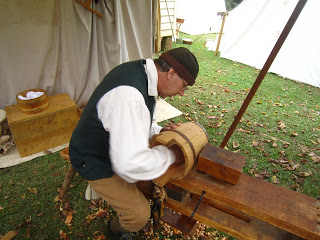
Many were fascinated by the work of the cooper. He had buckets in various stages of completion. To learn more about a cooper, look at this site from Williamsburg. http://www.history.org/kids/games/cooperation.cfm

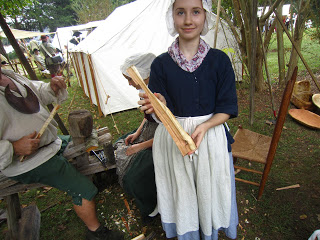
The woodcarver taught this young lady how to carve a spoon, and she was obviously proud of what she did. From a piece of kindling we would use in the fireplace was crafted a spoon that could be used for cooking. Our colonial ancestors wasted nothing.

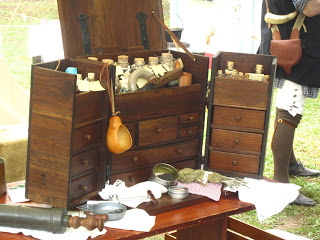
 On Saturday, this reenactor was making corn husk dolls with the children. On Sunday, she demonstrated the art of healing. During these days, the mother of the family would have knowledge of herbs and their healing properties. Often she was the only doctor a family would ever have. Not only did she provide medical treatment, she made oils, poultices, and mixed medicines.

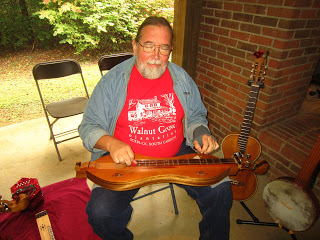
We enjoyed all the music played Becky Cleland and Ben Seymour. Ben makes dulcimers and plays them beautifully. Becky plays the bones, pieces of wood that are clicked together in a rhythm that is easily caught. The Celtic tunes they sang as duets had children and adults mesmerized. You might want to visit their web site at www.kudzupatch.net

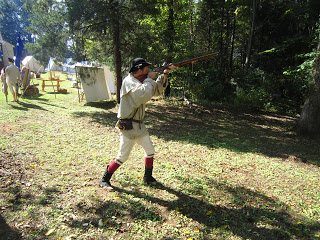
On both days, the battle fought between Bloody Bill Cunningham and the Patriots at Walnut Grove was reenacted. Once again, he was driven off before he burned the plantation. The rifles were loud, and some of the children put their hands over their ears. But this weekend was all about remembrance. We had the opportunity to celebrate our colonial heritage and see a battle that we read about in books come alive.

Those Scotch-Irish families that lived all across the Upcountry were firm in their beliefs that the land they built their houses on was theirs and not the king of England’s. They put their lives on the line and were considered troublemakers, just like the signers of the Declaration of Independence.

Our unalterable resolution would be to be free. They have attempted to subdue us by force, but God be praised! in vain. Their arts may be more dangerous then their arms. Let us then renounce all treaty with them upon any score but that of total separation, and under God trust our cause to our swords.

— Samuel Adams, letter to James Warren, April 16, 1776

Celebrating July 4, 2012 in Old Salem, North Carolina

 On July 3, John and I visited Bethabara for the first time. We were overwhelmed with information from the different docents and given an enlightening tour of this first Moravian settlement in North Carolina. Bethabara means House of Passage, and fifteen single men arrived there in 1753. “They all had a deep passion and belief that God would guide them” from Bethlehem, Pennsylvania to their new                            

                                                                    wilderness home.

 By the next spring, more than 15 acres of fields were cleared and planted. Fences and houses were standing. For protection, a palisade was built around the buildings. It took two years to build the grist mill, but only eighteen days to build the palisade. More families followed the original settlers.

 The 1788 church has been reconstructed and restored to exhibit the simple, not easy, daily lives of these settlers. Their community life blended with their religion. Whether a person was washing clothes, making shoes, or teaching children about Jesus, it was all done from the heart. The community was like a family with everyone having a job that benefited all.

 The wrist latches on the doors are made 
to be opened with an elbow if hands were full; it still works.


 This basket was in the kitchen, and during the summer it might have held potatoes from the garden or apples picked in the fall. Dirty clothes could have filled at any season,

 One of the rooms is set up as a schoolroom with one long table for the students and this plain desk for the teacher.

 You can see the quill pen and ink well on one side and the bell to bring order from possible chaos in another handy position.

 This doll on the child’s bed in the master bedroom waits patiently for its owner.

 Parts of an original cellar, where food would have been stored, gives us a different view of our pantries today. In these root cellars, they would have buried the vegetables in the dirt.

 The medicinal herb garden includes those plants that would have been used during the 18th. century; it is a living history exhibit for visitors. Dr. Hans Martin Kalberlahn was the first physician, and he originally planted the garden. Because of his expertise, this settlement became a regional medical center. These plants would be like our prescription drugs today.

 Fresh water was necessary, and some of the original wells are evident.

 There was a museum of period tools set up in a barn. This fish basket caught my eye. Putting the basket in the running water with some bait takes care of attaching a worm to the hook.

 On July 4, we spent the day in Old Salem. Salem, translated “peace,” was founded in November, 1766, and completed in 1771by the Moravians. The festivities of the celebration began with the militia marching in to post the colors. Everyone stood for the Pledge of Allegiance

Speakers celebrated the Naturalization Ceremony; there were 60 candidates from 38 different countries. Strong voices were raised as they recited the Oath of Allegiance. The applause from the spectators was deafening as new citizens waved American flags in the air. Like a college graduation ceremony, the new citizens’ names were called. They proudly walked to the podium to receive their papers. It was a moving ceremony.

Emblem of Hunt club

 The Gun Shop is the oldest, continually working gun shop in America. Today
 make about a dozen rifles a year that are used for hunting. Rifles used in the
Revolutionary War battles of Cowpens and Kings Mountain were crafted here.
The huntsman’s task in the Old Salem community to bring in fresh meat. The
rifles were made for the hunters.

Pistol made by Old Salem Gunsmiths

Members of 4th of July Band

Fire Truck

Water Buckets for Fire Truck filled by the women

On the steps of the tavern at 2:00, we assembled to hear the reading of the Declaration of Independence read. As you can see, the reader was dressed in period costume. Standing in front were men, women, and children attired in modern clothing and in 18th. century clothing, and the significance of this touched my heart. We must pass on to the next generation the importance of our freedom and our gratitude to those that fought in the Revolutionary War.

Crier for Reading of News

Crier Reading the new Declaration of Independence 

Ancient Silhouette Making machine

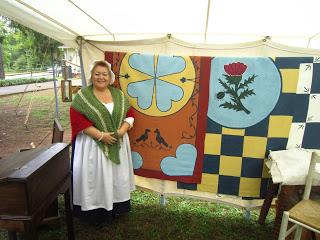
 Four women had put needle and thread into designing this quilt. Some crafts need to be passed down.

 There was one more ceremony at the end of the day that again included reenactors and visitors to Old Salem. The first city to plan a celebration for the 4th of July was Old Salem; it was in 1783. Psalm 46 was read, and all walked around the square singing “Now Thank We All Our God” as those first families did.

 It choked me up with emotion to hear adult voices floating across that square, and it was with pleasure and joy that John and I joined them.

 The band played while we sang, and then the benediction was read from Psalm 29:11. “The Lord will give strength unto His people; the Lord will bless His people, His people with peace.” Amen

History Lessons
Knitting Lesson

I met many new friends that day from all across America, and I enjoyed talking to them all. With a few colonial toys on display, I had the opportunity to answer questions about our ancestors.

Early Flag

 In the Miksch House, built in 1771, the docent was set up in the small kitchen cooking lunch. Dried herbs hung from the ceiling in cloth bags tied with string to keep the critters out.

Meal Preparation

 Some of the crocks had lids; others used imported cork. A housewife of the 18th. century used what was available at the time; one was sealed with a corncob as the stopper. As you can see, one of these is covered with leather and tied with string.

Food Keeping Vessels

Utensils

 The room was filled with baskets, pottery, bowls, bottles, graters, pewter spoons, and wooden spoons of all sizes and shapes.

More Food Storage Vessels

Potatoes from the garden

More storage vessels

Cooking on the hearth

 This is the Miksch House from the outside. It was the first single family home built in Salem. Matthew Miksch was trained as a gardner in Europe, and he supported his family in America by growing and selling vegetables and seeds. His wife Marie baked and sold gingerbread. (Maybe she swapped recipes with Winkler’s Bakery across the street.)

I wonder what the family would think of their home today.

These three days in and around Winston Salem reminded us once again of the price of freedom. We believe the Moravian motto is worth remembering.
                    
                     “In essentials, unity

In non essentials, liberty
In all things, Love.”
Camden, 2011

The Revolutionary War Field Days in Historic Camden was on November 5-6 this year. There were so many things to do, as well as reenactors to talk to about life during the Revolutionary War. Dr. Christine Swager and I told stories about three Revolutionary War women who fought against the British and Tories. Throughout the two days, there were artillery demonstrations, a fashion show, fife and drum performances, and colonial craftsmen. 

The Historic Camden Revolutionary War Site is called an outdoor museum on a 98 acre plot of land. On this weekend, there is a time warp as many walk the paths in colonial costumes. I met Dr. Benjamin Franklin, and he was just as witty as I imagined.

There were shops on Sutler’s Row where we could buy replicas of these times. A baker was set up right next to our tent, and the lines to go in his tent were always there. Right before we left, I finally broke down and bought toasted sourdough bread with melted cheddar.

The Battle of Hobkirk’s Hill was reenacted on Saturday. The preparation was evident in the camps, as men from both sides readied themselves for their parts. This battle took place on April 25. 1881, but the cannon and musket firing gave reality to the men who fell to the ground.

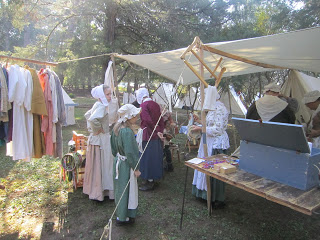
In the camps, life went on without interruption. There were meals to fix, mending to do, and knitting to complete.

Children of all ages played with sticks, balls, and whatever was lying around. I saw no X Box games set up. A wooden spoon beat a cadence in the background.

The camp was in constant motion and activity. Small children carried buckets to get water. There was practice with bows and arrows. Above is the evidence of hunting expeditions with the tanning of hides. To survive in the eighteenth century, everyone had to be a participant.

The artillery demonstrations helped the visitors realize that everyday life had in its background the possible sounds of enemy fire at all times. The bright sun and cloudless sky could have been deceiving.

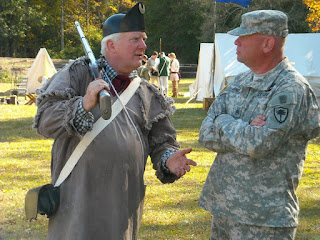
I wonder what these two soldiers were talking about. It appears to be a serious discussion. Even though both are at ease, there is an intensity in their stances. I guess the camaraderie in the military never changes, whatever the war under discussion.
     This brings to my mind a quote by Peter Muhlenberg from a Lutheran sermon read at Woodstock, Virginia in 1776. “There is a time for all things, a time to preach and a time to pray, but those times have passed away. There is a time to fight, and that time has now come.” 

King’s Mountain Celebration, 2011

     Thomas Jefferson called the Battle of King’s Mountain “the turn of the tide of Success.” It was fought on October 7, 1780 during the Revolutionary War. It was the first major patriot victory to occur after the British invasion of Charleston in May, 1780.

     There is a 26 minute film, produced by the History Channel, that gives an excellent overview of the battle, as well as introducing the major players.

     After watching the movie, you will want to visit the museum. There is an original Ferguson rifle there, as well as many artifacts found on the site. 

     Each year the National Parks Service invites the public to view a reeenactment of this battle, visit the camps of reenactors, and see how the army lived during a campaign. The living history demonstrations make the world of the eighteenth century  come alive.

    On Saturday, October 8, of this year, I had the opportunity to be a part of this year’s celebration. With my knitting in hand and my books ready to autograph, I spent the morning beside Dr. Bobby Moss, the noted author of nine books on the Revolutionary War. What a privilege to talk to him!


I was asked to speak about the lives of women during the Revolutionary War and set up a table of pewter, wool, knitting, corn husk and church dolls, a butter churn, paddle and mold, etc. This was my version of show-and-tell.

Gourds were used for containers and dippers; today we see them made into clocks  or decorative pieces. Someone has called them the natural Tupperware. I believe it helps all of us to both see and touch articles that we aren’t familiar with to get a better understanding of their usages.

This butter pat was my husband’s great, great grandmother’s. Even with much use, you can still tell that one side is flat for patting the butter into the mold. The other side is rounded for allowing the whey to fall back into the crock. Even though my churn is made of crockery, rather than the more typical wood, it shows a different container used during these times.

This butter mold is also a family heirloom that has a carved out design for the presentation top of the butter.

 I showed balls of virgin wool from both lambs and sheep that look and felt quite different. Then I had yarn spun from that same herd of sheep. Lastly, there was a wool blanket, hand made from their wool. The children were quite interested in how long it all took to get from the sheep to the blanket; my only reply was that it took a long time. Does anyone know the approximate length of time from shearing to laying the blanket on the bed?  

Pioneer Day in Gray Court, South Carolina

On the second weekend in September, Pioneer Day is celebrated in Gray Court, South Carolina. The Gray Court-Owings Historical Society was organized in February, 2001 with fourteen dedicated members and has grown to thirty members. It was founded to preserve the history and historic structures of this small rural area.

 The two small towns of Gray Court and Owings grew up around the railroad to serve the small farming communities nearby. The first European settler in the area was Richard Owings III who brought his family from Owings Mill, Maryland about 1757. His son Richard Owings IV was a patriot in the Revolution. The area has much historic value and as yet luckily has evaded the swath of the bulldozer and development. The towns consist of old homes and buildings and there is beautiful farmland outside the town limits.

 The Culbertson Back Country Settlement is on a beautiful two-acre circle on the old Georgia Road in Gray Court, just in front of the old Gray Court cemetery on the hill. This is where Pioneer Days is celebrated. The road was an old wagon road to Georgia that once was traveled by stagecoach to the Dorroh Inn just down the road. The Settlement consists of two log cabins, a block house, a one-room African-American school, corn crib, 1882 church, and a blacksmith shop. All of these structures have been given to the society and were in need of rescue.


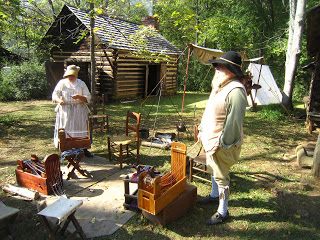
As you can see, great attention to detail in the restoration of this log cabin give it a life of its own that takes visitors back to the 18th century.

As you can see, the porch is held up by sturdy rocks.

 The rock chimney stands tall, and the back country settlement gives a visual of our ancestor’s way of life.

 Inside the cabin were teen age girls working with wool. They happily explained the process from carding to spinning.

 This loom was set up to finish a rug.

 Costumes were worn by the young and old. This girl was decked out from head to toe as a Cherokee. She said the moccasins were quite comfortable.

 This family goat posed for the cameras of many.

 It was hot around the fire, but all day the blacksmith continued to create small tools from his forge.

This September day brought many smiles to our faces, as we met new friends.

 And it was time for the parade! There were walkers and animals of all descriptions. The street was lined with spectators. Dianne Culbertson and Sarah Jane Armstrong, the organizers for this event, led the way.

 There was much clapping for our flag.

 As I said, there were animals, too. This pig and goat walked sedately with their caretakers.

 Most were in colonial dress.

 Many chose to make bricks that day, and the process was a surprise. I heard someone say that maybe some of the Lowe’s and Home Depot personnel would be surprised at the old way of doing things.

 These two handmade quilts were beautiful. Besides being exhibited, they were given away in a raffle. I admit to being a bit jealous of the winners.

 This lady was making another quilt. Her stitches were small and precise.

 These hand carved spoons were made of various woods indigenous to our region, including peach.

 There was a group of Cherokee Indians at this event. They entertained many with their storytelling, drum playing, and explaining their costumes.

 Mark C. Anthony, the SCSSAR President presented a program on American flags and their history that fascinated many.

 For every age, there is something to look at, listen to, and learn from.

 In the Owings Music Hall, the shape note singers sang from 9:00 to 4:00. They started in the morning with a hymn and a prayer. Several times during the day, I went to sit at the back and savor their music.

On the second Saturday in September, the public is invited to celebrate our American heritage in Gray Court, South Carolina. Bluegrass music and barbecue are additions to this day, as well as friendly people to answer your questions about this part of our history. You will want to put this festival on next year’s calendar!


Camden

Festifall at Walnut Grove

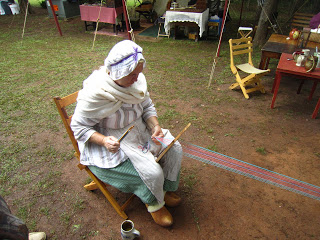
 Every year the Spartanburg County Historical Association hosts a two day historical reenactment at Walnut Grove Plantation in Roebuck, South Carolina. This was the home of Charles and Mary Moore; it was built in 1765. During Festifall, hundreds of reenactors camp out for two nights and share their expertise of what life was like during the 18th century. Spinning wool into yarn was a simple, but time-consuming process.

Spinning wool into yarn was a simple, but time-consuming process.

Dressed in their colonial costumes, they will both explain and answer questions about their activities. In front of this lady are the dyed skeins of yarn.

Besides dressing their parts, the blacksmith will be making hinges and nails at his forge. Broom making, basket weaving, and buckets and barrels made by the cooper are all demonstrated.

No, this dachshund was not dressed for battle. Its owner did have her dressed up for the occasion though. The dog posed well for pictures, but only at a distance. Her attire brought in her own personal audience.

This is a small spinning wheel that was portable. In comparing it to the chair, you can see how handy this was for the housewife.

Carding was an important step in the making of cloth. After the shearing of the wool, it was cleaned with these carders. The metal combs took out any twigs or burrs.

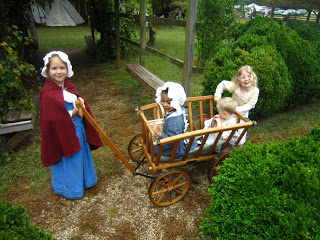
This handcrafted wagon would have been used for hauling corn or any other similar task. At this point the children were enjoying playing with it.

As author and illustrator of Courageous Kate and Fearless Martha, we also chose to dress as my protagonists would have dressed. Besides selling my books, John cut silhouettes of the children.

There is a reenactment of the skirmish that actually took place at Walnut Grove in the fall of 1781. The roar of muskets is loud, and the reality hits home as we see “soldiers” fall to the ground. Because of the militia arriving in time, the house was not burned to the ground, even though lives were lost.

As you can see from the smoke, there is reality to this battle.

There is contrast all over the grounds during these two days. I saw men, women, and children going about daily tasks as they worked hard to put food on the table, take care of crops and animals, see to their family’s needs, and fight a war for independence at the same time.

These militiamen are mustering together. Just as they would have been dressed during the Revolutionary War, these Patriots wore their regular clothes. They had no uniforms, but the military drills were serious.

Walter Edgar quoted in his book, Partisans and Redcoats, that a “man’s best friend was his rifle.” Those rifles were never far away from their owners.

During the eighteenth century, children dressed like adults.

There was never a moment of idle time during this century. Meals took a long time to prepare, whether it was in a home in the fireplace or outside over an open flame. Mending was an endless task, and because each person had few clothes, they had to be kept in wearable condition.

The cars in the distance certainly don’t seem to belong to this fireside scene, but it is part of the spell that is Festifall as you step back in time and see first hand how our ancestors lived. Visitors come back every year, because there is so much to see. If you have never visited Walnut Grove Plantation, I encourage you to put it on your list for next year.

Visit to Red Fern Farm

Hello Everyone,

My dad grew up on a dairy farm in Kentucky, and I have great memories of spending a week every summer there. He would walk the fields with us and take us down to the barn when they were milking. It was always a peaceful week with little routine. The pace was slow and relaxing.

Right now I have started leading a Bible study that is called Scouting the Divine; the first part focuses on the many references to sheep in the Bible. I wanted to know more about farm life and particularly sheep. Since sheep were also used for their wool to make clothes during colonial times, I thought learning more about them would help me with my writing.

Last week Clark Mizzel, the owner of Red Fern Farm, took John and me on a tour of his flock of sheep.

Rather than having a sheep dog, he has donkeys to guard his sheep. This is Lucy and her son Dilly Bean. Donkeys have a natural antipathy for canines, such as coyotes, dogs, and foxes, who are predators to sheep. Just their size intimidates coyotes, and they can kill with their hooves. As you can tell, they were both quite curious about me. At one point, Lucy dedided that Dilly Bean was getting too much attention and pushed him away. (I thought donkeys were much taller than this!)

Both of them posed for John’s camera, and here is Dilly Bean by himself.

The Mizzels raise Tunis sheep, originally from Tunisia, hence the name. They were imported to America in 1799. The two characteristics that make them stand out are their cream-colored wool and reddish/brown faces and legs. Twins are born frequently to this breed, and they don’t have horns.

Because sheep have a “flight zone,” they didn’t allow us to get close to them in the field. Clark said he starts talking to them before he enters their pasture, because they have excellent hearing. The zoom on John’s helped bring them closer to us.


The ewes teach their lambs about what not to eat in the fields; lemon grass, switch grass, and horse nettles are poisonous. This flock is grass fed, and there are fifty acres in pasture on this farm. With that much open space, they certainly don’t get bored with their surroundings.

There are portable shelters, as well as trees, in each pasture for their shade. Plenty of water is available, also. Ethel, Lucy, and Carmen are some of the names of the sheep.

As you can see, these sheep are content. Just watching them as they moved peacefully around the pasture and then lay down for a while, it reminded me of that most familiar Psalm 23 with the words of “He maketh me to lie down in green pastures.”

Clark told us that donkeys pick up on routines, and they don’t have a flight zone. I believe I can attest to the fact that they are quite curious, also, and like to be petted. In fact, Lucy pushed Dilly Bean away from me at one point; she wanted all the attention herself. Another thing Clark pointed out was that donkeys can be quite cooperative if they so choose.

They welcomed us into this pasture.

The sheep’s wool is made into blankets in a mill on Prince Edward Island, and they can be bought at the farm. You will enjoy looking at their web site at www.redfernfarms.com.

These sheep were more curious about us in their close quarters. In fact, the brown one came charging out to welcome us. Their names are Ricky and Fred.

Why they were less skittish than the ones in the large pasture, I don’t know. But this one enjoyed posing for John’s camera. Clark was kind enough to share some small bags of wool with me; some from the lambs and the adults. They are both soft and thick, but the lamb’s wool is softer.

This family only started what they call “an adventure of a lifetime” fifteen years ago. They also offer herbs and vegetables to the public and weekly are found on Saturdays at the Greenville Farmer’s Market/www.redfernfarms.com.
I understand why they call this an adventure. John and I spent two hours there, and the time flew. The quiet, except for nature’s sounds, brought our schedules to a stop. Just watching the contented sheep with obviously not a care in the world reminded me that contentment is not in what I have but being content with where I am. 

Easy Colonial Recipe

Hello Friends,

Most of us like new recipes, but this one is certainly not a new one. When I was writing the biography about Kate Moore Barry, I found this simple recipe for shortbread cookies. I have made them, and they are delicious. They are good with a cup of tea or coffee in the afternoon, and a delicious aroma invades your home while they are baking. I have taken them with me on some author visits, and the reviews have been favorable. Is it not amazing that a recipe from over 200 years ago can still be enjoyed by us today? I hope you might find time to bake a few for you and your family, and I believe they won’t stay around long.

Shortbread Cookies

1 cup sugar
1 cup butter
1 cup flour
Blend all the ingredients, and bake until golden brown in a moderate oven.

There are a few hints that will make this easier. The butter needs to be softened. Even though the batter can be blended with a wooden spoon, a mixer makes it quicker. I combined the sugar and butter and then slowly added the flour. Using an ungreased cookie sheet, I dropped a teaspoon of batter and baked them in a 350 degree oven for about 20 minutes. Knowing our ovens are different, you might want to watch the first batch. This recipe only made about 24 small cookies.

Aren’t we glad we can use the gauges of our ovens to determine the temperature and don’t have to see if the hairs on our arms are singed by the heat!?!

Happy Baking! 🙂

Design a site like this with WordPress.com
Get started