In the early 18th century, a settlement began at the 96th milepost from Keowee Indian village on a trail used by traders with the Indians. Today, that village would be near Clemson, SC. Traders packed firearms, blankets, beads, and wares along an Indian trail called the Cherokee Path, swapping them for furs. Then the furs were taken to Charlestown to sell. By 1700 this trail was a major commercial artery, flowing with goods essential to a prospering colony.
By 1771, Robert Goudy owned a small trading post there and supplied traders with such items as rum, sugar, and gunpowder. He grew grain and tobacco, raised cattle, served as a banker, and sold cloth, shoes, beads, gunpowder, tools, and rum. He amassed over 1,500 acres, and, at his death in 1775, some 500 people were in his debt. His success as an entrepreneur was a major asset to the back country of Carolina.
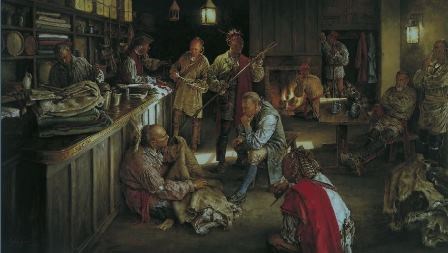
As more and more immigrants moved into this area, conflicts between the Native Americans and settlers escalated. Royal Governor James Glen made this a safer area by deeming it “a proper place to build a magazine and stockade fort.” At the crossroads of Ninety Six was Goudy’s post. Goudy’s house, barn, and outbuildings were enclosed in a 90-foot-square Stockade. In March, 1760, the militia defended the successfully from an attack by 250 Cherokee warriors.
Location of fort at Ninety-Six today.

In 1770, an act for establishing courts, building jails, and appointing sheriffs was passed. According to records, this jail was completed by 1774. Plans for the courthouse and jail required these buildings to be built within a mile of the fort. Lumbar would be the material choice for the courthouse and brick for the jail. With four windows and a shingled roof over three stories, the jail was a visible mark for law and order in the Ninety-Six district.

This jail had walls 16 inches thick and included a third floor lookout room and a dungeon below ground.Chains and irons kept the unruly placed in the center of a thirty foot square, open room that was 45 feet from the ground. Swivel guns were at each of the windows for protection. A gallows and cemetery could be seen from the open grates in the windows.

Twelve houses were also built during this time, and a crossroads became a community.
The winds of war brought stories of battles being fought in the north during the early days of the Revolutionary War. In this district of Carolina, allegiances were mixed. Some believed that King George III should continue to rule over this colony, but many others stood shoulder-to-shoulder with the men who boldly took on the King’s soldiers. In some homes, loyalties were even mixed. here was a sharp division in this region as to whether loyalties should be to the Crown or to a new independent nation. As such, the revolution took the for of a localized Civil War in the back country of the south.
The first wave of battle swept over Ninety Six in November 1775, barely six months after the battles of Lexington, Concord, and Bunker Hill to the north. On the 19th of that month a band of 600 Patriots had fortified themselves at Ninety Six and were attacked by a much larger force of 1,900 Loyalists. The attacks proved fruitless and after a number of days of fighting the two sides called a truce and went their separate ways. Losses were light but none-the-less it was a historic moment. It was the first land engagement in the south and, as such, the first battle in the south to cause casualties in the Revolution.
Nearly 200 years later, in 1973, as archaeologists and historians excavated the area within the outlines of the Williamson Fort at Ninety Six, they made a grim discovery: a lone skeleton found in one corner of where the structure would have stood two centuries earlier. It was the remains of James Birmingham, the first Patriot soldier killed in the South during the Revolutionary War. Birmingham fought in the Long Cane Malitia and is believed to be from the Long Cane Creek area in Abbeville County.
This was the beginning of an eight year struggle along the eastern coast of the United States, and many more died in this war for our independence.
In a visit to this NPS site, he original places of the star fort, town jail and the small town are outlined along the path to show the proximity between community and fighting. Besides being open to the public all year, there is a celebration this weekend at the site.
Living history encampments and demonstrations will be ongoing from 9:00 am to 4:00 pm on Saturday, April 6, and 10:00 am to 3:00 pm on Sunday. Children’s activities will occur throughout both days. Visitors are encouraged to wander through encampments to discover camp life of the militia, and the colonial home life of families.
Special performances by the Fiddlin’ Hayley King are scheduled for Saturday at 10:00 am, 12:00 pm and 2:00 pm and on Sunday at 11:00 am and 1:00 pm. On Saturday there will be a special first-person regulator presentation “Regulators, SC Backcountry Crimestoppers!” at 1:00 pm. Historic musket demonstrations are scheduled for Saturday at 11:00 am, 1:30 pm, and 3:30 pm and on Sunday at 12:00 pm and 2:30 pm.
Walk back into history to a time when men and women met their enemies on their porches and in their yards. Daily, they made life-and-death decisions to protect their families and land while planting crops and churning butter.

 Sheila Ingle