
Dear Granddaddy Thomas Davis,
Tomorrow, there will be a remembrance at the site of the Battle of the Waxhaws. The South Carolina Society of the Sons of the American Revolution, the South Carolina Daughters of the American Revolution, and the South Carolina Children of the American Revolution will honor you and the men who fought with you at that battle.
You were a member of the reinforcements consisting of 380 men, the 3rd Virginia Detachment, under the command of Colonel Abraham Buford that failed to reach the city before Charles Town fell. Cornwallis dispatched Lieutenant Colonel Banastre Tarleton to pursue and engage you.
As I have been getting more involved in lineage societies over the past twenty years, I have thought more and more about you. Born in one century on November 30, 1761 in Spotsylvania County and dying in the next century on November 8, 1839 in Woodford County, Kentucky, you must have lived through many changes. In The Descendants of Captain Thomas Carter, it states that you and Susannah and you visited in 1809 a new wax museum in Lexington and had your silhouettes cut. That forty mile journey didn’t deter you from visiting this collection.
I am proud of you for fighting for our freedom during the Revolutionary War. It makes sense that you enlisted in the Virginia line, where you were born and raised. When I read your pension record, I saw you served your promised 18 months. You were committed to our independence from England.
It is only 96 miles from where I live in Spartanburg, SC to where you fought in the Battle of the Waxhaws. From what I read, this was a bloody battle, and I am glad you were one of the 53 prisoners. After you escaped, you were able to join the war again and be at the surrender of Cornwallis at Yorktown; that must have been quite the celebration.
Along with the other men under Colonel Abraham Buford in the Virginia Continentals and Virginia Regiment, the normal rules of war weren’t adhered to in this battle. Most people today consider it a slaughter.

I wrote about this battle in a book about Elizabeth Hutchinson Jackson, the mother of President Andrew Jackson, called Brave Elizabeth. Here is the introduction to the chapter titled “The Fog of War.”
Ordinary sights and sounds of the forest flooded the Camden-Salisbury Road, and the air was filled with darting birds and their songs. A menagerie of spring wildlife made their afternoon excursions. A doe followed by her fawn leapt over the fallen tree. A red-tailed hawk silently swooped toward the uneven red clay to grab an unsuspecting field mouse. Young squirrels easily jumped from limb to limb, and bunnies hopped awkwardly around their mother.
It was Monday, May 29, 1780, when military sounds interrupted this warm and sultry spring day.
First along the road trekked a caravan of supply wagons and field artillery. Some wagons were drawn by four horses and others by two. Strapped down in the covered baggage wagons were medicine chests, tents, and officers’ gear. Foodstuffs were also in covered wagons, and the various barrels of hard- tack, potatoes, corn, and dried and salted beef were tightly packed. In between the casks were iron cooking pots and skillets, tin kettles, axes, and wooden cooking utensils. Another set of wagons carried extra rifles and muskets, sturdy barrels of gunpowder, and lead bricks to make bullets. Two, six-pounder cannons on caissons brought up the rear.
Shouts from the wagoners and the crack of whips encouraged the horses forward.
In the midst of the wagons rode the advanced guard. When a Continental Army force marched, it carried its own supplies. All these accouterments and provisions were essential to the livelihood of the 3rd Virginia Regiment of Colonel Abraham Buford. Since the fall of Charlestown to the British on May 12, his men were the last Continental troops in the South. They had been ordered to retreat to Hillsborough, North Carolina and await orders.
It was barely three o’clock when the military sounds of wagons and horses turned into the sounds of battle and bloodshed.
I wonder if the scene around that dirt road was similar to what I wrote?
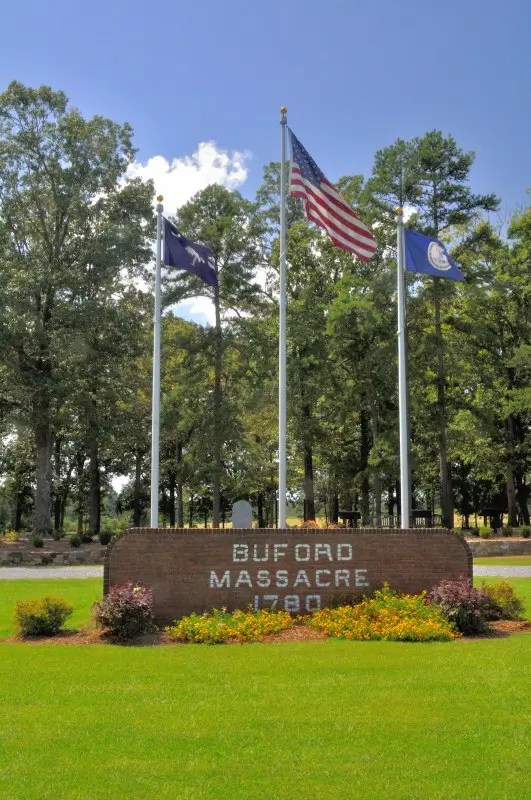
One of the memorials to those who fought in this battle is at the site of the common grave.

There is a new one closer to the street that has a list of those Americans who fought in the Battle of the Waxhaws, and your name is there. I was so proud to let those know to be sure your name was there, but I am delighted that my sixth great grandfather, Private Thomas Davis, stood tall during the Revolutionary War.
My grandmother, Lucile Hitt Collins, did an enormous amount of research of our family. She was your fourth great granddaughter, and she savored history, especially family history. Like you, she was a schoolteacher. I also chose this profession and enjoyed my years as an educator. You must have passed down that gene for education.
Christmas is my favorite holiday, and I love it that your parents, James Davis and Mary Elizabeth Carter, were married on Christmas day. She was sixteen, and your father was eighteen.
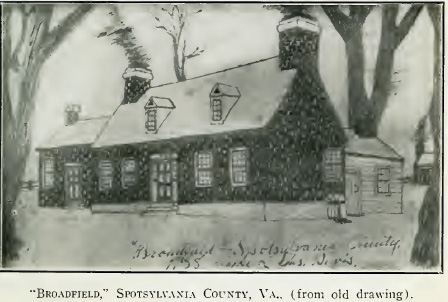
Two years later, they moved into a large home on the plantation called Broadfield in Spotsylvania. I can picture the interior where you grew up with its great inside chimneys, large rooms, and dormer windows. With 600 acres to choose from, was that brick, story and a half home on a hill perhaps?
I found this sketch you did of the house before you moved to Kentucky. With you and your nine siblings, I guess it was a bit crowded at times. Thank you for taking time to make the sketch to take the memory with you.
With you father dying when you were only four, that must have been a loss to your whole family.
I am glad you kept an account book. In February, 1783, you wrote, “Paid for & brought home for Fred’ks’b’g my wedding clothes – 18.3 pounds. 1 Black Velvet Coat, 1 Green Silk Waistcoast, 1 pr Black Cloath Breeches, 1 pr Silk Stockings and one Hat.” You must have been quite dashing! I am sure your bride, Susannah Hyatt, was impressed.
Since you were the youngest child, your inheritance was not linked to your father’s estate. I wonder where you found the money to buy the 400 acres in Orange County? And why on earth did you decide to leave one of the loveliest parts of Virginia to live in unsettled and untamed Kentucky? Were there some heated discussions between you and Susannah? To leave family and friends for a new home beyond the mountains must have been hard.
But you did leave. Selling most of your household goods, because all had to be carried on horseback. There was no room on the trails for wagons; the trek was six weeks. This tedious journey was around 325 miles.
A warm welcome awaited you, as neighbors from miles around arrived to rear a cabin. The day was appointed, and a multitude of capable and willing hands arrived. This helping newcomers was considered a duty of every able-bodied man.
That little account book must have been important to you, since you continued to write about your business. Lists of the servants you took with you to Kentucky and the new furniture you bought for your home upon arrival are there. There are amazing details, e.g. the dozen silver teaspoons, half a dozen tablespoons, and a small silver ladle you bought on July 2, 1783 to take to Kentucky. The story goes that these were the first silver spoons in the state.
Then you have your book purchases listed, too. The Art of Surveying, Bailes Dictionary, The Surveyor, in 4 Vols., History of Europe, in Vols., Robertson’s History of Scotland, Shakespeare’s Works in 6 Vols, Blackwell’s Classics, in 2 Vols., Malvern Dale, a novel, Common Prayer Book, and Domestic Medicine. (It appears that my love of history and its stories goes back to you!)
When you advertised in the Kentucky Gazette for a job in 1788, you mentioned your qualifications to teach “reading, writing and arithmetic, its various branches, bookkeeping, surveying and navigation, geography or the use of the globes, etc.” Your tutor must have instilled in you a curiosity for many things. Compared to the teaching you did, did you, also, enjoy the land surveys you did on the side?
Amazing that you and Susannah raised thirteen children there on Sinking Creek in Woodford County, and I am glad you received your pension for your service. Your granddaughter Sallie said you always enjoyed company dropping by, was quite the tease, and a good story teller.
I truly wish I could have known you! Would you have caught me around the waist, as you did Grandmother Susanna, and dance me around the room?
Winston Churchill said, “We sleep safely at night because rough men stand ready to visit violence on those who would harm us.”
Thank you for fighting for our country. I am so thankful for your service and your patriotism.
Your granddaughter,
Sheila


 Sheila Ingle