“One of the great stories from the American Revolutionary Era happened in Virginia – the story of the “Patriot Pastor,” John Peter Muhlenberg.
On January 21, 1776, at the Lutheran church in Woodstock, Virginia, Pastor Muhlenberg preached from the third chapter of Ecclesiastes, which starts, “To everything there is a season.”
After reading the eighth verse, “a time of war, and a time of peace,” he declared, “And this is the time of war.” He then threw off his clerical robe to reveal the uniform of a Continental Army Colonel. It turns out that Pastor Muhlenberg also had a military background, and George Washington had personally asked him to raise and command the 8th Virginia Regiment of the Continental Army.
Outside the church, drums began to roll as the men in the congregation turned to kiss their wives and then walked down the aisle of the church to enlist. Within a half hour, 300 men had joined the 8th Virginia Regiment and marched on to fight for their country’s independence.
After the Revolutionary War, John Muhlenberg went on to serve the new republic in both the U.S. Senate and House of Representatives. The “Patriot Pastor” became a great American story of faith and freedom.”
On the plaque are these words telling a snippet about his service to his country.
SOLDIER Commissioned Colonel of Virginia Militia 1775 Commanded Eighth Virginia Regiment Which Became the “German Regiment” of the Continental Army Fought at Charleston and Philadelphia Promoted to Brigadier General 1777 Wintered with his Troops at Valley Forge 1777-1778 Fought at Brandywine, Germantown, Monmouth and Stony Point Member, Royal Arch Masonic Lodge, Philadelphia 1779 Named Commander of All Forces in Virginia 1780 Fought at Portsmouth and Yorktown Promoted to Major General 1783 Retired November 3, 1783
Serving / His Church / His Country / His State
Muhlenberg commanded a Virginia regiment during the Revolution, first seeing action at Sullivan’s Island in South Carolina. He led his men in further engagements, worked closely with George Washington and before the war’s end rose to the rank of brigadier general. After the war, he served in the U.S. House and Senate, representing Pennsylvania.
This pastor, and many others, were Patriots who fought for the independence of our country.
It is the beginning of the New Year, 2024, and it reveals on the calendar 365 unknown days. Some are already marked on our personal datebook as holidays, family and friends’ birthdays, and anniversaries. But we know we will encounter surprises and unknown celebrations.
There will also be plenty of choices to make. Some will be easy decisions, and others may drive us to distraction with their complications. Following the paths of others might seem easier, but the conclusion for us would end in errors and blunders. The resolve to walk the road “less traveled” could be a solitary journey. But if it is the way for us, we can march on it with certitude and resolve.
We chose to attend a commemoration program at the Cowpens Battlefield today. John’s SAR Chapter, the Daniel Morgan NSDAR, and the state SAR, along with the National Park Service, commemorated the 243 anniversary of the Battle of Cowpens today. It was in the twenties, but there was little wind. The large tent with heaters kept us from freezing.
I met a fellow DAR from Hendersonville, NC and another DAR from Lexington, Kentucky. My mother, both her parents, and great grands were born and lived in that quaint North Carolina town. As to Kentucky, my dad was reared on a farm about sixty miles from Lexington. I was thrilled with our three connections. They were both visiting the battlefield today with their husbands, who were SAR members. What a delightful time we had talking about our families and our love for America and its history. All three of our families had served in the military, also.
The leader of the Whigs, those fighting against the English for their freedom, were led by a man named Daniel Morgan.
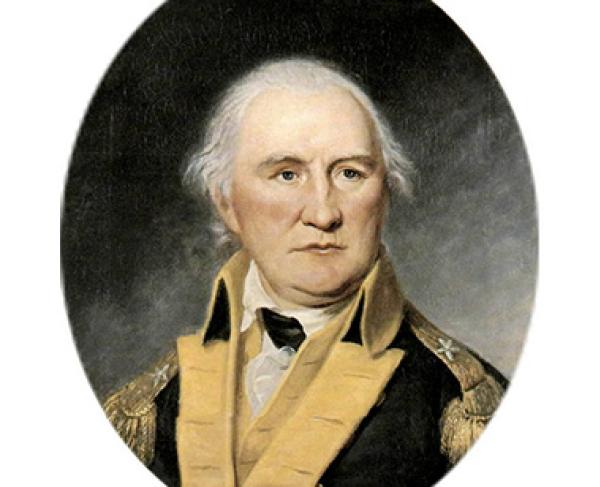
Daniel Morgan was a penniless, illiterate teenager with nothing but the clothes on his back when he showed up in Winchester, Virginia, evidently escaping a mysterious past that he never discussed with anyone. He found work as a teamster and eventually he saved enough money to buy a team and a wagon of his own. He took the jobs no one else wanted–the most grueling, the most dangerous–and he established a successful trade. Morgan literally brawled and fought his way up the frontier ladder, teaching himself to read and write along the way.
In 1755, while working as a teamster on Braddock’s expedition, Morgan slugged a British officer who had insulted him. For that he was sentenced for 500 lashes–often a death sentence. For the rest of his life Morgan would show his scars to anyone who asked to see them, and to many who didn’t. He always said that he counted the lashes as they were being administered, and there were only 499 of them. “King George still owes me one,” he would say with a laugh.
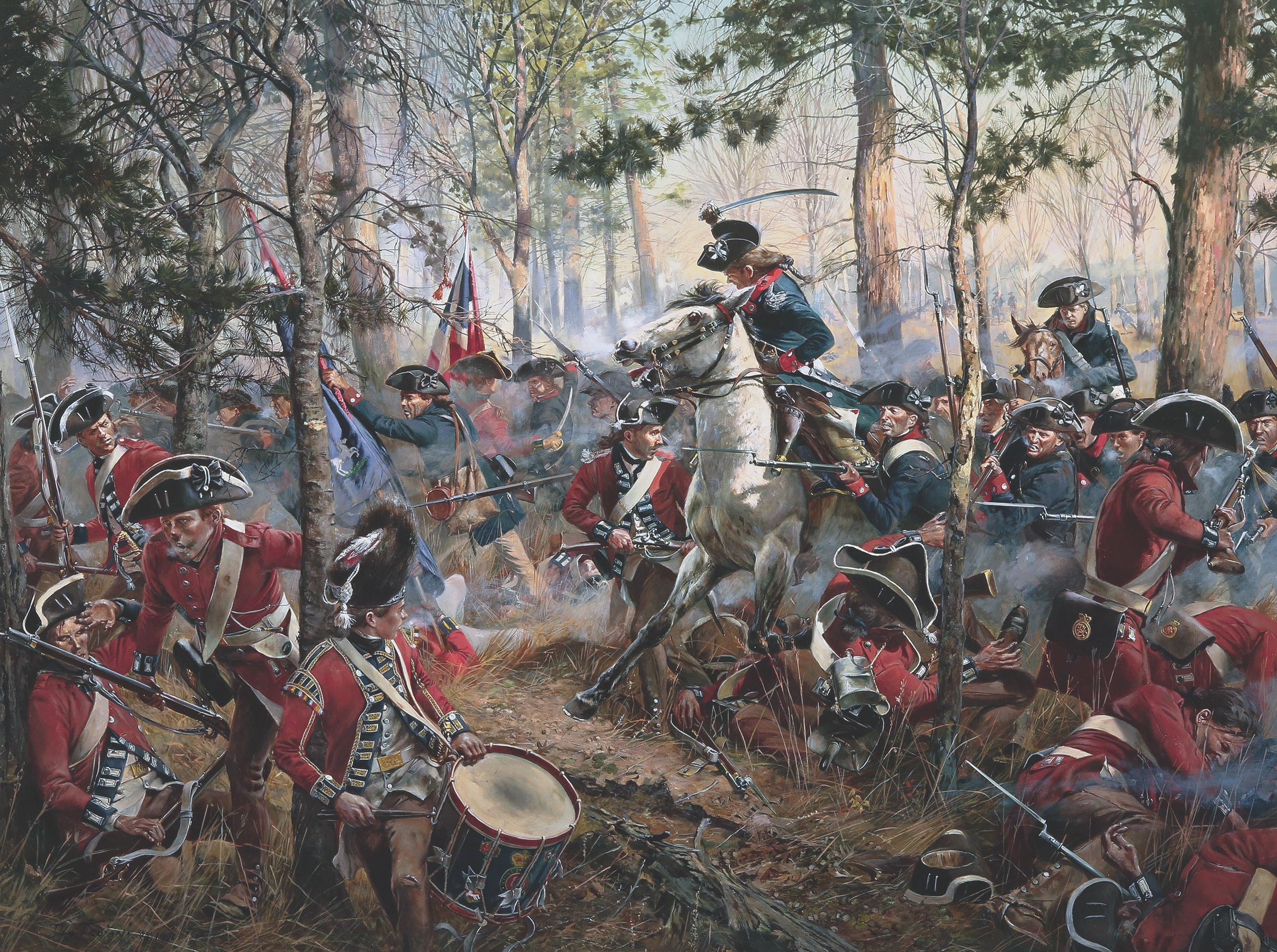
Morgan was already a legend and a hero when he and his “Flying Army” squared off against Banastre Tarleton on a frosty Carolina morning at a place called Cowpens. There he would score one of the most impressive (and improbable) victories in American military history, nearly annihilating Tarleton’s command, at trifling cost to his own–employing an innovative and daring battle plan that ended with a double envelopment of the British. Of his battle plan, historian John Buchanan says, “This untutored son of the frontier was the only general in the American Revolution, on either side, to produce a significant original tactical thought.” A few days after the battle, Morgan wrote to a friend, “I have given him (Tarleton) a devil of a whipping.”
3026934 The Battle of Cowpens 1781 Daniel Morgan\’s, 1996 (w/c & gouache on paper) by Troiani, Don (b.1949); Private Collection; (add.info.: General Daniel Morgan\’s Continentals rout the British 7th Regiment of Foot.); � Don Troiani; American.
The British historian Charles Stedman, who served under Cornwallis during the campaign, would later write, “Had Lord Cornwallis had with him at the action at Guilford Courthouse those troops that were lost by Colonel Tarleton at the Cowpens, it is not extravagant to suppose that the American colonies might have been reunited to the empire of Great Britain.”
On January 16, 1781, Morgan’s 1800 men deployed with a group of riflemen in front (in trees), followed by militiamen, then more riflemen. The night before the battle, Morgan told his men “Just hold up your heads, boys! Give them three fires and you will be free. Then when you return home, how the old folks will bless you and the girls will kiss you, for your gallant conduct.” The next morning, Tarleton and the British (about 1100 men in all) began marching toward them. As the British approached, the riflemen in front picked off many of them, then fell back and joined the second. Then the militiamen fired off two volleys and fell back to the third line. The British were drawn forward.
As Dr. Christine Swager describes in her book, “Come to the Cowpens,” Daniel Morgan was known as the best horseman, the fastest runner, the fiercest fighter and the strongest wrestler. On a bitter cold day in January 1781, at an upcountry cattle pasture known as “the cow pens,” the cantankerous brigadier general led an army of militiamen, Continental soldiers and cavalry in a stunning defeat of the British.
This victory was a stunning example of military prowess and skilled leadership, the Battle of Cowpens near Chesnee, South Carolina, was a critical American victory in the Revolutionary War. This engagement further weakened British attempts to wrest the southern colonies from American control.
“It is impossible to foresee all the consequences that this unexpected and extraordinary event may produce.” – Report of Lord Cornwallis to Sir Henry Clinton, and he was right.
Huzzah to those men who put their lives on the line for you and me!





 Sheila Ingle