Knowing nothing about the reality of the Pilgrims’ journey to America or those first years of deprivation and death, it was a fun holiday to celebrate during my younger years. At school, we would make Pilgrim and Indian hats and headpieces, eat vegetable soup and cornbread, and sing loudly, “Come Ye Thankful People Come.”
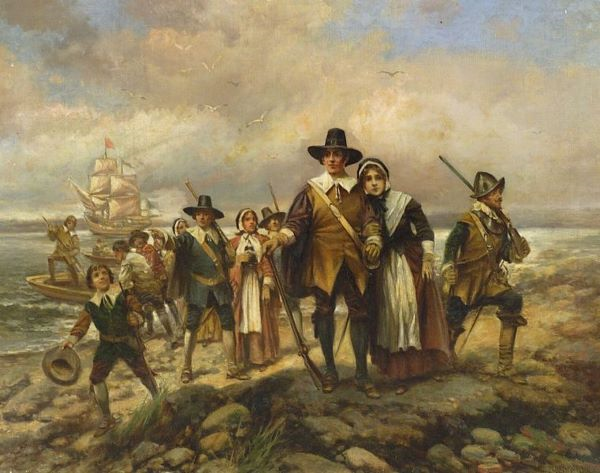
The faces and body language in this painting show us a more authentic view of the Plymouth Rock that the Mayflower brought the Pilgrims to.
Leaving England nine weeks late, New England’s harsh weather fiercely threatened their survival. In December, the men built crude shelters for the winter; the women and children stayed on the ship. There is a melancholy tone in the journal entries for that winter:
“…Aboute no one, it began to raine…at night. It did freee &snow …still the cold weather continued…very wet and rainy, with the greatest gusts of wind ever we saw…frost and foule weather hindered us much; this time of the yeare seldom could we worke half the week.”
Building houses was the first order of business.
Most of their houses only had one room. The colonists did their cooking, eating, and sleeping, as well as other work, in this room. The women cooked around a hearth, where small fires were lit. The fire from the hearth provided heat during the winter months and light at night. Candles and oil lamps were sometimes lit too. If there was a chimney, it was built of timber and clay and clapboards just like the rest of the house.
Most of the time, the houses were very dark. They had only a few small windows that closed with a wooden shutter. The floors were hard-packed earth. Some houses had a storage space above the first floor, called a loft. These spaces were used to store food and other goods, like dried herbs from the garden, bundles of corn from the fields, or even beds. They used ladders to climb up to the loft.
Living off the land was a new experience. Fishing was even difficult, because they brought the wrong fish hooks. They began to grow more Indian corn, which they learned to cultivate from the Wampanoag People. And they learned the best ways to hunt and trap animals such as deer, rabbit, turkey, geese, duck, and other wildfowl. The domesticated animals that they brought from England — chickens, goats, sheep and cows — were increasing in number and were able to be eaten.
During that winter, more than half of the heads of households died. Five of the eighteen wives lived through the scourges of pneumonia, tuberculosis, and scurvy.
On March 24, a journal entry sums their situation up:
“Dies Elizabeth, the wife of Mr. Edward Winslow. N.B. This month thirteen of our number die. And in three mons past dies halfe our company…Of a hundred persons, scarce fifty remain, the living scarce able to bury the dead.”
What a courageous group of men, women, and children; there are no words to laud their fortitude. During the third week of March, the weakened survivors from the Mayflower rowed ashore to their new homes in New Plymouth in those huts that needed rebuilding.
In the fall of 1621, when their labors were rewarded with a bountiful harvest after a year of sickness and scarcity, the Pilgrims gave thanks to God. They also celebrated their bounty with a tradition called the Harvest Home. In a letter to a friend in England, “E.W.” (Pilgrim Edward Winslow) wrote the only record of the celebration that survives:
Our harvest being gotten in, our governor sent four men on fowling, that we might after a more special manner rejoice together, after we had gathered the fruits of our labors. They four in one day killed as much fowl as, with a little help beside, served the Company almost a week. At which time, amongst other recreations, we exercised our arms, many of the Indians coming amongst us, and among the rest their greatest king Massasoit, with some 90 men, whom for three days we entertained and feasted, and they went out and killed five deer, which they brought to the plantation and bestowed on our governor, and upon the captain and others. And although it be not always so plentiful as it was at this time with us, yet by the goodness of God, we are so far from want that we often wish you partakers of our plenty.
They could have given up and returned to England. They could have thrown up their hands in despair. But their faith was in God, and they chose to not let the hardships make them bitter. Their trust laid the enduring foundations of our country America, and they were thankful.
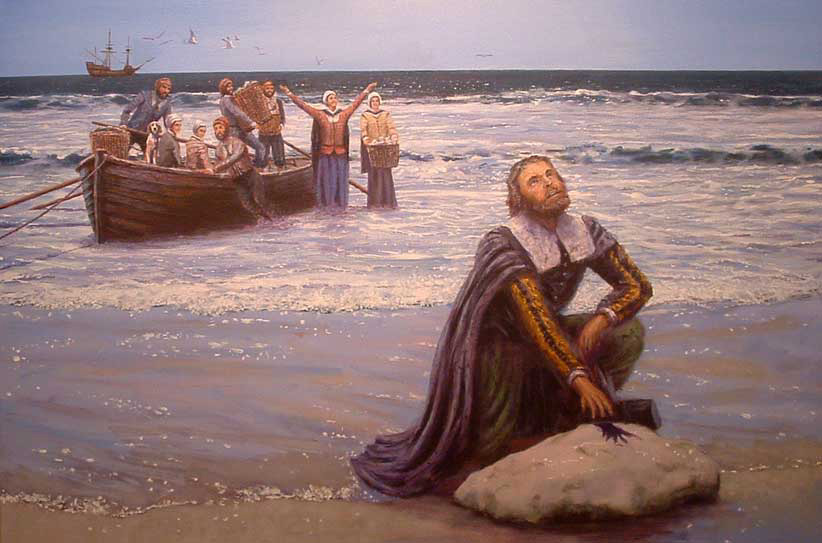
As William Bradford wrote in his book describing his witness to the Pilgrims, “Thus out of small beginnings greater things have been produced by His hand that made all things of nothing, and gives being to all things that are; and, as one small candle may light a thousand, so the light here kindled hath shone unto many…”
If these few could fight, fall, and rise to fight again against wild animals, extreme weather, poor housing, and a starvation diet, I believe we should certainly sing this November, 2023,
There is quite a discussion in “A Charlie Brown Thanksgiving” about this holiday. Marcy says, “But Thanksgiving is more than eating, Chuck. You heard what Linus was saying out there. Those pilgrims were thankful for what had happened to them, and we should be thankful, too. We should just be thankful for being together. I think that’s what they mean by Thanksgiving, Charlie Brown.”
Linus reiterates her thoughts with “In the year 1621, the Pilgrims held their first Thanksgiving feast. They invited the great Indian chief Massasoit, who brought ninety of his brave Indians and a great abundance of food. Governor William Bradford and Captain Miles Standish were honored guests. Elder William Brewster, who was a minister, said a prayer that went something like this: ‘We thank God for our homes and our food and our safety in a new land. We thank God for the opportunity to create a new world for freedom and justice.”
Happy Thanksgiving!
 Sheila Ingle