Author Archives: Merianna Neely Harrelson

King’s Mountain Celebration, 2011

     Thomas Jefferson called the Battle of King’s Mountain “the turn of the tide of Success.” It was fought on October 7, 1780 during the Revolutionary War. It was the first major patriot victory to occur after the British invasion of Charleston in May, 1780.

     There is a 26 minute film, produced by the History Channel, that gives an excellent overview of the battle, as well as introducing the major players.

     After watching the movie, you will want to visit the museum. There is an original Ferguson rifle there, as well as many artifacts found on the site. 

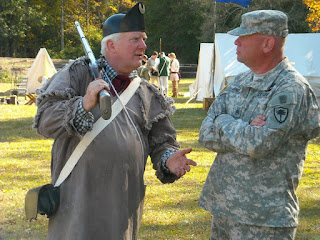
     Each year the National Parks Service invites the public to view a reeenactment of this battle, visit the camps of reenactors, and see how the army lived during a campaign. The living history demonstrations make the world of the eighteenth century  come alive.

    On Saturday, October 8, of this year, I had the opportunity to be a part of this year’s celebration. With my knitting in hand and my books ready to autograph, I spent the morning beside Dr. Bobby Moss, the noted author of nine books on the Revolutionary War. What a privilege to talk to him!


I was asked to speak about the lives of women during the Revolutionary War and set up a table of pewter, wool, knitting, corn husk and church dolls, a butter churn, paddle and mold, etc. This was my version of show-and-tell.

Gourds were used for containers and dippers; today we see them made into clocks  or decorative pieces. Someone has called them the natural Tupperware. I believe it helps all of us to both see and touch articles that we aren’t familiar with to get a better understanding of their usages.

This butter pat was my husband’s great, great grandmother’s. Even with much use, you can still tell that one side is flat for patting the butter into the mold. The other side is rounded for allowing the whey to fall back into the crock. Even though my churn is made of crockery, rather than the more typical wood, it shows a different container used during these times.

This butter mold is also a family heirloom that has a carved out design for the presentation top of the butter.

 I showed balls of virgin wool from both lambs and sheep that look and felt quite different. Then I had yarn spun from that same herd of sheep. Lastly, there was a wool blanket, hand made from their wool. The children were quite interested in how long it all took to get from the sheep to the blanket; my only reply was that it took a long time. Does anyone know the approximate length of time from shearing to laying the blanket on the bed?  

Pioneer Day in Gray Court, South Carolina

On the second weekend in September, Pioneer Day is celebrated in Gray Court, South Carolina. The Gray Court-Owings Historical Society was organized in February, 2001 with fourteen dedicated members and has grown to thirty members. It was founded to preserve the history and historic structures of this small rural area.

 The two small towns of Gray Court and Owings grew up around the railroad to serve the small farming communities nearby. The first European settler in the area was Richard Owings III who brought his family from Owings Mill, Maryland about 1757. His son Richard Owings IV was a patriot in the Revolution. The area has much historic value and as yet luckily has evaded the swath of the bulldozer and development. The towns consist of old homes and buildings and there is beautiful farmland outside the town limits.

 The Culbertson Back Country Settlement is on a beautiful two-acre circle on the old Georgia Road in Gray Court, just in front of the old Gray Court cemetery on the hill. This is where Pioneer Days is celebrated. The road was an old wagon road to Georgia that once was traveled by stagecoach to the Dorroh Inn just down the road. The Settlement consists of two log cabins, a block house, a one-room African-American school, corn crib, 1882 church, and a blacksmith shop. All of these structures have been given to the society and were in need of rescue.


As you can see, great attention to detail in the restoration of this log cabin give it a life of its own that takes visitors back to the 18th century.

As you can see, the porch is held up by sturdy rocks.

 The rock chimney stands tall, and the back country settlement gives a visual of our ancestor’s way of life.

 Inside the cabin were teen age girls working with wool. They happily explained the process from carding to spinning.

 This loom was set up to finish a rug.

 Costumes were worn by the young and old. This girl was decked out from head to toe as a Cherokee. She said the moccasins were quite comfortable.

 This family goat posed for the cameras of many.

 It was hot around the fire, but all day the blacksmith continued to create small tools from his forge.

This September day brought many smiles to our faces, as we met new friends.

 And it was time for the parade! There were walkers and animals of all descriptions. The street was lined with spectators. Dianne Culbertson and Sarah Jane Armstrong, the organizers for this event, led the way.

 There was much clapping for our flag.

 As I said, there were animals, too. This pig and goat walked sedately with their caretakers.

 Most were in colonial dress.

 Many chose to make bricks that day, and the process was a surprise. I heard someone say that maybe some of the Lowe’s and Home Depot personnel would be surprised at the old way of doing things.

 These two handmade quilts were beautiful. Besides being exhibited, they were given away in a raffle. I admit to being a bit jealous of the winners.

 This lady was making another quilt. Her stitches were small and precise.

 These hand carved spoons were made of various woods indigenous to our region, including peach.

 There was a group of Cherokee Indians at this event. They entertained many with their storytelling, drum playing, and explaining their costumes.

 Mark C. Anthony, the SCSSAR President presented a program on American flags and their history that fascinated many.

 For every age, there is something to look at, listen to, and learn from.

 In the Owings Music Hall, the shape note singers sang from 9:00 to 4:00. They started in the morning with a hymn and a prayer. Several times during the day, I went to sit at the back and savor their music.

On the second Saturday in September, the public is invited to celebrate our American heritage in Gray Court, South Carolina. Bluegrass music and barbecue are additions to this day, as well as friendly people to answer your questions about this part of our history. You will want to put this festival on next year’s calendar!


Camden

Festifall at Walnut Grove

 Every year the Spartanburg County Historical Association hosts a two day historical reenactment at Walnut Grove Plantation in Roebuck, South Carolina. This was the home of Charles and Mary Moore; it was built in 1765. During Festifall, hundreds of reenactors camp out for two nights and share their expertise of what life was like during the 18th century. Spinning wool into yarn was a simple, but time-consuming process.

Spinning wool into yarn was a simple, but time-consuming process.

Dressed in their colonial costumes, they will both explain and answer questions about their activities. In front of this lady are the dyed skeins of yarn.

Besides dressing their parts, the blacksmith will be making hinges and nails at his forge. Broom making, basket weaving, and buckets and barrels made by the cooper are all demonstrated.

No, this dachshund was not dressed for battle. Its owner did have her dressed up for the occasion though. The dog posed well for pictures, but only at a distance. Her attire brought in her own personal audience.

This is a small spinning wheel that was portable. In comparing it to the chair, you can see how handy this was for the housewife.

Carding was an important step in the making of cloth. After the shearing of the wool, it was cleaned with these carders. The metal combs took out any twigs or burrs.

This handcrafted wagon would have been used for hauling corn or any other similar task. At this point the children were enjoying playing with it.

As author and illustrator of Courageous Kate and Fearless Martha, we also chose to dress as my protagonists would have dressed. Besides selling my books, John cut silhouettes of the children.

There is a reenactment of the skirmish that actually took place at Walnut Grove in the fall of 1781. The roar of muskets is loud, and the reality hits home as we see “soldiers” fall to the ground. Because of the militia arriving in time, the house was not burned to the ground, even though lives were lost.

As you can see from the smoke, there is reality to this battle.

There is contrast all over the grounds during these two days. I saw men, women, and children going about daily tasks as they worked hard to put food on the table, take care of crops and animals, see to their family’s needs, and fight a war for independence at the same time.

These militiamen are mustering together. Just as they would have been dressed during the Revolutionary War, these Patriots wore their regular clothes. They had no uniforms, but the military drills were serious.

Walter Edgar quoted in his book, Partisans and Redcoats, that a “man’s best friend was his rifle.” Those rifles were never far away from their owners.

During the eighteenth century, children dressed like adults.

There was never a moment of idle time during this century. Meals took a long time to prepare, whether it was in a home in the fireplace or outside over an open flame. Mending was an endless task, and because each person had few clothes, they had to be kept in wearable condition.

The cars in the distance certainly don’t seem to belong to this fireside scene, but it is part of the spell that is Festifall as you step back in time and see first hand how our ancestors lived. Visitors come back every year, because there is so much to see. If you have never visited Walnut Grove Plantation, I encourage you to put it on your list for next year.

Visit to Red Fern Farm

Hello Everyone,

My dad grew up on a dairy farm in Kentucky, and I have great memories of spending a week every summer there. He would walk the fields with us and take us down to the barn when they were milking. It was always a peaceful week with little routine. The pace was slow and relaxing.

Right now I have started leading a Bible study that is called Scouting the Divine; the first part focuses on the many references to sheep in the Bible. I wanted to know more about farm life and particularly sheep. Since sheep were also used for their wool to make clothes during colonial times, I thought learning more about them would help me with my writing.

Last week Clark Mizzel, the owner of Red Fern Farm, took John and me on a tour of his flock of sheep.

Rather than having a sheep dog, he has donkeys to guard his sheep. This is Lucy and her son Dilly Bean. Donkeys have a natural antipathy for canines, such as coyotes, dogs, and foxes, who are predators to sheep. Just their size intimidates coyotes, and they can kill with their hooves. As you can tell, they were both quite curious about me. At one point, Lucy dedided that Dilly Bean was getting too much attention and pushed him away. (I thought donkeys were much taller than this!)

Both of them posed for John’s camera, and here is Dilly Bean by himself.

The Mizzels raise Tunis sheep, originally from Tunisia, hence the name. They were imported to America in 1799. The two characteristics that make them stand out are their cream-colored wool and reddish/brown faces and legs. Twins are born frequently to this breed, and they don’t have horns.

Because sheep have a “flight zone,” they didn’t allow us to get close to them in the field. Clark said he starts talking to them before he enters their pasture, because they have excellent hearing. The zoom on John’s helped bring them closer to us.


The ewes teach their lambs about what not to eat in the fields; lemon grass, switch grass, and horse nettles are poisonous. This flock is grass fed, and there are fifty acres in pasture on this farm. With that much open space, they certainly don’t get bored with their surroundings.

There are portable shelters, as well as trees, in each pasture for their shade. Plenty of water is available, also. Ethel, Lucy, and Carmen are some of the names of the sheep.

As you can see, these sheep are content. Just watching them as they moved peacefully around the pasture and then lay down for a while, it reminded me of that most familiar Psalm 23 with the words of “He maketh me to lie down in green pastures.”

Clark told us that donkeys pick up on routines, and they don’t have a flight zone. I believe I can attest to the fact that they are quite curious, also, and like to be petted. In fact, Lucy pushed Dilly Bean away from me at one point; she wanted all the attention herself. Another thing Clark pointed out was that donkeys can be quite cooperative if they so choose.

They welcomed us into this pasture.

The sheep’s wool is made into blankets in a mill on Prince Edward Island, and they can be bought at the farm. You will enjoy looking at their web site at www.redfernfarms.com.

These sheep were more curious about us in their close quarters. In fact, the brown one came charging out to welcome us. Their names are Ricky and Fred.

Why they were less skittish than the ones in the large pasture, I don’t know. But this one enjoyed posing for John’s camera. Clark was kind enough to share some small bags of wool with me; some from the lambs and the adults. They are both soft and thick, but the lamb’s wool is softer.

This family only started what they call “an adventure of a lifetime” fifteen years ago. They also offer herbs and vegetables to the public and weekly are found on Saturdays at the Greenville Farmer’s Market/www.redfernfarms.com.
I understand why they call this an adventure. John and I spent two hours there, and the time flew. The quiet, except for nature’s sounds, brought our schedules to a stop. Just watching the contented sheep with obviously not a care in the world reminded me that contentment is not in what I have but being content with where I am. 

Easy Colonial Recipe

Hello Friends,

Most of us like new recipes, but this one is certainly not a new one. When I was writing the biography about Kate Moore Barry, I found this simple recipe for shortbread cookies. I have made them, and they are delicious. They are good with a cup of tea or coffee in the afternoon, and a delicious aroma invades your home while they are baking. I have taken them with me on some author visits, and the reviews have been favorable. Is it not amazing that a recipe from over 200 years ago can still be enjoyed by us today? I hope you might find time to bake a few for you and your family, and I believe they won’t stay around long.

Shortbread Cookies

1 cup sugar
1 cup butter
1 cup flour
Blend all the ingredients, and bake until golden brown in a moderate oven.

There are a few hints that will make this easier. The butter needs to be softened. Even though the batter can be blended with a wooden spoon, a mixer makes it quicker. I combined the sugar and butter and then slowly added the flour. Using an ungreased cookie sheet, I dropped a teaspoon of batter and baked them in a 350 degree oven for about 20 minutes. Knowing our ovens are different, you might want to watch the first batch. This recipe only made about 24 small cookies.

Aren’t we glad we can use the gauges of our ovens to determine the temperature and don’t have to see if the hairs on our arms are singed by the heat!?!

Happy Baking! 🙂

Musgrove Mill Celebration on August 20, 2011

Hello Friends,

Yesterday John and I joined with many others from Georgia, North Carolina, and our own state of South Carolina to celebrate the Whig victory over the British partisan forces at Musgrove Mill. On August 18, 1780, the British were defeated in a battle that only lasted about an hour.

Individuals from various D.A.R., S.A.R., and C.A.R. chapters began arriving around 9:00 with their wreaths of remembrance. Two pictures are still in my mind’s eye today; one is of the men, women, and children standing to sing our national anthem. While most were dressed in modern clothes, others were attired in colonial costumes. This visual game me pause as to how we are honoring and remembering those who came before us to settle this great country of ours; because of them, we are here.

Later in the program, the Musgrove Mill Militia carefully loaded and shot their rifles, but in the midst of their line was one reenactor dressed as a member of the British Legion. There was no mistaking his green jacket amidst the men wearing their hunting coats and every day colonial clothes. This would never have happened during the American Revolution, but it reminded me of some words of George Washington that he wrote in a letter to James Madison in 1788. Our first President said, “Liberty, when it begins to take root, is a plant of rapid growth.” Our country is a product of the sowing of the seeds of Liberty.
 

 Robert Hall, a descendent of Elsie Bratton, knows all about his lineage and told me some stories about the Bratton family after the Revolutionary War. There is no doubt that he knows his family’s history and has continued to tell its story through reenactments.


 Two sisters of the reenactors of the Musgrove Mill Militia & Co. safely spent the night on Friday. There were no distubances to their sleep, but they did say that several pairs of eyes greeted them. (You might want to check out this militia group’s Facebook site.)

 During the eighteenth century, hot weather was ignored when their was work to do. This blacksmith and his helper never stopped during the day, but explained the process to all who stopped by.

 This is a picture of Tony Zeiss, the author of Backcountry Fury. Dressed in early nineteenth century clothes, he was visiting on the porch with Bob Swager. Tony shared an entertaining and informative monologue of the life of Thomas Young, one of the young men who fought at the Musgrove Mill battle and the protagonist of his book.

 Here is Tony Scotti, the reenactor dressed as a member of the British Legion. Just in case you are interested, Tony’s musket is a 54 caliber smooth bore. (This was the same British Legion that fought with Captain Christian Huck at the Battle of Huck’s Defeat.)

 The reenactor, Fitzpatrick Williamson, was dressed as one of the Overmountain Men. He and Chris Swager, author of numerous Revolutionary War books catch up. (Chris’ books are available through Sandlapper Publishing.) She is an expert on the Southern Campaign in South Carolina. 

 In the afternoon, again on the porch, we were once again entertained and informed by another author and storyteller. Randell Jones, the author of In the Footsteps of Daniel Boone, In the Footsteps of Davy Crockett, and, The Overmountain Men and the Battle of King’s Mountain.

John had the opportunity to cut many silhouettes of the children visiting the site, and the typical summer humidity of our state didn’t mar the day. We came away with a renewed resolve to continue telling the stories of the fearless and courageous men and women who lived and fought in South Carolina during the Revolutionary War. We were glad to be part of this day of celebration at Musgrove Mill.

Martha Washington said, “I am determined to be cheerful and happy in whatever situation I may find myself. For I have learned that the greater part of our misery or unhappiness is determined not by our circumstance but by our disposition.”
 
That was good advice then, as well as now!

August 5 Book Launch for “Fearless Martha, A Daughter of the American Revolution”

On Friday, August 5, our friends and family joined us at 7:00 for the book launch of Fearless Martha, A Daughter of the American Revolution. Children and their grandparents kindly listened to my words of introduction to the biography on the life of Martha Bratton. I read the chapter, “Fearless Martha” and answered a few questions. Thank you for your love and support; John and I appreciate your allowing us to be part of your lives!

Our great niece was there that night and wrote me a letter after she finished reading Martha’s story. I would like to share a paragraph with you.
A quote I admired from this book was said by Colonel Bratton on page 61. He said, “I reckon my son opened my eyes mighty quick then. I taught my son he must always stand tall, and he reminded me that I too must stand tall. We must stand tall, brothers! We must stand tall for our families and friends. We must stand tall against the British and the Tories!”
This quote taught me to stand tall for everyone, not just for myself, but for my family and friends. I hope someday I could be as fearless as Martha.”
She certainly caught the importance of what we can learn from reading about the bravery and courage of the men and women who put their lives on the line for the freedom of our country. We need to keep sharing these stories with the next generation. As Dr. J. B. O. Landrum said in his book, Colonial and Revolutionary History of Upper South Carolina, “Let us preserve our memories, our traditions, and our history, not only for our own information and pride, but for the benefit of the generations that come after us.”

Historic Brattonsville, July 9-10, 2011

It was a typical hot summer day in South Carolina and many visitors walked from building to building to meet  volunteers and reenactors , as they explained what life was like in the upcountry of Carolina during the Revolutionary War. In one home, there was a spinning demonstration at a small spinning wheel. Her hands moved with assurance as the yarn moved through her fingers.

John took my picture on the same porch that Martha had the sickle put to her throat in the 18th century. To walk, stand, and sit where ordinary people made extraordinary decisions that changed the course of history can take your breath away.
Michael C. Scoggins, the Historian Cultural and Heritage Museums, spoke on both Saturday and Sunday on Huck’s Battlefield Archaeology. His power point  presentation was full of information, and he led a tour of the battlefield on Saturday. 

As guests entered the Visitor’s Center, they were greeted by Michael. He answered many questions, including mine. John and I were seated at a table right next to his desk.

On Sunday, we gathered at the stage area for worship. The Reverend Donald A. Lowery read from the Old Testament and then shared from a sermon that was preached two weeks after the Battle of Waxhaws. He led the congregation in singing from the Psalter and encouraged everyone to remember the freedom we have came at a cost from men, women, and children that chose liberty two hundred years ago. It was moving to look over and see those in colonial dress seated by others in modern clothes sitting on half log benches; it brought Reverend Lowery’s words to life. Hats were doffed by all the men for the prayers.

On Sunday afternoon visitors enjoyed the entertaining and stirring monologue presented by Howard Burnham.  In costume and using the words of long ago, he became General Thomas Sumter. He shared the General’s biography and ended his presentation with ” in South Carolina, there will always be a fighting gamecock.”

As we walked to the Battle of Huck’s Defeat Reenactment, we were greeted by violin music. Drawing the crowds closer to the battlefield was a musician playing eighteenth century music. The soloist took us back to a simpler, but a harder way of life. I was glad of the modern technology that enhanced the tunes.

Here are some of the reenactors that helped us all picture the reality of those days and encouraged us to two days of remembrance. I was quite excited that my fictionalized biography, Fearless Martha, A Daughter of the American Revolution, had its debut in Historic Brattonsville. Martha Bratton was a woman who stood tall, along with her family and many others, to make sure the British did not stay in Carolina in 1780.

“The Art of Housewifery”

                                                           “The Art of Housewifery”
          In my book, Courageous Kate, A Daughter of the American Revolution, there is a chapter called “The Art of Housewifery.” Not all of the chores that were part of these times are described, but a good many are.  In my second book, Fearless Martha, a Daughter of the American Revolution, there are more descriptions of the ways eighteenth century women ran their homes. Mothers taught their daughters at an early age how to keep a household running smoothly. The chores were endless, and many hands were needed to make light work. (Both books are available at Hub City Press http://www.hubcity.org/ – , Barnes and Noble, and Amazon.)
          The Revolutionary War women that lived on the small farms were busy from before daylight to after dark. Maybe that is where the saying “a woman’s work is never done” originated. The farmer’s wife saw to the dairy, the chickens, the vegetable and herb gardens, cleaned house. She cured and preserved meats, made soap and candles, dried vegetables, spin thread to make cloth for clothes from her own flax, prepared meals, and doctored her family.
          As I was learning about this myriad of daily tasks, I visited Middleton Gardens in Charleston, South Carolina. A large millstone was there to entertain visitors. The pole in the middle of the two stones was stout, and the stones were at least a yard wide. Turning the pole crushed the corn kernels, and this was no easy task. My whole body was involved in turning the pole; I quickly remembered the motions of the dance, the Twist, from years ago. I have to admit my practice at this didn’t last long, and my husband was kind enough not to laugh.
          My grandparents owned a dairy farm in Kentucky, and I was always fascinated with the milking process, though I didn’t have a lot of personal luck. I admit I was leery of the cows after getting swatted by several of their tails at different times. There was no choice during the eighteenth century for this task, because milk was used for drinking, making butter, and cooking. Also, the cows had to be milked every day because they produced up to five gallons of milk daily.  Churning is an easy, but tiring process. It sometimes took almost an hour of plunging that dasher up and down in the churn to turn that creamy milk into butter. (My husband and I have butter molds from both sides of our families that we treasure.)
          When I taught kindergarten, we made candles at Christmas. It seemed an endless task for my eighteen students to walk around the table dipping their string into the hot wax. I went to Michael’s to buy the wax, but that was not available two hundred years ago. In the colonial days, the hard fat of cows or sheep was melted for the wax or perhaps bee’s wax was used. Bayberries were often added to give off a pleasant scent when burning, but almost a bushel of berries was needed to make just a few candles. Believe it or not, many women could make as many as 200 candles in one day. I did read that mice liked to eat candles, so the housewives had to store them carefully.
           I enjoy using my crock pot to make stews or soups. The smells after several hours of cooking are an encouragement that supper is in process. In those earlier times, a large, iron pot filled with meat and vegetables would also cook all day in the fireplace.  The chickens would have come from the yard, or the deer meat from a hunting expedition. The vegetables were from the kitchen garden and any herbs from the herb garden. The wife took care of scalding and plucking the feathers of the chicken. She would have prepared the ground, planted the seeds, weeded and watered the garden, and then picked her vegetables and herbs. Sometimes the family would eat on this stew for several days, with daily additions. Everything took a lot of time. Nothing was wasted. This old rhyme describes how a stew might keep on cooking. “Pease porridge hot. Pease porridge cold. Pease porridge in the pot nine days old. Some like it hot. Some like it cold. Some like it in the pot nine days old.”
           John and I met Revolutionary War reenactors at Cowpens National Battlefield the other weekend, and I learned about another time-consuming task called cording. I was not familiar with this, but learned quickly that with the help of a lucet that one cord could be put together to make a stronger, square cord. These cords were used for women’s stays, drawstring bags, button loops, and anything else that needed a tie-together. A sewing basket would have cords in various stages of completion. (There are several internet sites available to find more information about this task, as well this YouTube video at http://www.youtube.com/watch?v=3y5K7FiT2Og  to help you learn this craft.) From the little bit of experience I have had with holding the yarn and the lucet, expertise making this necessity would take practice.
          Speaking of the reenactors, they have learned to share this time period with us with much proficiency. They are always willing to share their knowledge and know-how of these times and the tasks that both men and women needed for survival. It is a worthwhile drive to visit any of their many campsites at Revolutionary War events, and I encourage you to do so. From the food they cook to the tents they set up, they will help open your eyes to an ordinary day in the lives of our early American families.    
         These are a few comparisons of housewifery between the eighteenth century and the twenty-first century; there are many others. With the well-being of their families hanging in the balance, these strong and courageous women did their jobs of taking care of both hearth and home. They left us a legacy of the importance of seeing to our households, and it is one to remember and follow their models.
Suzanne Adair asked me to create a post for her blog for the week of July 4, 2011. This encouraged me to begin a blog myself, so I am sharing with you what I wrote. Be sure to check out Suzanne’s blog for more information on the Revolutionary War.
Sheila Ingle
Author of Courageous Kate, A Daughter of the American Revolution
Winner of the 2007 DAR Historic Preservation Award
Author of Fearless Martha, A Daughter of the American Revolution
Design a site like this with WordPress.com
Get started