Tag Archives: hurricane Hugo

Memories and Hurricanes

Sue Monk Kidd in The Secret Life of Bees wrote, “The month of August had turned into a griddle where the days just lay there and sizzled.”

I believe August had a head start this year by starting in June with its summer heat. But this is the South. If you have lived here for a while, you know that we, not only talk about the hot temps during the summer, but also enjoy them.

With the hurricane Debbie headed for South Carolina, thoughts of hurricanes come to mind. Hurricanes are a part of Charleston’s history. In 1700, the Rising Sun hit Charles Town with its destructive force. Edward Hyme wrote a letter describing it to his wife in England. Obviously, the damage from hurricanes has changed little.

“On Tuesday Septemb: 3d [that’s September 14 on the modern Gregorian calendar] here happened a most terrible Storm of Wind or Hurricane wth continual Rain; wch has done great Damage to ye Country. Thousands of Trees have been torn up by ye Roots; many Houses blown down & more damnified; much Rice Corn &c. spoiled, but ye greatest Mischeif fell amongst ye Shipping of which about a Dozen Sail (of all Sorts) were riding at Anchor before ye Town, some of wch were driven on Shoar & broke all in Pieces, some were carryed a great Way up into the Marshes & One (a Brigantine of about 80 Tons) driven clear over ye Point of Land wch parts ye Two Rivers into Ashley River [that is, over what is now White Point Garden], in her way breaking down a Pair of Gallows on wch 8 Pirat[e]s at once were hanged since my com[i]ng here)[.] Some [vessels] were turn’d Bottom upwards & lost. [Captain] Bell lost all his Masts & was turn’d Bottom upwards, but they have got her to rights again, & I believe she will be ye next Ship for England. . . . Being Spring Tides ye Water was very high & raging, so that if ye Wind had not shifted as it did about 2 Hours before high-Water, it is thought the best & greatest part of ye Town would have been washed down into ye River, as One or 2 Houses were & others very near.”

“The greatest and most deplorable loss of all was that of a great Scot ship called the Rising Sun, which … was riding at anchor [outside the] bar, with design to come in here and refit…. The storm rose and she foundered at anchor, the captain and all the Scots on board, being about 100, miserably perishing.”

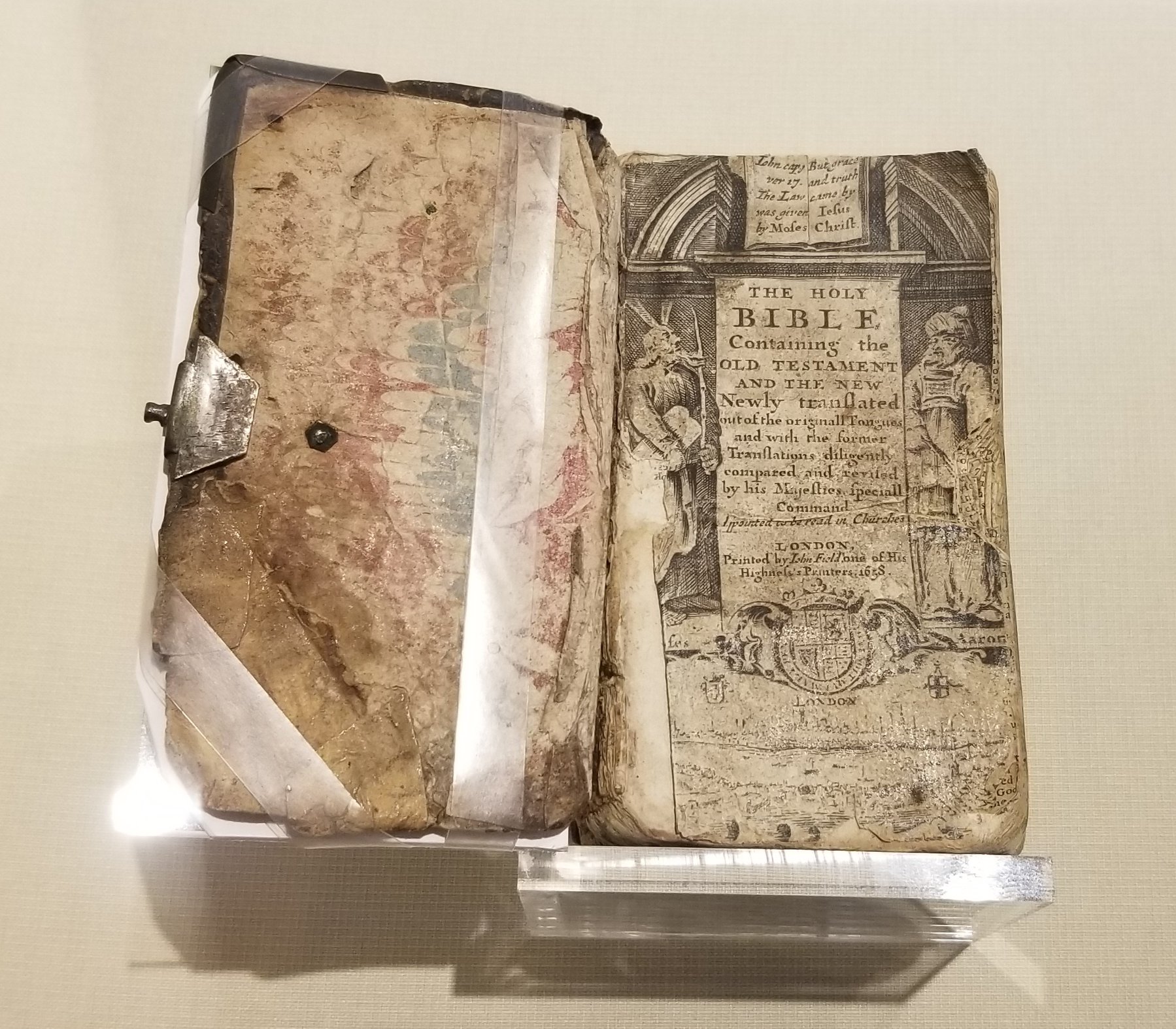
Saved from that ship is this Bible, which belonged to the Reverend Archibald Stobo, founding patriarch of the Presbyterian church in South Carolina. You can see this at the South Carolina Historical Society Museum. Reverend Stobo had been invited into town to preach at the White Meeting House (now Circular Congregational Church). He, his wife, and a small group from the ship were saved.
I was born in Charleston. My dad used to tell me that I slept through my first hurricane the year I was born. Of course, Hugo continues to be talked about. My brother and his family left the Holy City for the upstate, along with thousands of others. When they went back, it was to a destroyed city. Today, the rain sounds like it is going to pommel Charleston once again.

Folly Beach after Hugo

One of my early memories is of a quick meeting with the President of the United States. When I was around four, I met President Dwight D. Eisenhower. In a long line of people, my parents and I were outside a church in Augusta, Georgia. (Since then, I have found out that it was the Reid Memorial Presbyterian Church, where the President attended in that city.) I can still remember that it was Daddy, then Mother, then me standing beside the sidewalk. As the President walked by, he shook Daddy’s hand and then smiled and patted me on the head. It makes no sense that I can still visualize this occasion, but I do. I guess I am supposed to have this one in my memory bank.

Both my grandmothers and mother made jelly and preserves every summer. They started the spring season with strawberry preserves, following that with peach and blackberry preserves, and ending with apple jelly in the fall. I saw that it was hot work, as they all dealt with the steam from the jars boiling and the fruit being brought to a boil. But it wasn’t long after I married that I chose to follow in their footsteps. There really isn’t much enjoyment from the process, but there certainly is in eating the finished product. I, also, enjoy sharing them with friends and watching their eyes light up with anticipated pleasure. If I could only bake biscuits, like those three ladies, to go with those preserves, I would be truly following in their footsteps. (In case you didn’t know it, Mary B biscuits are a delicious second choice!)

As I continue to say, we need to share our stories. I hope, as you may have had extra time with family, that you have regaled another generation about your younger years.

To quote Sue Monk Kidd again, “Stories have to be told or they die, and when they die, we can’t remember who we are or why we’re here.”

Hurricanes

In the Colonial period, tropical storms and hurricanes were known as “September gales,” probably because the ones people remembered and wrote about were those which damaged or destroyed crops just before they were to be harvested.

Charleston was hit on September 25, 1686. It was described as “wonderfully horrid and destructive…Corne is all beaten down and lyes rotting on the ground… Aboundance of our hoggs and Cattle were killed in the Tempest by the falls of Trees…”

But this gale also protected Charleston by preventing a Spanish naval assault on the city.  It destroyed one of their galleys and killed the commander of the Spanish attack.

On August 28, 1893, an unnamed storm left its calling card of destruction. This storm made landfall near the South Carolina / Georgia border, winds estimated at over 120 miles per hour, loss of life estimated at more than 2,000 and thousands were left with nothing.

Clara Barton, the American Red Cross founder, launched a 10-month relief effort on the islands and said some 35,000 people lived on the islands were affected.

It would be called The Great Sea Island Storm, as the storm’s strength was so great that a tidal wave that struck at high tide near Hilton Head consumed entire islands. It also spun destruction from Jacksonville, Fla., into New York.

Hurricanes and tropical storms are irregular visitors to coastal South Carolina. Starting in 1851, there is more information about each one. In the period, 1851-2018,  thirty-one hurricanes have made landfall on SC. In that same time period, forty-seven, made direct hits on North Carolina.

Last week Hurricane Florence made forty-eight to make landfall in NC.

Winds, rain, and surf overwhelmed parts of North Carolina, and Hurricane Florence shared her visit with South Carolina, too. The images on the television and the internet have been horrifying. For those who were in her path, it has been heart-rending. And now, flooding will take its toll.

North Carolina Gov. Roy Cooper described Hurricane Florence, which slammed into his state early Friday, as “an uninvited brute who doesn’t want to leave.”

Hurricane Hugo attacked South Carolina and North Carolina 27 years ago, but those that lived through its assault have not forgotten its sound and fury.

“The weather on September 21st, 1989 started off not much different than any other late summer or early Fall day. But that all began to change quickly as nighttime approached. For those that decided to stay it was certainly a night they will never forget.”

http://www.youtube.com/watch?v=eb34rcG6heQ&feature=youtu.be

We don’t have to wait for storms to come into our lives; strong winds of hurt and loss can make us stumble during any day or month. But as Gandalf said, ““All we have to decide is what to do with the time that is given us.”

I watched a DVD series last month called the Winds of War. It was a 1983 miniseries based on books written by Herman Wouk. The plot follows an American family as they face the history before World War II. Even though the circumstances are the same, each individual has different reactions and chooses his own path, just as in life.

In her book, Bird by Bird: Some Instructions on Writing and Life, Anne Lamott tells this story.

“Thirty years ago my older brother, who was ten years old at the time, was trying to get a report written on birds that he’d had three months to write, which was due the next day. We were out at our family cabin in Bolinas, and he was at the kitchen table close to tears, surrounded by binder paper and pencils and unopened books about birds, immobilized by the hugeness of the task ahead. Then my father sat down beside him put his arm around my brother’s shoulder, and said, “Bird by bird, buddy. Just take it bird by bird.”

When we encounter someone who is buffeted by hurricanes, let’s choose to encourage them. In fact, we can walk beside them. That is what friendship is all about.

Image result for encouragement about compassion

“He Ain’t Heavy, He’s My Brother”
“The road is long
With many a winding turn
That leads us to who knows where
Who knows when
But I’m strong
Strong enough to carry him
He ain’t heavy, he’s my brother

So on we go
His welfare is of my concern
No burden is he to bear
We’ll get there
For I know
He would not encumber me
He ain’t heavy, he’s my brother

If I’m laden at all
I’m laden with sadness
That everyone’s heart
Isn’t filled with the gladness
Of love for one another

It’s a long, long road
From which there is no return
While we’re on the way to there
Why not share
And the load
Doesn’t weigh me down at all
He ain’t heavy, he’s my brother

He’s my brother
He ain’t heavy, he’s my brother…”

It is a privilege to walk with our brothers and sisters, isn’t it? Let’s walk together!


Remembering Hurricane Hugo

In the Colonial period tropical storms and hurricanes were known as “September gales,” probably because the ones people remembered and wrote about were those which damaged or destroyed crops just before they were to be harvested.

Charleston was hit on September 25, 1686. It was described as “wonderfully horrid and destructive…Corne is all beaten down and lyes rotting on the ground… Aboundance of our hoggs and Cattle were killed in the Tempest by the falls of Trees…” But this gale also prevented a Spanish assault on the city by destroying one of their galleys and killing the commander of the Spanish assault.

Hurricanes and tropical storms are irregular visitors to coastal South Carolina. Starting in 1851, there is more information about each one. In the period, 1851-2016,  24 hurricanes have made landfall.

Hurricane Hugo attacked South Carolina and North Carolina 27 years ago, but for us that lived through its assault have not forgotten its sound and fury.

“The weather on September 21st, 1989 started off not much different than any other late summer or early Fall day. But that all began to change quickly as nighttime approached. For those that decided to stay it was certainly a night they will never forget.”

http://www.youtube.com/watch?v=eb34rcG6heQ&feature=youtu.be

Today the Eastern shores of Georgia and South Carolina await another hurricane named Hermine. It made landfall early this morning in Florida with a furious mix of rain, whistling winds and surging waves. As it continues to move, it has been downgraded to a tropical storm. Hermine’s toll has yet to be determined.

We don’t have to wait for storms to come into our lives; strong winds of hurt and loss can make us stumble during any day or month. But as Gandalf said, ““All we have to decide is what to do with the time that is given us.”

I watched a DVD series last month called the Winds of War. It was a 1983 miniseries based on books written by Herman Wouk. The plot follows an American family as they face the history before World War II. Even though the circumstances are the same, each individual has different reactions and chooses his own path, just as in life.

In her book, Bird by Bird: Some Instructions on Writing and Life, Anne Lamott tells this story.

“Thirty years ago my older brother, who was ten years old at the time, was trying to get a report written on birds that he’d had three months to write, which was due the next day. We were out at our family cabin in Bolinas, and he was at the kitchen table close to tears, surrounded by binder paper and pencils and unopened books about birds, immobilized by the hugeness of the task ahead. Then my father sat down beside him put his arm around my brother’s shoulder, and said, “Bird by bird, buddy. Just take it bird by bird.”

When we encounter someone who is buffeted by hurricanes, let’s choose to encourage them. In fact, we can walk beside them. That is what friendship is all about.


September Events:

September 10 – Pioneer Day in Gray Court, SC

September 16 – Revolutionary War History Museum in Simpsonville, SC

September 17 – Bethabara Apple Festival in Winston Salem, NC

September 22 – DAR Chapter in Bishopville, SC


Design a site like this with WordPress.com
Get started