Tag Archives: John Adams

The Pilgrims, the Settlers, the Survivors

 In a few weeks, we will celebrate Thanksgiving, a national and family holiday in our country. We will gather together for fun, food, and fellowship. But will we be thankful for what we have? Will we count our blessings? Name them one-by-one? Will we serve others? Will we remember the sacrifices of those who settled our country?

“As we express our gratitude, we must never forget that the highest appreciation is not to utter words, but to live by them.”– John Fitzgerald Kennedy

Knowing nothing about the reality of the Pilgrims’ journey to America or those first years of deprivation and death, it was a fun holiday to celebrate during my younger years. At school, we would make Pilgrim and Indian hats and headpieces, eat vegetable soup and cornbread, and sing loudly, “Come Ye Thankful People Come.”

Growing up in twentieth century South Carolina, I could never have imagined this model of the insides of their ship.

The bravery of this group who was willing to give up all they knew for an unknown destination. It was their desire to worship God as they felt led that pushed them on the Mayflower.

The above painting shows this group of settlers boarding their ship. On September 16, 1620, the Mayflower, no larger than a volleyball court today, sailed from Plymouth, England, bound for the Americas with 102 passengers. Headed for Virginia, storms and navigational errors pushed the Mayflower off course. And it was on November 21, they reached Massachusetts. This was the first permanent European settlement in New England.

The Embarkation of the Pilgrims (1857) by American painter Robert Walter Weir.

The painting below is a rendering of their arrival at Plymouth Rock. The faces are quite solemn and serious, as they look toward a forest and a wilderness.
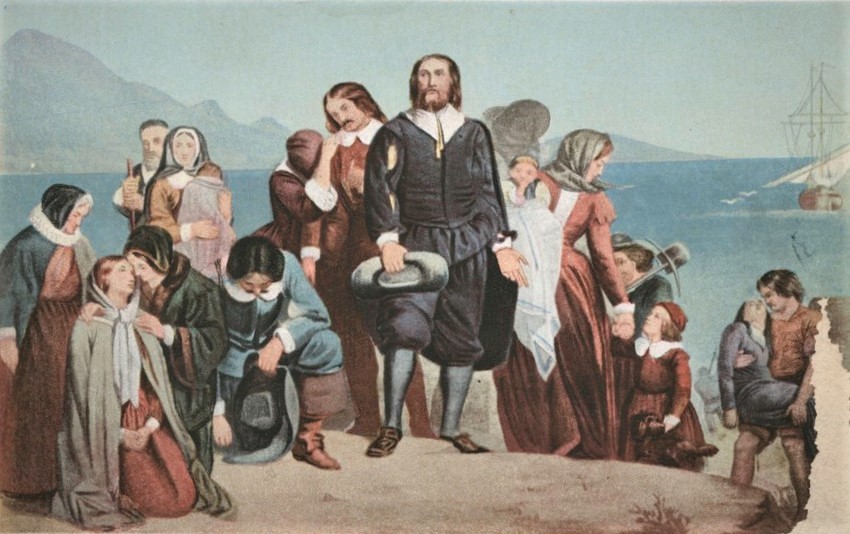
The colonists began building their town. While houses were being built, the group continued to live on the ship. Many of the colonists fell ill. They were probably suffering from scurvy and pneumonia caused by a lack of shelter in the cold, wet weather. Although the Pilgrims were not starving, their sea-diet was very high in salt, which weakened their bodies on the long journey and during that first winter.

As many as two or three people died each day during their first two months on land. Only 52 people survived the first year in Plymouth. More than half of the heads of households died. Five of the eighteen wives lived through the scourges of pneumonia, tuberculosis, and scurvy.

“…Aboute no one, it began to raine…at night. It did freee &snow …still the cold weather continued…very wet and rainy, with the greatest gusts of wind ever we saw…frost and foule weather hindered us much; this time of the yeare seldom could we worke half the week.”

On March 24, a journal entry sums their situation up: “Dies Elizabeth, the wife of Mr. Edward Winslow. N.B. This month thirteen of our number die. And in three mons past dies halfe our company…Of a hundred persons, scarce fifty remain, the living scarce able to bury the dead.”

What a courageous group of men, women, and children; there are no words to laud their fortitude. During the third week of March, the weakened survivors from the Mayflower rowed ashore to their new homes in New Plimouth in those huts that needed rebuilding.

The earliest houses in Plymouth had thatched roofs, but because they were more likely to catch on fire, the colony eventually passed a law that required new homes be built with plank instead. Most houses had dirt floors, not wooden floors, and each had a prominent fire and chimney area, since this was the only source of heat as well as the only way to cook. Each house would have had its own garden, where vegetables and herbs could be grown. Each family was also assigned a field plot just outside of town, where they could grow corn, beans, peas, wheat, and other crops that required more space to grow, as well as to raise larger livestock.

Still, God’s grace was sufficient. English-speaking Indians named Samoset and Squanto helped the Pilgrims learn how to farm the land and harvest the bay. Squanto lived with the Pilgrims until 1622 when he died. His last request was that Gov. William Bradford would pray that he might go to the Englishman’s God in heaven. Bradford wrote: “Squanto continued with them and was their interpreter, and was a special instrument sent of God for their good beyond their expectation. He directed them how to set their corn, where to take fish and to procure other commodities and was also their pilot to bring them to unknown places for their profit, and never left them till he dyed.”

By 1621, passenger Edward Winslow wrote a letter in which he said “we have built seven dwelling-houses, and four for the use of the plantation.” In 1622, the Pilgrims built a fence around the colony for their better defense–the perimeter was nearly half a mile, and the fence was about 8 to 9 feet high.

They could have given up and returned to England. They could have thrown up their hands in despair. But their faith was in God, and they chose to not let the hardships make them bitter. Their trust laid the enduring foundations of our country America, and they were thankful.\A pilgrim is a person who goes on a long journey often with a religious or moral purpose, and especially to a foreign land.

After the Mayflower arrived, the first baby born was a boy. His parents (William and Susannah White) named him Peregrine – a word which means traveling from far away and also means pilgrim. Governor William Bradford wrote, “They knew they were pilgrims, and looked not much on those things, but lifted up their eyes to the heavens, their dearest country; and quieted their spirits.”

This beautiful cradle is believed to have been brought on the Mayflower by William and Susanna White, for the use of Peregrine White, who was born onboard the ship in November 1620 while it was anchored off the tip of Cape Cod.  It is on display at the Pilgrim Hall Museum in Plymouth.

These few fought, fell, and rose to fight again against wild animals, extreme weather, poor housing, and a starvation diet. Then they intentionally celebrated a day of thanksgiving after a time of such hardship. Long-time chronicler and governor William Bradford described this celebration in 1621 with these words.

They began now to gather in the small harvest they had, and to fit up their houses and dwellings against winter, being all well recovered in health and strength and had all things in good plenty. For as some were thus employed in affairs abroad, others were exercising in fishing, about cod and bass and other fish, of which they took good store, of which every family had their portion. All the summer there was no want; and now began to come in store of fowl, as winter approached, of which this place did abound when they came first (but afterward decreased by degrees). And besides waterfowl there was great store of wild turkeys, of which they took many, besides venison, etc. Besides they had about a peck of meal a week to a person, or now since harvest, Indian corn to that proportion. Which made many afterwards write so largely of their plenty here to their friends in England, which were not feigned but true reports.

“It is therefore recommended . . . for solemn thanksgiving and praise, that with one heart and one voice the good people may express the grateful feelings of their hearts and consecrate themselves to the service of their divine benefactor . . . .”– November 1, 1777 (adopted by the 13 states as the first official Thanksgiving Proclamation) – Samuel Adams


For more information about our forefathers, look at MayflowerHistory.com.

July 3, 1776 Letter

Posted on

John Adams was born on October 30, 1735, in Quincy, Massachusetts. He was a direct descendant of Puritan colonists from the Massachusetts Bay Colony. He studied at Harvard University, where he received his undergraduate degree and master’s, and in 1758 was admitted to the bar. In 1774, he served on the First Continental Congress and helped draft the Declaration of Independence. Adams became the first vice president of the United States and the second president.

Stout elderly man in his 60s with long white hair, facing partway leftward

John Adams (1735-1826) was instrumental in negotiating in favor of independence at the Continental Congresses (1774-78), signed the Declaration of Independence.

John Adams’ famous letter of July 3, 1776, in which he wrote to his wife Abigail what his thoughts were about celebrating the Fourth of July is found on various web sites but is usually incorrectly quoted. Following is the exact text from his letter with his original spellings:

“The Second Day of July 1776, will be the most memorable Epocha, in the History of America. I am apt to believe that it will be celebrated, by succeeding Generations, as the great anniversary Festival. It ought to be commemorated, as the Day of Deliverance by solemn Acts of Devotion to God Almighty. It ought to be solemnized with Pomp and Parade, with Shews, Games, Sports, Guns, Bells, Bonfires and Illuminations from one End of this Continent to the other from this Time forward forever more. You will think me transported with Enthusiasm but I am not. I am well aware of the Toil and Blood and Treasure, that it will cost Us to maintain this Declaration, and support and defend these States. Yet through all the Gloom I can see the Rays of ravishing Light and Glory. I can see that the End is more than worth all the Means. And that Posterity will tryumph in that Days Transaction, even altho We should rue it, which I trust in God We shall not.”

“(The Book of Abigail and John: Selected Letters of the Adams Family, 1762-1784, Harvard University Press, 1975, 142).

https://i0.wp.com/static.blastingnews.com/media/photogallery/2016/3/3/main/declaration-of-independence-by-john-trumbull_628359.jpg

Trumbull’s Declaration of Independence – committee presents draft to Congress. Adams is depicted at center with his hand on his hip.

In 2008, HBO produced a mini series about the life and times of John Adams. I believe it is masterly told. If you have a chance to watch it, I recommend you do. Here is a clip.

https://video.search.yahoo.com/yhs/search;_ylt=AwrEeSVN8B1dzg8AHBQPxQt.;_ylu=X3oDMTByMjB0aG5zBGNvbG8DYmYxBHBvcwMxBHZ0aWQDBHNlYwNzYw–?p=john+adams+and+youtube&fr=yhs-pty-pty_email&hspart=pty&hsimp=yhs-pty_email#id=14&vid=70024796465575d49ca28d01df056de8&action=view

So today is July 4th, and it is time to celebrate our country’s birthday. What are we waiting for? Let the party begin!

Faith of the Founders

When the 56 Signers of The Declaration of Independence signed their names to that document, each knew they were committing treason against the British Crown.  If caught and captured, they risked death. But death would not be swift. It would be by hanging to the point of unconsciousness, then being revived, disemboweled, their body parts boiled in oil and their ashes scattered into the wind. Our Founding Fathers valued freedom, for themselves and their posterity, to the extent that they found this fate worth the risk.

Image result for why was the declaration of independence written

Second President John Adams said, “The general principles upon which the Fathers achieved independence were the general principles of Christianity…I will avow that I believed and now believe that those general principles of Christianity are as eternal and immutable as the existence and attributes of God.”

Image result for why was the declaration of independence written

The Declaration of Independence identified the source of all authority and rights as “Their Creator,” and then accentuated that individual human rights were God-given, not man-made.

Image result for why was the declaration of independence written

In that core group of delegates, according to public record were 28 Episcopalians, 8 Pres- byterians, 7 Congregationalists, 2 Lutherans, 2 Dutch Reformed, 2 Methodists,  Roman Catholics, 1 unknown, and 3 deists (those who  believe in an impersonal God), who gave the world its initial impetus but then left it to run its course).

Pictured above: Thirty-three-year-old Thomas Jefferson wrote most of this document. In approximately two weeks, he penned it in two rented rooms in the home of Graff, a noted bricklayer.

The universal words were carefully chosen, but it was individuals who signed their names. The Declaration of Independence was seditious and a break-up letter never to be forgotten.

Image result for why was the declaration of independence written

What were their professions? Twenty-five were lawyers or jurists. Eleven were merchants. Nine were farmers or large plantation owners. One was a teacher, one a musician, and one a printer. These were men of means and education, yet they signed the Declaration of Independence, knowing full well that the penalty could be death if they were captured.

Their commitments were heart-felt. As Abraham Clark said, “Let us prepare for the worst. We can die here but once.”

Five were captured by the British and brutally tortured as traitors. Nine fought in the War for Independence and died from wounds or hardships they suffered. Two lost their sons in the Continental Army. Another two had sons captured. At least a dozen of the fifty-six had their homes pillaged and burned. Seventeen lost everything they owned. The British jailed Francis Lewis’ wife for two months, and that and other hardships from the war so affected her health that she died only two years later.

Thomas Heyward, Jr., Edward Rutledge, and Arthur Middleton, all of South Carolina, were captured by the British during the Charleston Campaign in 1780. They were kept in dungeons at the St. Augustine Prison until exchanged a year later.

Such were the stories and sacrifices typical of those who risked everything to sign this precious document. They were soft-spoken men of means and education who were passionate about their country. They had security, but they valued liberty more. Standing tall, straight, and unwavering, they pledged:

“For the support of this declaration, with a firm reliance on the protection of the Divine Providence, we mutually pledge to each other, our lives, our fortunes, and our sacred honor.” 

Image result for why was the declaration of independence written

The basement of Independence Hall in Philadelphia once served as the city’s dog pound, and the second floor was once the home to Charles Wilson Peale’s museum of natural history. Windows were kept tightly closed, so that others could not hear their discussions. It is said that the elder statesman, Benjamin Franklin, would intentionally trip other delegates from his aisle seat. Serious, thoughtful, careful were the discussions, and sometimes quite loud.

“If we wish to be free, if we mean to preserve inviolate those inestimable privileges for which we have been so long contending, if we mean not basely to abandon the noble struggle in which we have been so long engaged, and which we have pledged ourselves never to abandon until the glorious object of our contest shall be obtained, we must fight!

The distinctions between Virginians, Pennsylvanians, New Yorkers, and New Englanders are no more. I Am Not A Virginian, But An American!” Patrick Henry

Related image

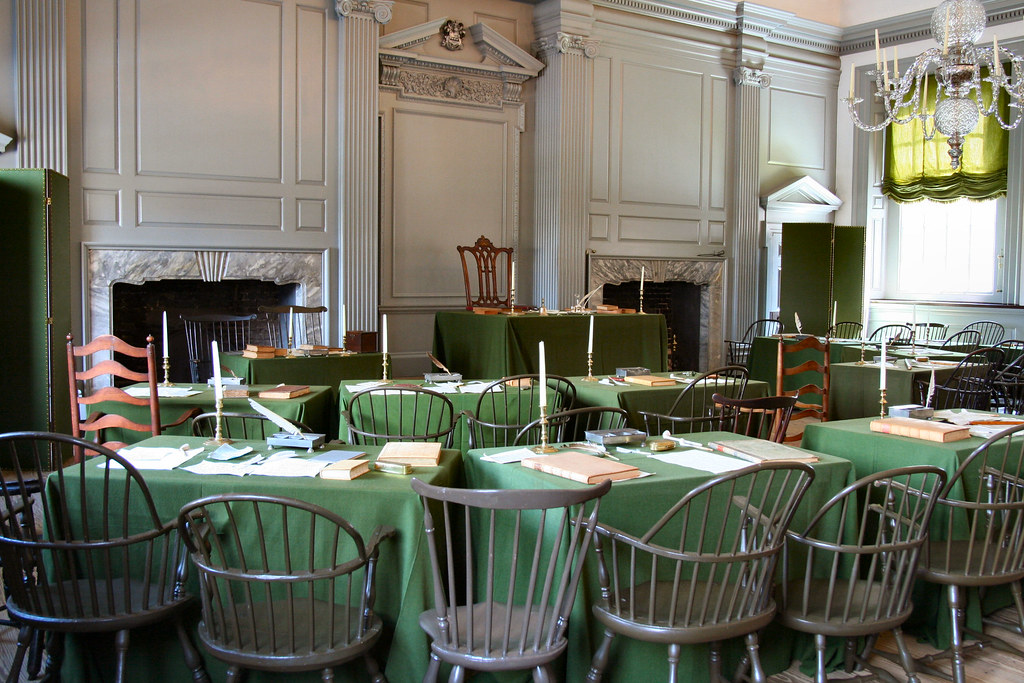
And it happened here in the Assembly Room of Independence Hall in Philadelphia, Pennsylvania.

This is why we celebrate July 4, 1776.

The Battle of Huck’s Defeat, July 12, 1780

Posted on

At Brattonsville, SC, this Saturday, July 11, will be an all-day celebration of the Battle of Huck’s Defeat.

You can find more information at http://www.chmuseums.org/battle-o.. Visit the original house, and walk where this family worked and lived.

I thought you might enjoy some of the back story of the Revolutionary War heroine, Martha Bratton, who made sure this battle happened. You can read more of her story in my biography about her called Fearless Martha.

In 1765, William, his four brothers and their families, and his sister and her family moved to Upcountry South Carolina from Rowan County, North Carolina. They purchased land grants and moved as a clan. Settling side-by-side, they soon became part of the community. They chopped down trees to build cabins and plant fields and joined the Bethesda Presbyterian Meeting House.

At the time of the Revolution, a woman’s role in society was limited. Most devoted themselves to taking care of home and family, and the men dealt with the political arena.

Still, many women became involved in events because they war came into their front yards. Some were Whigs – believers in independence for the colonies. Others were Loyalists – supporters of Britain’s king. All of the Bratton family, both men and women, were staunch Whigs.

Life wasn’t easy on the home front. With the men away at war, women had to protect their families, see to the crops, and defend family property. This was in addition to their normal every day routine that started before sun rise and ended long after dark. I believe the saying, “a woman’s work is never done” might be used to describe their daily lives. There were constant demands.

There is little known about the early life of this fearless woman, Martha Bratton. Traditions say that she was born onboard a ship crossing the Atlantic Ocean from Ireland to America about 1750. She was taught how to heal with herbs and had a gift for home health. When she and William moved to this area, known as the New Acquisition in the 18th century, there were no doctors. Because of her expertise, she treated and cared for her family and her neighbors.
The Bratton family brought little in the way of earthy goods with them, but they brought a strong allegiance to God and family, as well as a fierce love of liberty. Their Scots-Irish heritage was a clannish one, and their loyalty to each other was real.

Most of the factual information we know about Martha is during the summer of 1780. Charlestown fell to the British in May, and British and Tory soldiers were ordered to quell any rebellion.

Martha’s husband William and his militia were away for much of that summer at General Thomas Sumter’s camp, so Martha was in charge of their children, their home, and their land. Elizabeth, young William, young Martha, Jane, and Elsie were their children.

Two specific stories are told about how Martha stood up to the enemies of her new country. Both were in the summer of 1780.

A British soldier, Captain Christian Huck, was constantly attacking homes, meeting houses, and people in the New Acquisition. He had a hatred for the Scotch-Irish and made it clear with his words and the violence of his attacks.

In June, Huck had burned Reverend John Simpson’s home and killed a young neighbor. William Hill’s Iron Works was the headquarters of the Whig militia, and Huck burned it and the Hill home. His house-to-house raids struck fear in the whole community.

Soon it was July and time to get the wheat crop in. The crop was necessary to their livelihood, and there were only three days to get the wheat in before it would go bad. Besides using the wheat for baking, the stalks were fed to the livestock.
Martha and her four oldest children, as well as some of the older men including her brother-in-law Robert, were hard at work in the Bratton fields on July 11. It was a back-breaking job. The adults, as well as Elsie and Jane, all leaned over and cut the stalks as close to the ground as they could. Young Martha and William bundled them together. They all worked hard, but kept a watchful eye out for any British troops.

Word had come to the family that Huck was on the move that day. Martha knew that William and the rest of the men of the New Acquisition militia needed to know about these new atrocities. William’s militia was with Brigadier General Thomas Sumter at a camp. She sent Watt, one of their slaves, on a mission to alert the men that their homes and families were in danger.

Captain Christian Huck, a thirty-two year old lawyer, had been given new orders that read he was to “push back the rebels as far as you deem convenient.” His goal was to do just that.

When Captain Huck, his British soldiers, and Tory militia of over a hundred men galloped up the road to her home, everyone in the field hurried to the comparative safety of the house.

Martha hung the sickle on the outside wall, and stood with her loaded musket awaiting the intruders. Her children were with her, along with her brother-in-law. The wait was not long; within minutes enemy soldiers were standing beside her.
“Where is your husband?” was the quick question.

Martha’s reply was just as speedy, “I do not know the exact whereabouts of my husband.”

As she finished speaking, an unknown Tory soldier grabbed the sickle and Martha. He put the sharp sickle to her throat and asked again about William. Once more, Martha refused to give any information. The angry man tightened his grip, but Lieutenant John Adamson, another Tory, knocked the sickle away with his sword. Within seconds, the lieutenant used his sword to make sure the unruly soldier was off the porch and on the ground.

That afternoon Captain Huck tried his hand at finding out where William Bratton was, but he was not successful either. Martha didn’t know where the camp was, but she made it clear she wouldn’t divulge it even if she knew. Huck was nice to young William for a few minutes and allowed him to sit on his knee and play with his watch, but Huck’s anger at Martha’s uncooperativeness landed William on the floor with a bloody nose.

As a mother, Martha must have been angered by the man’s carelessness that caused injury to her son. But she knew she was not in a situation to aggravate him further. She had to protect her children, not put them in more jeopardy.
Huck demanded Martha cook a meal for him and his officers. I wonder how hard that was for her. If you have visited Brattonsville, you know how small the keeping room is. She cooked and served the enemies of her family and country at the same table where her family usually sat. It is said she considered poisoning the meal, but again that might have brought on more danger. Martha chose to protect her children by not taking this chance.

Finally Huck left. A guard was posted around the Bratton house. Doubtless, it was a long night.

Colonel Bratton did receive the news that Huck was wrecking havoc in his neighborhood and his family was in danger.
133 men under the leadership of William Bratton, John McClure, Andrew Neil, and Edward Lacy set out to protect their families and their land. There was a half moon that night of July 12, 1780, but the militia didn’t need it. They were in familiar territory, and anger drove them against the enemy.

Surprise was on the Whig side. The British forces were camped around the home of John Williamson. Huck had 35 British Legion Dragoons, 20 New York Volunteers, and 60 Loyalist militia. The four posted guards were shot quickly, and then the Whig militia marched in.

 Huck ran outside and was clearly seen in his white shirt. He mounted his horse and raised his sword to rally the troops. Seeing he was surrounded, he and several of his dragoons tried to escape. Huck was killed by a single rifle shot by John Carroll.

Within five minutes, the battle was over.

John Adamson was wounded.

Adamson feared for his life and asked someone to get Martha. He knew she would tell about how he saved her life. When she recognized John Adamson, she did not hesitate on telling her husband and the other soldiers about his actions on her front porch. She insisted that the wounded be taken to her home.

Besides nursing Captain Adamson back to health, Martha also nursed the wounded from both sides. She turned her home into a hospital. Martha demonstrated mercy to her enemies and the enemies of her country.

The winning of this battle encouraged the Whigs and gave hope to the Brattons and their neighbors that the enemy could be defeated. More volunteers joined the Whig cause, and these part time soldiers continued to taste victory. The defeat of the dreaded British Legion gave new heart to the Upcountry.

This battle could be called a turning point in South Carolina. During the rest of 1780 and early 1781, more than 35 more battles were fought in South Carolina. And the best part of that news is that 30 of them were Whig victories.

Besides her part in the Whig victory of the Battle of Huck’s Defeat, it is told that Martha stood up to another group of Tories the next month in August.

Before Charlestown fell to the British, Governor John Rutledge had sent around kegs of gunpowder to different citizens to hide until it was needed. The Brattons had a keg hidden on their farm.

Tory soldiers came to find the gunpowder to use for themselves, but Martha was warned ahead of time about their mission. She raced to the tree where it was hidden and blew it up just as the enemy arrived.

Of course, she was caught. There was nowhere to hide. Struggle against the arms that held her was as futile as escape. Angry voices asked her who had blown up the powder. The soldiers looked for a man, and they demanded the whereabouts of the traitor from Martha.

Martha boldly told them she was responsible with the words, “It was I who did it!” Though outnumbered once again by the enemy, she bravely announced her actions.

Martha was willing to pay the ultimate price for independence and freedom, but this was not required of her. Though she was threatened, Martha was fearless and never wavered in being a firm supporter of freedom. It is said that she encouraged her family and neighbors to stand tall.

William and Martha Bratton’s children obviously were proud of their parents.

On July 12, 1839, there was a celebration of Huck’s Defeat at Brattonsville. Dr. John Bratton, William and Martha’s youngest son, believed that the Whig victory should be celebrated. Many words of remembrance were spoken and toasts of spring water were offered to the Whig soldiers that were involved in this battle. I believe the toast made to Mrs. Martha Bratton on that day is worth noting.

“To the memory of Mrs. Martha Bratton – In the hands of an infuriated monster, with the instrument of death around her neck, she nobly refused to betray her husband; in the hour of victory, she remembered mercy, and as a guardian angel interposed in the behalf of her inhuman enemies. Throughout the American Revolution, she encouraged the Whigs to fight on to the last; to hope on to the end. Honor and gratitude to the woman and heroine, who proved herself so faithful a wife, so firm a friend to liberty.”

The Bratton children also had inscribed on William and Martha’s stone, “This Marble is erected by the children of the deceased in mournful testimony of their affection and respect for their dear parents Col. William Bratton and Martha Bratton.”

Along with her children, I believe we owe Martha Bratton “respect” as we remember her valiant fight to give us the freedom and liberty we enjoy today. I salute her fearless courage and encourage you to do the same.

As Abigail Adams wrote in a letter to her husband, John Adams, “Remember the women.”

Design a site like this with WordPress.com
Get started