Tag Archives: Thanksgiving

The Pilgrims, the Settlers, the Survivors

 In a few weeks, we will celebrate Thanksgiving, a national and family holiday in our country. We will gather together for fun, food, and fellowship. But will we be thankful for what we have? Will we count our blessings? Name them one-by-one? Will we serve others? Will we remember the sacrifices of those who settled our country?

“As we express our gratitude, we must never forget that the highest appreciation is not to utter words, but to live by them.”– John Fitzgerald Kennedy

Knowing nothing about the reality of the Pilgrims’ journey to America or those first years of deprivation and death, it was a fun holiday to celebrate during my younger years. At school, we would make Pilgrim and Indian hats and headpieces, eat vegetable soup and cornbread, and sing loudly, “Come Ye Thankful People Come.”

Growing up in twentieth century South Carolina, I could never have imagined this model of the insides of their ship.

The bravery of this group who was willing to give up all they knew for an unknown destination. It was their desire to worship God as they felt led that pushed them on the Mayflower.

The above painting shows this group of settlers boarding their ship. On September 16, 1620, the Mayflower, no larger than a volleyball court today, sailed from Plymouth, England, bound for the Americas with 102 passengers. Headed for Virginia, storms and navigational errors pushed the Mayflower off course. And it was on November 21, they reached Massachusetts. This was the first permanent European settlement in New England.

The Embarkation of the Pilgrims (1857) by American painter Robert Walter Weir.

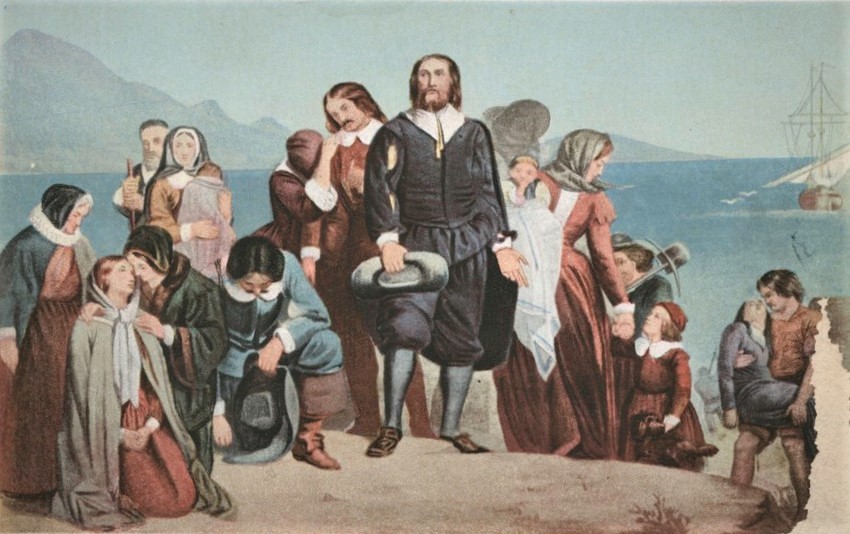
The painting below is a rendering of their arrival at Plymouth Rock. The faces are quite solemn and serious, as they look toward a forest and a wilderness.
The colonists began building their town. While houses were being built, the group continued to live on the ship. Many of the colonists fell ill. They were probably suffering from scurvy and pneumonia caused by a lack of shelter in the cold, wet weather. Although the Pilgrims were not starving, their sea-diet was very high in salt, which weakened their bodies on the long journey and during that first winter.

As many as two or three people died each day during their first two months on land. Only 52 people survived the first year in Plymouth. More than half of the heads of households died. Five of the eighteen wives lived through the scourges of pneumonia, tuberculosis, and scurvy.

“…Aboute no one, it began to raine…at night. It did freee &snow …still the cold weather continued…very wet and rainy, with the greatest gusts of wind ever we saw…frost and foule weather hindered us much; this time of the yeare seldom could we worke half the week.”

On March 24, a journal entry sums their situation up: “Dies Elizabeth, the wife of Mr. Edward Winslow. N.B. This month thirteen of our number die. And in three mons past dies halfe our company…Of a hundred persons, scarce fifty remain, the living scarce able to bury the dead.”

What a courageous group of men, women, and children; there are no words to laud their fortitude. During the third week of March, the weakened survivors from the Mayflower rowed ashore to their new homes in New Plimouth in those huts that needed rebuilding.

The earliest houses in Plymouth had thatched roofs, but because they were more likely to catch on fire, the colony eventually passed a law that required new homes be built with plank instead. Most houses had dirt floors, not wooden floors, and each had a prominent fire and chimney area, since this was the only source of heat as well as the only way to cook. Each house would have had its own garden, where vegetables and herbs could be grown. Each family was also assigned a field plot just outside of town, where they could grow corn, beans, peas, wheat, and other crops that required more space to grow, as well as to raise larger livestock.

Still, God’s grace was sufficient. English-speaking Indians named Samoset and Squanto helped the Pilgrims learn how to farm the land and harvest the bay. Squanto lived with the Pilgrims until 1622 when he died. His last request was that Gov. William Bradford would pray that he might go to the Englishman’s God in heaven. Bradford wrote: “Squanto continued with them and was their interpreter, and was a special instrument sent of God for their good beyond their expectation. He directed them how to set their corn, where to take fish and to procure other commodities and was also their pilot to bring them to unknown places for their profit, and never left them till he dyed.”

By 1621, passenger Edward Winslow wrote a letter in which he said “we have built seven dwelling-houses, and four for the use of the plantation.” In 1622, the Pilgrims built a fence around the colony for their better defense–the perimeter was nearly half a mile, and the fence was about 8 to 9 feet high.

They could have given up and returned to England. They could have thrown up their hands in despair. But their faith was in God, and they chose to not let the hardships make them bitter. Their trust laid the enduring foundations of our country America, and they were thankful.\A pilgrim is a person who goes on a long journey often with a religious or moral purpose, and especially to a foreign land.

After the Mayflower arrived, the first baby born was a boy. His parents (William and Susannah White) named him Peregrine – a word which means traveling from far away and also means pilgrim. Governor William Bradford wrote, “They knew they were pilgrims, and looked not much on those things, but lifted up their eyes to the heavens, their dearest country; and quieted their spirits.”

This beautiful cradle is believed to have been brought on the Mayflower by William and Susanna White, for the use of Peregrine White, who was born onboard the ship in November 1620 while it was anchored off the tip of Cape Cod.  It is on display at the Pilgrim Hall Museum in Plymouth.

These few fought, fell, and rose to fight again against wild animals, extreme weather, poor housing, and a starvation diet. Then they intentionally celebrated a day of thanksgiving after a time of such hardship. Long-time chronicler and governor William Bradford described this celebration in 1621 with these words.

They began now to gather in the small harvest they had, and to fit up their houses and dwellings against winter, being all well recovered in health and strength and had all things in good plenty. For as some were thus employed in affairs abroad, others were exercising in fishing, about cod and bass and other fish, of which they took good store, of which every family had their portion. All the summer there was no want; and now began to come in store of fowl, as winter approached, of which this place did abound when they came first (but afterward decreased by degrees). And besides waterfowl there was great store of wild turkeys, of which they took many, besides venison, etc. Besides they had about a peck of meal a week to a person, or now since harvest, Indian corn to that proportion. Which made many afterwards write so largely of their plenty here to their friends in England, which were not feigned but true reports.

“It is therefore recommended . . . for solemn thanksgiving and praise, that with one heart and one voice the good people may express the grateful feelings of their hearts and consecrate themselves to the service of their divine benefactor . . . .”– November 1, 1777 (adopted by the 13 states as the first official Thanksgiving Proclamation) – Samuel Adams


For more information about our forefathers, look at MayflowerHistory.com.

Thanksgiving Ramblings

“One day a very wealthy father took his son on a trip to the country for the sole purpose of showing his son how it was to be poor. They spent a few days and nights on the farm of what would be considered a very poor family.”

Kaufman County's 'poor farm' being restored and turned into historical park

  “After their return from the trip, the father asked his son how he liked the trip.

‘It was great, Dad,’ the son replied.

‘Did you see how poor people can be?’ the father asked.

‘Oh Yeah,’ said the son.”

  “’So what did you learn from the trip?’ asked the father.

The son answered, ‘I saw that we have one dog, and they had four. We have a pool that reaches to the middle of our garden, and they have a creek that has no end.’”

“‘We have imported lanterns in our garden, and they have the stars at night. Our patio reaches to the front yard, and they have the whole horizon. We have a small piece of land to live on, and they have fields that go beyond our sight. We have servants who serve us, but they serve others.’”

“‘We buy our food, but they grow theirs. We have walls around our property to protect us; they have friends to protect them.’

The boy’s father was speechless.

Then his son added, ‘It showed me just how poor we really are.’”

This story puts what we own and what others own in perspective, doesn’t it?

Next week, we will celebrate Thanksgiving, a national and family holiday in our country. We will gather together for fun, food, and fellowship. But will we be thankful for what we have? Will we count our blessings? Name them one-by-one, as the hymn says.

“All across America, we gather this week with the people we love to give thanks to God for the blessings in our lives,” said President George W. Bush.

Even publications remind us to give thanks.

November 15, 1815

“Harper’s Magazine,” 1874

“Saturday Evening Post,” 1959

November, 1948

I was telling a friend today about one of my best memories of spending the night with my grandparents in a two bedroom, one bath apartment on Wentworth Street in Charleston.

Nanna would fix pallets for Critt and me on the floor of the living room. There were several quilts to sleep on and sleep under and at least two pillows each. We would laugh and talk about our day. Whether it was at the park or playing at Folly Beach, it was always fun. Listening to the street noises, we finally closed our eyes. We thought it was wonderful to sleep on the floor, and we always looked forward to it.

When we said our prayers, we always said thank you for pallets.

“On Thanksgiving Day 1793, 75-year-old Samuel Lane was thankful for:

  • The Life & health of myself and family, and also of so many of my Children, grand Children and great grandchildren; also of my other Relations and friends & Neighbors, for Health peace and plenty amongst us.
  • for my Bible and Many other good and Useful Books, Civil & Religious Privileges, for the ordinances of the gospel; and for my Minister.
  • for my Land, House and Barn and other Buildings, & that they are preserv’d from fire & other accidents.
  • for my wearing Clothes to keep me warm, my Bed & Bedding to rest upon.
  • for my Cattle, Sheep & Swine & other Creatures, for my support.
  • for my Corn, Wheat, Rye Grass and Hay; Wool, flax, Cider, apples, Pumpkins, Potatoes, Cabbages, turnips, Carrots, Beets peaches and other fruits.
  • For my Clock and Watch to measure my passing time by Day and by Night,Wood, Water, Butter, Cheese, Milk, Pork, Beef, & fish, &c
  • for Tea, Sugar, Rum, Wine, Gin, Molasses, pepper, Spice & Money for to bye other Necessaries and to pay my Debts & Taxes &c.
  • for my Leather, Lamp oil & Candles, Husbandry Utensils, & other tools of every sort &c &c &c.”

We have so much to be thankful for this Thanksgiving, don’t we?

“Thanksgiving Day is a good day to recommit our energies to giving thanks and just giving.” —Amy Grant. 

Happy Thanksgiving, 2021!

“Come, Ye Thankful People, Come”

Come, ye thankful people, come,
Raise the song of harvest home;
All is safely gathered in,
Ere the winter storms begin;
God our Maker doth provide
For our wants to be supplied;
Come to God’s own temple, come,
Raise the song of harvest home.

All the world is God’s own field,
Fruit unto His praise to yield;
Wheat and tares together sown,
Unto joy or sorrow grown;
First the blade, and then the ear,
Then the full corn shall appear:
Lord of harvest, grant that we
Wholesome grain and pure may be.

For the Lord our God shall come,
And shall take His harvest home;
From His field shall in that day
All offenses purge away;
Give His angels charge at last
In the fire the tares to cast;
But the fruitful ears to store
In His garner evermore.

Even so, Lord, quickly come,
Bring Thy final harvest home;
Gather Thou Thy people in,
Free from sorrow, free from sin,
There, forever purified,
In Thy garner to abide;
Come, with all Thine angels come,
Raise the glorious harvest home.


For some reason, the first verse of this Thanksgiving hymn has been running around in my mind all day. Perhaps because cold weather is finally here. John built our first fire of the season last night. Or maybe because Thanksgiving is around the corner. We do tend to focus on our blessings more during this season.

Norman Rockwell

I can remember learning and singing this song in third grade chorus and in church choir. At Park Hills Elementary School, we had a program to celebrate Thanksgiving, and we loudly sang this. Some of us wore Indian headbands, and the rest of us wore Pilgrim garb. Our parents smiled and applauded our efforts, even if there were a few notes off-key.

Tom Lyles, our Minister of Music, directed all the choirs in singing the Sunday before Thanksgiving. Dressed in our short choir robes, we stood on the steps of the podium in front of the adult choir. The setting and atmosphere were quite different than at school. I don’t remember any smiling or clapping from those in the pews. But the organ was a magnificent accompaniment.

Rather than a Thanksgiving feast provided by our mothers, we listened to a sermon about being thankful for God’s gifts.

George Henry Durrie

“On Thanksgiving Day we acknowledge our dependence,” wrote William Jennings Bryan.

Henry Alford, the author of Come, Ye Thankful People, Come, was born in London and came from a line of five successive generations of Anglican priests.  His mother died when he was very young, and so he was brought up by his widowed father.  He was a very bright and, at times, precocious child.  He was immersed in the classics from an early age and was educated at Trinity College, Cambridge, where he was made a fellow in 1834.

He wrote the inscription for his grave marker. Translated into English, it said, “the inn of a traveller on his way to Jerusalem.” Isn’t this a beautiful way to describe our lives on earth?

Alford was a talented artist, musician and writer.  He translated the Odyssey, edited an edition of the Greek New Testament, the works of John Donne, and published a number of his poems.

This American holiday is always about family, food, and friends.

Doris Lee

President Franklin Roosevelt prayed, “Almighty God, who hast given us this good land for our heritage; We humbly beseech Thee that we may always prove ourselves a people mindful of Thy favor and glad to do Thy will.”


“Mary Had a Little Lamb”

Posted on
(from a 1903 edition of Mother Goose)
Mary had a little lamb,
Its fleece was white as snow;
And everywhere that Mary went
The lamb was sure to go.
It followed her to school one day,
Which was against the rule;
It made the children laugh and play
To see a lamb at school.
And so the teacher turned it out,
But still it lingered near,
And waited patiently about
Till Mary did appear.
Why does the lamb love Mary so?
The eager children cry;
Why, Mary loves the lamb, you know,
The teacher did reply.
The nursery rhyme was first published by the Boston publishing firm Marsh, Capen & Lyon, as a poem by Sarah Josepha Hale on May 24, 1830, and was possibly inspired by an actual incident. The book, Poems for Our Children, was designed for families, Sabbath schools, and infant schools and written to inculcate moral truths and virtuous sentiments.
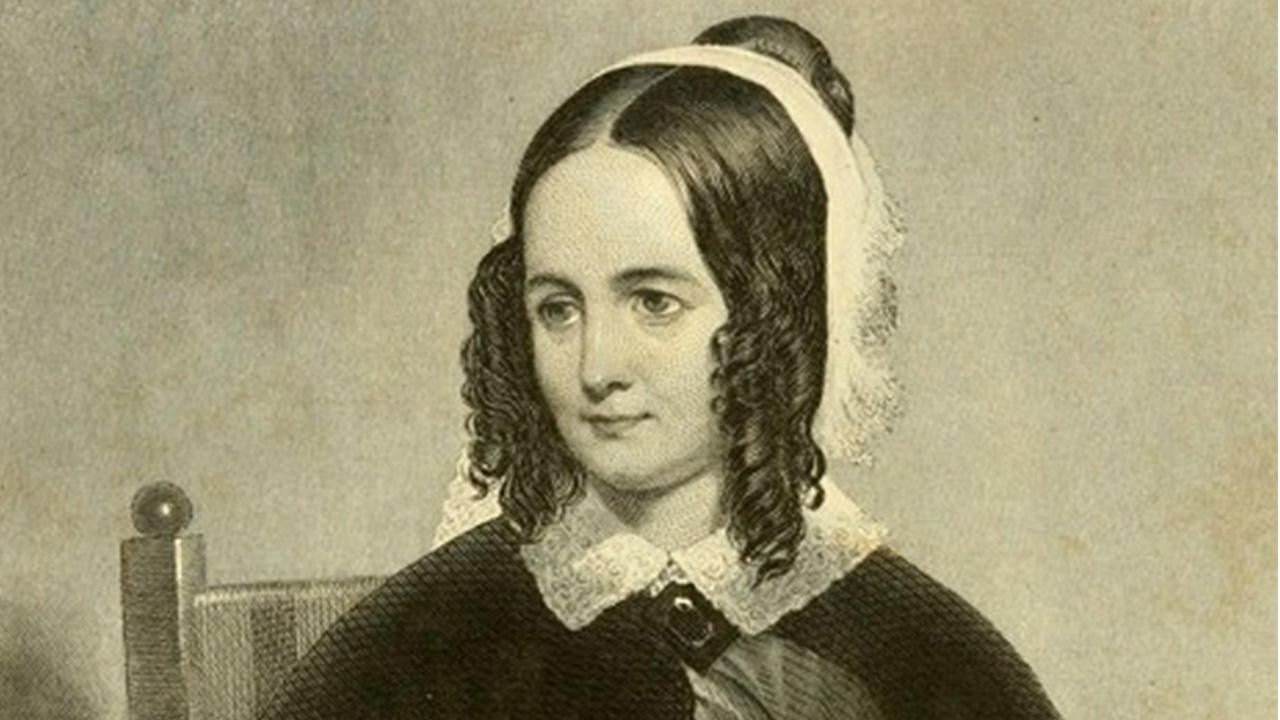
Sarah Josepha Hale
The author of this children’s poem was Sarah Josepha Buell, who was born in Newport, New Hampshire, on October 24, 1788. Home schooled from the textbooks of Dartmouth College, used by her brothers, she became a teacher at 18 in her hometown.
Image result for sarah josepha hale
Sarah married lawyer David Hale in 1813, and he encouraged her avid reading and writing. The couple had five children before David died of a stroke in 1822. As a single mother, she worked first as a milliner, a designer and maker of hats, before she started her career as a writer and editor.
Image result for sarah josepha hale
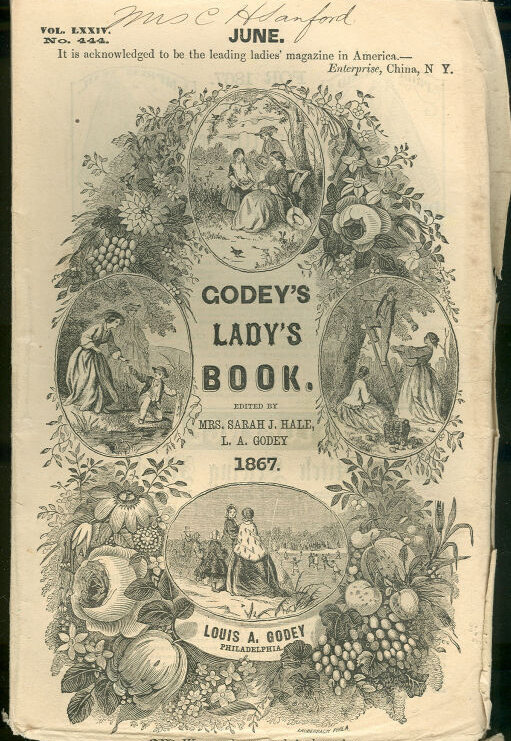
In 1828, Hale became editor of Ladies Magazine, which became the popular Godey’s Lady’s Book in 1837. She worked for this magazine for 40 years and focused on feminine etiquette of the day.
Image result for sarah josepha hale
Hale and Publisher Louis Godey steered away from politics, religion, and social issues, focusing instead on women’s domestic education from health to home to fashion—the magazine was especially noted for its colored fashion plates. See below.
This publication eventually had a circulation of 150,000. She published the work of Harriet Beecher Stowe, Edgar Allan Poe, Ralph Waldo Emerson, and Nathaniel Hawthorne. She also published unknown women authors who wrote about abolition, temperance, and suffrage.

Hale kept attuned to world news. The American public couldn’t get enough information about the increasing royal family, publications such as Godey’s Lady’s Book, always on the pulse of subjects of interest to women, presented the engraving “Queen Victoria’s Treasures” in February 1844, invoking the idea of royal jewels (see below). In the accompanying article, the Queen is observed to “be an example for the women of her own great kingdom, [and] is, therefore, highly important to the world; and we rejoice that she so beautifully exemplifies the best virtues of her sex, in her character as wife and mother.” In order to ensure that there were no questions about viewers’ gaze being directed towards her maternal characteristics the article concludes, “All the regalia in the Tower of London would not so adorn and beautify Victoria in our eyes, as the jewels of her maternal love, which she displays in this picture.”


Image result for prince of wales and queen victoria

As an editor, she focused on promotion of causes she also was passionate about: the preservation of Mount Vernon and the establishment of the Bunker Hill Monument in Boston. She advocated for property rights, increased wages for women, as well as expanded educational and career opportunities. She knew first hand what it was like to support a family on her own.
The cover of Godey's Lady's Book in 1867.
What she wanted was to create a new national holiday—the American Thanksgiving Day. In her quest to accomplish this, she sent detailed petitions to five presidents and devoted numerous column inches to the idea in her magazine. More than any other individual, Hale was responsible for the creation of Thanksgiving as we know it, a country-wide day of rest and feasting at the end of November. She campaigned for a Day of Thanksgiving, conceived as a Christian holiday, focused on prayer rather than food.
In 1860, more than a decade after she first started promoting the idea, Hale declared victory. “We may now consider Thanksgiving a National Holiday,” she wrote. So many states had celebrated it so consistently on the same day, that Thanksgiving was no longer “a partial and vacillating commemoration of gratitude to our Heavenly Father, observed in one section or State” but a “great and sanctifying promoter of the national spirit.”
Finally, she retired in 1877 at the age of 89 and then died at her Philadelphia home in 1879. This literary pioneer opened the doors for other women authors and editors, as she worked hard at her job for fifty years.
Related image
In a Vermont Public Radio commentary, the historian Cyndy Bittinger said of Sarah Josepha Hale, “With Hale as an advocate, women began to study at female seminaries and academies, and many contributed original material to her Godey’s Lady’s Book...[By publishing] the works of women [and] giving them a platform for their ideas and advocacy…Hale enabled female reformers of the 19th century to influence attitudes…[of both women and men].”
Sarah Hale said, “The burning soul, the bruden’d mind, In books alone companions find.”
This nineteenth century, American woman is one to be remembered. Her story is one of unending influence, as she maximized her intelligence and creativity.

November 4, 2016

Knowing nothing about the reality of the Pilgrims’ journey to America or those first years of deprivation and death, it was a fun holiday to celebrate during my younger years. At school, we would make Pilgrim and Indian hats and headpieces, eat vegetable soup and cornbread, and sing loudly, “Come Ye Thankful People Come.”

Image result for thanksgiving paintings

The faces and body language in this painting show us a more authentic view of the Plymouth Rock that the Mayflower brought the Pilgrims to.

Leaving England nine weeks late, New England’s harsh weather fiercely threatened their survival. In December, the men built crude shelters for the winter; the women and children stayed on the ship. There is a melancholy tone in the journal entries for that winter:

“…Aboute no one, it began to raine…at night. It did freee &snow …still the cold weather continued…very wet and rainy, with the greatest gusts of wind ever we saw…frost and foule weather hindered us much; this time of the yeare seldom could we worke half the week.”

During that winter, more than half of the heads of households died. Five of the eighteen wives lived through the scourges of pneumonia, tuberculosis, and scurvy.

On March 24, a journal entry sums their situation up:

“Dies Elizabeth, the wife of Mr. Edward Winslow. N.B. This month thirteen of our number die. And in three mons past dies halfe our company…Of a hundred persons, scarce fifty remain, the living scarce able to bury the dead.”

What a courageous group of men, women, and children; there are no words to laud their fortitude. During the third week of March, the weakened survivors from the Mayflower rowed ashore to their new homes in New Plimouth in those huts that needed rebuilding.

They could have given up and returned to England. They could have thrown up their hands in despair. But their faith was in God, and they chose to not let the hardships make them bitter. Their trust laid the enduring foundations of our country America, and they were thankful.

Image result for pilgrim paintings

If these few could fight, fall, and rise to fight again against wild animals, extreme weather, poor housing, and a starvation diet, I believe we should certainly sing this November, 2016.

Happy Thanksgiving!

“Come, Ye Thankful People, Come”

“Come, ye thankful people, come,
raise the song of harvest home;
all is safely gathered in,
ere the winter storms begin.
God our Maker doth provide
for our wants to be supplied;
come to God’s own temple, come,
raise the song of harvest home.

2. All the world is God’s own field,
fruit as praise to God we yield;
wheat and tares together sown
are to joy or sorrow grown;
first the blade and then the ear,
then the full corn shall appear;
Lord of harvest, grant that we
wholesome grain and pure may be.

3. For the Lord our God shall come,
and shall take the harvest home;
from the field shall in that day
all offenses purge away,
giving angels charge at last
in the fire the tares to cast;
but the fruitful ears to store
in the garner evermore.

4. Even so, Lord, quickly come,
bring thy final harvest home;
gather thou thy people in,
free from sorrow, free from sin,
there, forever purified,
in thy presence to abide;
come, with all thine angels, come,
raise the glorious harvest home.”

If you aren’t familiar with this old hymn, here is the Mormon Tabernacle Choir singing it. http://www.youtube.com/watch?v=msOzJ6DY7EA – 290k

When I was growing up, this was a song we sang at Thanksgiving programs at school and at church. Dressed as Pilgrims and Indians, we sang at the top of our lungs. (The grocery stores with their brown bags provided our costumes. Perhaps you remember cutting holes out for our heads and arms.) We built log cabins out of popsicle sticks and took canned food for the needy. Acting out the story of that first Thanksgiving was fun.

It wasn’t until later that I learned that this holiday was a traditional harvest feast for the Pilgrims.

Food, football, and fellowship were the key ingredients to our home celebrations. There was a standard menu that always included turkey and dressing. The table and counter groaned with the side items. We ate in the dining room, and Mother brought out her good china and silver. Family and friends joined us each year, and each shared their family’s favorite recipes. Whether watching football or playing it in the backyard, it was the afternoon’s entertainment. Some of the adults slept through those tv games. Because of the abundance of food, there was always enough for supper.

As I spent time in the grocery store today with my list for Thanksgiving dinner, I found myself buying ingredients to make and bake those same delicious foods. Family memories are not to be taken lightly; they are a part of us. I am blessed that I had parents who believed in being grateful on a regular basis and appreciate their teaching us that importance. Those magic words of “thank you” should never grow old.

Dietrich Bonhoeffer said,  “In ordinary life we hardly realize that we receive a great deal more than we give, and that it is only with gratitude that life becomes rich.”

Happy Thanksgiving to you and your family!


Design a site like this with WordPress.com
Get started