Author Archives: Sheila Ingle

“I am prepared for the worst but hope for the best.” (Benjamin Disraeli)

Where there is no vision, there is no hope. - George Washington Carver

In the shabby basement of an old house in Atlanta, Georgia, lived a young widow and her little girl. During the Civil War, she had married a young Confederate soldier, against her Yankee father’s will, and had moved with him south, to Atlanta. Her wealthy father, angry and hurt at what he considered to be her disloyalty, both to him and the North, told her never to come back.

The soldier had died bravely during the war, and his death left his wife and child without any support. Alone in Atlanta, Margaret did washing, ironing, and other menial jobs that she could find to help her scrape by and feed little Anna. Their clothes became ragged, and they were both ill from sleeping in the damp basement.

Anna loved to hear her mother’s stories about her home in the North. She sat in her mother’s lap and listened for hours to descriptions of the big, brick house in Boston, the sprawling shade trees, the beautiful flower gardens, and the wide grassy lawn. She loved to imagine the horses trotting across the meadow, the smell of bread baking in the kitchen, and the soft feel of the four-poster feather beds. Although Anna had never seen her mother’s home, she thought it must be marvelous and secretly hoped that someday they would go there to live.

Margaret often sat looking wistfully up through the narrow basement windows at the blue sky, remembering her mama’s smile, laughing with her two sisters, chasing her little brother, and sitting on her father’s lap. She missed her family and home so much. But there was nothing she could do. She could never earn enough money to pay the train fare to Boston, no matter how hard she worked. And when she remembered her father’s hurt, angry expression when she left, she knew there was little hope of ever seeing her family again.

On Christmas Eve, the landlady of the house knocked on the basement door. Anna ran to answer, and the lady handed her a letter. Margaret knew immediately that the broadly scrawled handwriting on the envelope was her father’s. With trembling fingers she pulled open the flap of the envelope. When she pulled out the single-sheet letter, two one-hundred dollar bills fell out on the floor. The letter had just three words: “Please come home.”

“God Works in a Mysterious Way”

by William Cowper:

God moves in a mysterious way
His wonders to perform;
He plants His footsteps in the sea
And rides upon the storm.

Deep in unfathomable mines
Of never failing skill
He treasures up His bright designs
And works His sov’reign will.

Ye fearful saints, fresh courage take;
The clouds ye so much dread
Are big with mercy and shall break
In blessings on your head.

Judge not the Lord by feeble sense,
But trust Him for His grace;
Behind a frowning providence
He hides a smiling face.

His purposes will ripen fast,
Unfolding every hour;
The bud may have a bitter taste,
But sweet will be the flow’r.

Blind unbelief is sure to err
And scan His work in vain;
God is His own interpreter,
And He will make it plain.”

Image result for william cowperCowper

Born in 1731, William Cowper dealt with depression most of his life, and yet he wrote over 65 hymns about his hope in the Lord to work things out. At age 33, Cowper apparently became a believer in 1764 while in residence at St. Albans Insane Asylum. He happened upon a Bible on a bench in the garden, and God used John 11 and Romans 3:25 to open his eyes to the goodness of Jesus and the sufficiency of his atoning work.

There are many scriptures about a Christian’s “blessed hope.” Psalm 3:2-6 proclaims, “Many are saying of me, ‘God will not deliver him.’ But you, LORD, are a shield around me, my glory, the One who lifts my head high. I call out to the LORD, and He answers me from His holy mountain. I lie down and sleep; I wake again, because the LORD sustains me. I will not fear though tens of thousands assail me on every side.”

As we celebrate the first week of Advent with its emphasis on hope, it is this candle in the Advent wreathe that we light first. We look forward with hope to Christmas, the celebration of the birth of Jesus.

I only hope that we don't lose sight of one thing - that it was all started by a mouse. - Walt Disney

Big Thursday in South Carolina

Related image

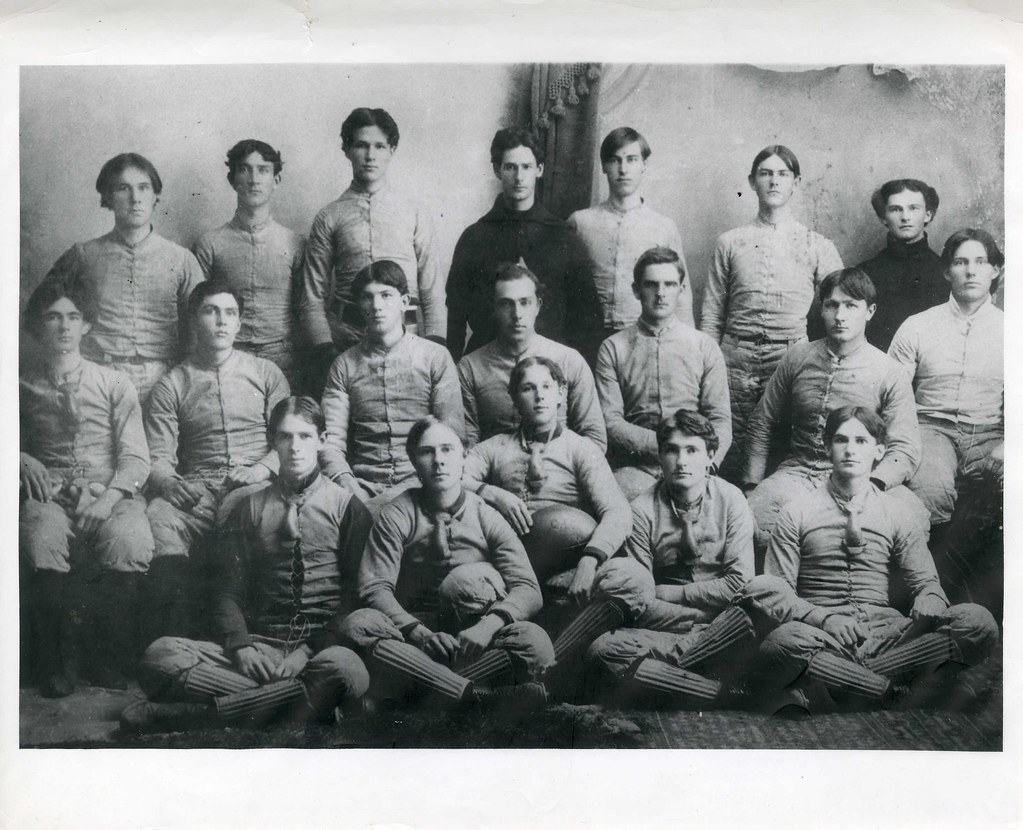
1896 Clemson football team

A typical October day in Columbia, South Carolina, with a slight wind rustling the leaves in the leaves and on the ground, but this third Thursday was different. It was Big Thursday, and football was king, even though it was a new game. Because the horse races in the afternoon were a popular event, they played early. Twenty-five cents was the cost of those tickets.

The State Fair, with all its fun, food, entertainment and contests, took second fiddle once again. Unbelievably, across the state of South Carolina, every school, business, and company have closed their doors. A vacation day was declared for the football game between USC and Clemson. At this time, South Carolina was known as the Jaguars and Clemson as Ploughboys.

Not only was Big Thursday a holiday, but it was also a fashion show. Ladies were dressed in their Sunday-best with the accouterments of hats, gloves, and jewelry, and the men sported their best suits, ties, and hats. Husbands and boyfriends bought corsages for their ladies.

“A combination of a country picnic, Old Home Week, a state fair and a Roman holiday” was how Wilton Garrison, former sports editor of The Charlotte Observer, once described Big Thursday.

The excitement was palatable; everywhere in the city were smiling faces and laughter. Children raced around their parents, as they walked to the fair grounds. Picnic baskets were packed to the brim with fried chicken, potato salad, cookies, and cakes. Tailgates were all over town, and many were using blankets as tables.

For Clemson, the week began with a Tuesday night rally on the campus. Then the following morning, the corps of cadets took a train to Columbia. Until 1955, Clemson University was an all-male college, and all-military until 1957. The military marched with rifle and bayonet from the train station to camp at the fairgrounds.

The cadets pitched tents, watched the freshman teams duel on what was called Little Wednesday, and planned for Big Thursday. If Clemson won, the cadets celebrated with a weekend leave for all. If there was a defeat, the cadets left on a midnight train that night and proceeded to Friday morning classes.

The first Big Thursday was in 1896 when Clemson Agricultural College started their football program. There was already rivalry between the two schools. The administrators of both schools saw this as an opportunity for bragging rights in a new way. For those who couldn’t attend this game, it was broadcast on the radio.

Poster depicting the annual "Big Thursday" rivalry game
Poster depicting the annual “Big Thursday” rivalry game


South Carolina College won the very first Big Thursday Game, 12-6. After that, Clemson won four straight games leading up to the Brawl of 1902. All over Columbia, there were fights that year because of a poster that Clemson took major offense to. That poster pictured their new mascot Cocky leading a Tiger by the tail. To keep the peace, the poster was burned, and the game suspended for seven years.

After 20 years as the Clemson football coach, Frank Howard tells Columbia good by.

In 1949, Time magazine wrote,

“In South Carolina, it is unpardonable for a red-blooded citizen to be neutral on Big Thursday. On that momentous day, by decree of State law and with the State Fair as a backdrop, Clemson College (enrollment 3200) fights it out on the football field with the University of South Carolina (enrollment 4000). As usual last week, schools closed down and politicians scurried back from Washington as citizens began working themselves in the mood for the 47th annual [sic] battle.”

Don Barton’s book, Big Thursday and Super Saturdays, is a wealth of stories on the history of Clemson/Carolina football.

Whether on radio, live streaming, television, or attendance at 7:30 this Saturday night, the Clemson Tigers and the Carolina Gamecocks will meet once again to see who has football bragging rights for 2016. Enjoy!


“Dulce Et Decorum Est”

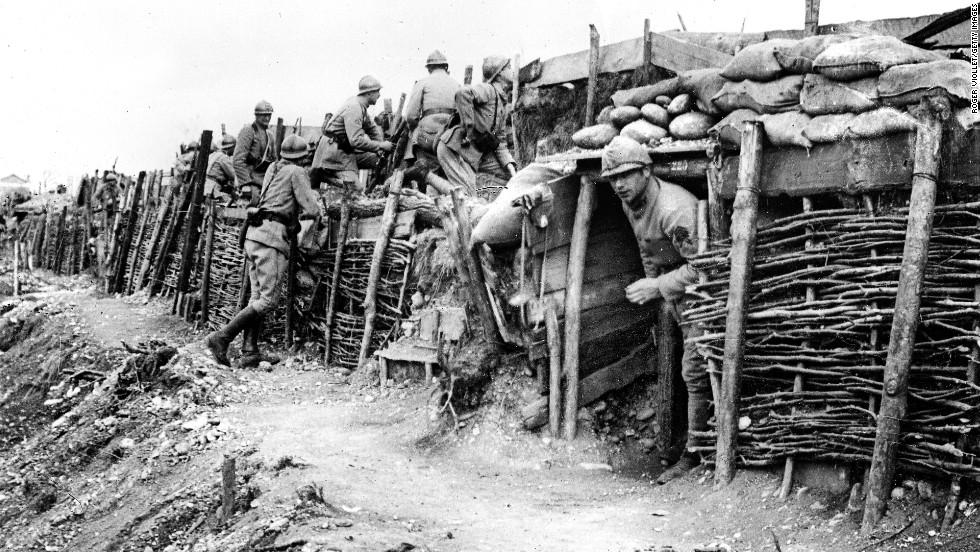
Image result for italy world war 1

Germany invaded neutral Belgium on August 4, 1914, as part of a planned attack on France. By nightfall, Britain had joined the war.

The war was not expected to last long. Instead of weeks, the continent was plunged into unknown hardship and misery of World War I for more than four years.

Roughly 10 million soldiers lost their lives in World War I, along with seven million civilians. The horror of the war and its aftermath altered the world for decades, and poets responded to the brutalities and losses in new ways.

Just months before his death in 1918, English poet Wilfred Owen famously wrote, “This book is not about heroes. English Poetry is not yet fit to speak of them. Nor is it about deeds, or lands, nor anything about glory, honour, might, majesty, dominion, or power, except War. Above all I am not concerned with Poetry. My subject is War, and the pity of War.”

Image result

At age 25, Wilfred Owen was killed in battle, fighting for his country in France on November 4. His parents received word of his death on Armistice Day, November 11, 1918. With his words, he paints the nightmares he encountered.

Knock-kneed, coughing like hags, we cursed through sludge,
Till on the haunting flares we turned our backs,
And towards our distant rest began to trudge.
Men marched asleep. Many had lost their boots,
But limped on, blood-shod. All went lame; all blind;
Drunk with fatigue; deaf even to the hoots
Of gas-shells dropping softly behind.

Gas! GAS! Quick, boys!—An ecstasy of fumbling
Fitting the clumsy helmets just in time,
But someone still was yelling out and stumbling
And flound’ring like a man in fire or lime.—
Dim through the misty panes and thick green light,
As under a green sea, I saw him drowning.

In all my dreams before my helpless sight,
He plunges at me, guttering, choking, drowning.

If in some smothering dreams, you too could pace
Behind the wagon that we flung him in,
And watch the white eyes writhing in his face,
His hanging face, like a devil’s sick of sin;
If you could hear, at every jolt, the blood
Come gargling from the froth-corrupted lungs,
Obscene as cancer, bitter as the cud
Of vile, incurable sores on innocent tongues,—
My friend, you would not tell with such high zest
To children ardent for some desperate glory,
The old Lie: Dulce et decorum est
Pro patria mori.

Notes:
Latin phrase is from the Roman poet Horace: “It is sweet and fitting to die for one’s country.”

Image result for wwi color photos


The silence screams, as this video declares Armistice Day in 1920 with the burial of Britain’s Unknown Soldier.


We must never forget the sacrifices of those who have fought for our country.

“The Class That Never Was”

My dad, Samuel Moore Collins, died seven years ago. This article was published in South Carolina’s magazine, “The Sandlapper,” before he died. What fun it was to interview him and his friends!

As we celebrate Veterans Day this week, I decided to share it again. It was an honor for these men in the Class of ’44 to fight for their nation.

Gentlemen, once again, I thank your for your service.


The 1940 plebes prematurely were carried off by a small diversion known as “World War II.” At mess one day in 1943, The Citadel Class of ’44 were ordered to stand up. They heard the words: “Gentlemen, you are shipping out.”


                                                                                The Class That Never Was

In 1940, World War II enveloped Europe. Belgium, Norway and France surrendered to the German Army. Italy, siding with Germany, declared war on Britain and France in June. Hitler’s parade into Paris was broadcast in American theaters on Fox Movie-tone News. Air battles and daylight raids between the Luftwafte and the Royal Air Force over Britain’s skies began in August. Men, women and children were dying.

That same year in America, Big Band sounds filled the air waves and dance floors. Crooner Bing Crosby and comedian Bob Hope made their first movie together. Everyone flocked to laugh at My Favorite Wife and The Philadelphia Story. (Our Office of War declared movies essential for morale and propaganda.) But in May, the country listened to President Franklin D. Roosevelt give a “Fireside Chat” on National Defense. He looked backward and forward at the situation in Europe and its future
effect on America.

World War II was winding closer to home shores.

On September 2, 1940, 565 high school graduates reported to The Citadel in Charleston for their freshmen year of college. They came from across the United States. Each entered the same wrought iron gate. Young men arrived from California, Indiana, Pennsylvania . . . but most were South Carolinians. Registration began at 9 a.m. in the armory with forms to fill out and fees to pay. Freshman expenses were $531.50 for first-year South Carolina cadets, $671.50 for out-of-state cadets. Gen. Charles Pelot Summerall, Citadel president, welcomed the class that night.

Among “the class that never was”—the anticipated Class of 1944—not one at the time could have imagined there would be no cadets in what would have been their graduating class.

That first week was packed with new experiences. Padgett-Thomas Barracks was their new home. Rooms were no larger than oversized closets of today. Each cadet had a spring cot. They kept their mattresses in a press and folded up the cots for daily inspection. The barracks were fully screened, but the screens didn’t keep out the mosquitoes and “no see-ums.” “Air-conditioning” was free. (No charges are listed for it among freshman expenses.) (There was a sink with cold and hot water in each room.)

Reveille, the bugle wake-up call, sounded at 6:45 a.m. the first week, at 6:15 the rest of the year. There would be no turning over for a few extra minutes of shut-eye. The training cadre was meticulous in introducing the new class to all facets of cadet life, and that included early rising.

Each cadet received a copy of the Guidon. This was the information guide to help a new cadet survive his rigorous first year. Cadets had to memorize the Guidon’s three most important questions and be ready, willing and able to recite them at any place, under any circumstance:

1) What is the definition of leather? “The fresh skin of an animal, cleaned and divested of all hair, fats and other extraneous matter; immersed in a dilute solution of tannic acid, a chemical combination ensues; the gelatinous tissue of the skin is converted into a nonputrescible substance, impervious to and insoluble in water; this, sir, is leather.”

2)What time is it? “Sir, I am deeply embarrassed and greatly humiliated that due to unforeseen circumstances over which I have no control, the inner workings and hidden mechanisms of my chronometer are in such in-accord with the great sidereal movement by which time is reckoned that I cannot with any degree of accuracy state the exact time, sir; but without fear of being very far off, I will state that it is [so many minutes, so many seconds and so many ticks after such an hour].”

3)What do freshmen rank? “The president’s cat, the commandant’s dog, the waiters in the mess hall, and all the colonels at Clemson.”

“Ten-hut!” (“Attention!”) was quickly understood. Cadets prayed to hear, “As you were, Mister,” while standing at “ten-hut.”

Plebes (first-year students) had daily opportunities to become more adept at push-ups and pull-ups. “The Citadel takes boys and makes them men,” observes Bob Adden, a Class of ’44 member from Orangeburg. Lee Chandler of Greenville, retired S.C. Supreme Court justice, says he rapidly came to see “the value of living a life of discipline and control.” The first six weeks were hard, but he decided “to not be a quitter, even though not of a military inclination.”

Freshmen quickly learned to stand at attention and parade rest, to answer all questions with the prefatory and ending address of “sir,” to clean and carry a rifle, to walk square corners and eat square meals, and to march double time everywhere. Answering immediately to names like “Mr. Dumbsquat” and “Mr. Doowilly” became second nature. They became skilled at not blinking at gnat and mosquito attacks on the parade field.

Study hall, 7-11 p.m., was enforced by upperclassmen. Days started at 6:15 a.m. and ended with taps, the bugle signal for lights out, at 11 p.m. A duty officer then checked the occupancy of each room. Some cadets called The Military College of South Carolina by another name: “The Sing Sing on the Ashley.”

The Citadel prided itself on its military training and environment. Self-discipline controlled every hour of the day. It “was very good for me,” says Edward Haynesworth of Sumter. His father and two older brothers were Citadel graduates before him. Sam Collins of Shelbyville, Kentucky, says his older brother Wallace, two years ahead of him at The Citadel, helped keep him from making too many mistakes. Arthur Cummings of Greenville chose The Citadel because he knew others who attended and admired their character.

All plebes cringed at the order, “Drive by my room.” This command was issued by an upperclassman to a fourth classman (freshman) for more obedience training. Constant inspections by upperclassmen on the plebes’ uniforms, actions and room status kept them vigilant.

“Walking a tour” was to be avoided at all costs. “Tours” were walked on a weekend when a cadet was supposed to be at liberty. The one-hour walk carrying a rifle at shoulder arms around the quadrangle was monitored, and this “opportunity for marching” was meted out regularly. “You finally get used
to the regulations,” Sam Piper of Greenville says.

Plebes learned to discipline their actions, thoughts and words. Their camaraderie grew daily. They respected one another for persevering. “The camaraderie fed on itself,” Chandler recalls.

The Citadel ring was the ultimate prize. Like all those before and since, the fourth classmen of 1940 craved their graduation rings. But The Citadel’s training was and is to prepare soldiers to serve their country.

“It is believed that considerably more than half our living graduates, and a like proportion of our ex-cadets, are now in the service of the United States, with more entering every day. Each of these men symbolizes The Citadel’s essential teaching — service and sacrifice.”
– Gen. Summerall

On September 16, 1940, President Roosevelt signed the Selective Service Act—the first peacetime conscription bill. All men 18 and older were eligible for the draft. Now, the Class of ’44 had greater concerns than walking a tour. Training intensified.

Some fourth classmen enlisted by the middle of their first year. Sherrill Poulnot of Charleston waited until 1942 to join the Navy. (“Three meals a day and a dry place to sleep was not so bad,” he reflects.) Only 428 of the entering 1940 class returned for their sophomore year. Japan’s attack on Pearl Harbor on December 7, 1941, prompted still more war volunteers from the class.

The Army Specialized Training Program was launched in December 1942; only a few specialized students would be allowed to stay in school. Changes were made in The Citadel’s calendar, faculty were informed of their new military status, and training in the rules and practices of war for Uncle Sam accelerated by the day.

Daily, recent Citadel men were reported as dead, missing in action or prisoners of war. In his foreword to the December edition of the Alumni News, Gen. Summerall wrote, “It is believed that considerably more than half our living graduates, and a like proportion of our ex-cadets, are now in the service of the United States, with more entering every day. Each of these men symbolizes The Citadel’s essential teaching—service and sacrifice.”

“The Enlisted Reserve Corps [ERC] told us we would get to graduate, just not when,” says class member Bob Adden.

At the end of their junior year, the Class of ’43 recommended to Summerall that the Class of ’44 receive their class rings early. The general approved. What was so important about The Citadel ring? “Everything!” says Sam Collins, the Kentucky classmate. “I wear the ring.”

On May 2, 1943, the Class of ’44 marched to the Charleston station and boarded a train. They traveled to Ft. Jackson in Columbia to be inducted into the armed services. After processing, the train returned them to The Citadel. The United States had called the Class of ’44 to their duty—a duty for which The Citadel had trained them.

The cadets finished their junior year and received a two-week furlough, then were ordered to 13 weeks of basic training. Officers Candidate Schools were the next stop. Then they were commissioned.

For many, active duty ended in January 1946. Thirty-four soldiers from the Class of ’44 gave their lives to protect their country. Six were prisoners of war; four were imprisoned at the same time at a camp in Schubin, Poland. Countless received Purple Hearts, Silver Stars and Bronze Stars. They joined other Citadel men as guardians of freedom.

Some continued active service after the war was over. Some finished their education at other colleges and universities. Others returned to The Citadel to complete their senior year for graduation as veteran students; 152 from the Class of ’44 received diplomas from The Citadel in 1946 and 1947.

On Page 9 of the 1940 Guidon are Johann Wolfgang von Goethe’s words: “The destiny of any nation depends on what its young men under twenty-five are thinking.” The “Class of ’44” were men of character, dependability and self-reliance.

In 1954, the class gathered for their first reunion at The Citadel, and they have met every five years since then. In 1994, they finally received their 1944 yearbooks. Many class members wrote synopses of their memories of The Citadel and the war years. The annual includes pictures from earlier annuals and statistics about the class.

In May 2008, 17 members of the Class of ’44 attended the 2008 Citadel graduation exercises. The Class of ’44 was recognized with speeches and given a standing ovation. Lee Chandler spoke for the Class: “The ‘Class That Never Was’ has become the class that always will be.”

The class celebrated its 65th reunion at The Citadel’s homecoming November 7, 2009.

Author’s Note:

As the daughter of Sam Collins, I grew up attending many Citadel parades on homecoming reunion weekends. I watched the “Class of ’44” gather to stand in review. The corps marched past; cadets and graduates held their backs straight and tall. I remember the excitement of those alumni at seeing one another again, shaking hands and pounding backs. They huddled in tight groups, not wanting to miss one another’s words. Their grins of greeting were contagious.

After interviewing many of them for this article, I understand more about their closeness. They were all called to active duty at the same time and were trained by example. Retired Rev. Edward Haynesworth observed that Gen. Summerall “didn’t ask them to do anything that he didn’t do.”

All the cadets were required to attend chapel services on Sunday; the general attended, also. The general often wore a cape, and his exemplary military bearing made an impression. The corps would stand in front of his home to sing “Happy Birthday” to him before breakfast. Dressed in his uniform with all his medals, he greeted the cadets with, “Gentlemen, this is indeed a surprise!” Gen. Summerall’s example followed them overseas.

Many Citadel soldiers served in the same divisions during the war. Their training at The Citadel made them strong, and it didn’t break them.

I and my brothers, Critt Collins, Citadel Class of 1973, and Lee Collins, had the privilege of being reared by a Citadel Man, so we closely observed his character. He taught us the importance of always doing the right thing.

—Sheila Collins Ingle


First Presidential Election in United States

In 1789, the first presidential election, George Washington was unanimously elected president of the United States. With 69 electoral votes, Washington won the support of each participating elector. No other president since has come into office with a universal mandate to lead.

Image result

Between December 15, 1788 and January 10, 1789, the presidential electors were chosen in each of the states. On February 4, 1789, the Electoral College convened. Ten states cast electoral votes: Connecticut, Delaware, Georgia, Maryland, Massachusetts, New Hampshire, New Jersey, Pennsylvania, South Carolina, and Virginia. New York, however, failed to field a slate of electors. North Carolina and Rhode Island were unable to participate because they had not yet ratified the Constitution. After a quorum was finally established, the Congress counted and certified the electoral vote count on April 6.

Washington was both an obvious first choice for president and possibly the only truly viable choice. He was both a national hero and the favorite son of Virginia, the largest state at the time. Washington ascended to the presidency with practical experience, having served as the commander-in-chief of the Continental Army during the American Revolution and president of the 1787 Constitutional Convention in Philadelphia.

According to Article II of the Constitution, each elector in the Electoral College possessed two votes. The candidate who received a majority of the votes was elected president. The candidate with the second most votes in the Electoral College, whether a majority or a plurality, was elected vice president. Behind Washington, John Adams, who most recently had served as the first U.S. ambassador to Great Britain, finished with 34 electoral votes and became the first vice president of the United States. Being from Massachusetts, Adams’ election provided the administration a regional balance between the northern and southern states.

Hearing the news of his decisive election, Washington set out from Mount Vernon to take his place in presidential history. Though filled with great anxiety, Washington reported for duty “in obedience to the public summons” and explained that “the voice of my Country called.”

On April 30, 1789, at Federal Hall in New York City, the first capital of the United States, Washington took the presidential oath of office. Washington, dressed in an American-made dark brown suit with white silk stockings and silver shoe buckles, also wore a steel-hilted sword and dark red overcoat.

With a hand on the Bible, a “sacred volume” borrowed from a local Masonic lodge and subsequently known as the “George Washington Inaugural Bible,” he said, “I, George Washington, do solemnly swear that I will faithfully execute the Office of President of the United States, and will to the best of my Ability, preserve, protect and defend the Constitution of the United States.”

At that moment, the Chancellor of the State of New York, Robert Livingston, the person who administered the oath to the first chief executive, exclaimed, “Long live George Washington, President of the United States!”

The father of our nation was quiet about his Christian faith. But there can be no doubt his faith in our Lord Jesus Christ was deep and heartfelt.

Below is a prayer attributed to our first President that says much about the man he was. It was found in his personal prayer book, written in his own hand.

O eternal and everlasting God, I presume to present myself this morning before thy Divine majesty, beseeching thee to accept of my humble and hearty thanks, that it hath pleased thy great goodness to keep and preserve me the night past from all the dangers poor mortals are subject to, and has given me sweet and pleasant sleep, whereby I find my body refreshed and comforted for performing the duties of this day, in which I beseech thee to defend me from all perils of body and soul.

Direct my thoughts, words and work. Wash away my sins in the immaculate blood of the lamb, and purge my heart by thy Holy Spirit, from the dross of my natural corruption, that I may with more freedom of mind and liberty of will serve thee, the everlasting God, in righteousness and holiness this day, and all the days of my life.

Increase my faith in the sweet promises of the Gospel. Give me repentance from dead works. Pardon my wanderings, and direct my thoughts unto thyself, the God of my salvation. Teach me how to live in thy fear, labor in thy service, and ever to run in the ways of thy commandments. Make me always watchful over my heart, that neither the terrors of conscience, the loathing of holy duties, the love of sin, nor an unwillingness to depart this life, may cast me into a spiritual slumber. But daily frame me more and more into the likeness of thy son Jesus Christ, that living in thy fear, and dying in thy favor, I may in thy appointed time attain the resurrection of the just unto eternal life. Bless my family, friends and kindred unite us all in praising and glorifying thee in all our works begun, continued, and ended, when we shall come to make our last account before thee blessed Saviour, who hath taught us thus to pray, our Father.

As I read about these first veterans of our country, I continue to be startled by their dedication to God, family, and country. Sir, thank you for your service.

Image result for george washington prayer at valley forge

November 4, 2016

Knowing nothing about the reality of the Pilgrims’ journey to America or those first years of deprivation and death, it was a fun holiday to celebrate during my younger years. At school, we would make Pilgrim and Indian hats and headpieces, eat vegetable soup and cornbread, and sing loudly, “Come Ye Thankful People Come.”

Image result for thanksgiving paintings

The faces and body language in this painting show us a more authentic view of the Plymouth Rock that the Mayflower brought the Pilgrims to.

Leaving England nine weeks late, New England’s harsh weather fiercely threatened their survival. In December, the men built crude shelters for the winter; the women and children stayed on the ship. There is a melancholy tone in the journal entries for that winter:

“…Aboute no one, it began to raine…at night. It did freee &snow …still the cold weather continued…very wet and rainy, with the greatest gusts of wind ever we saw…frost and foule weather hindered us much; this time of the yeare seldom could we worke half the week.”

During that winter, more than half of the heads of households died. Five of the eighteen wives lived through the scourges of pneumonia, tuberculosis, and scurvy.

On March 24, a journal entry sums their situation up:

“Dies Elizabeth, the wife of Mr. Edward Winslow. N.B. This month thirteen of our number die. And in three mons past dies halfe our company…Of a hundred persons, scarce fifty remain, the living scarce able to bury the dead.”

What a courageous group of men, women, and children; there are no words to laud their fortitude. During the third week of March, the weakened survivors from the Mayflower rowed ashore to their new homes in New Plimouth in those huts that needed rebuilding.

They could have given up and returned to England. They could have thrown up their hands in despair. But their faith was in God, and they chose to not let the hardships make them bitter. Their trust laid the enduring foundations of our country America, and they were thankful.

Image result for pilgrim paintings

If these few could fight, fall, and rise to fight again against wild animals, extreme weather, poor housing, and a starvation diet, I believe we should certainly sing this November, 2016.

Happy Thanksgiving!

Honor Flight Upstate: October 27, 2016

HFU Online Post pic


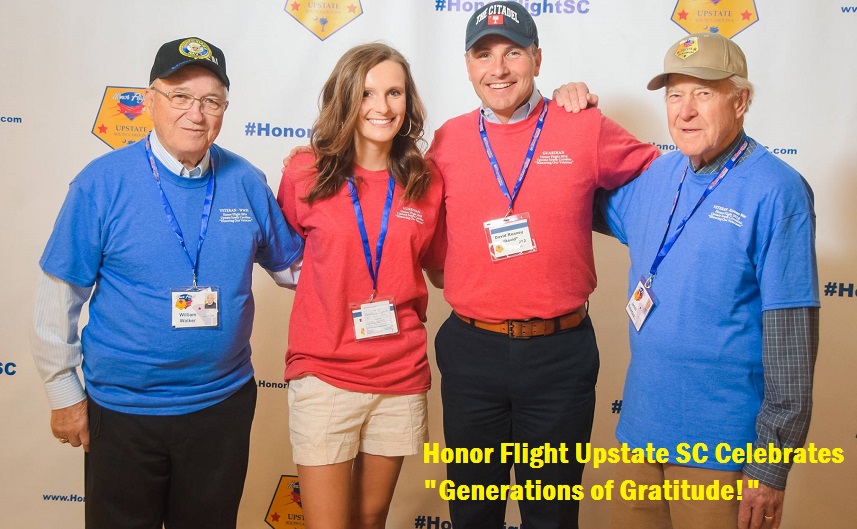
On October 27, 2016, several hundred men, women, and children greeted the Honor Flight Upstate in Greenville/Spartanburg Airport. Cub scouts, marines, police men and women stood and sat to wait for the World War II veterans to return from their trip to Washington, DC.

Image may contain: one or more people

These kids performed for our veterans as they prepared to leave Greenville-Spartanburg International Airport for their trip. #fetegreenville

Honor Flight Upstate SC is a non-profit, volunteer-based program that is dedicated to honoring some of our veterans for the sacrifices they have made to keep our nation safe and our people free.

Image may contain: 2 people

They shows their honor and support to these heroes by offering a program that flies World War II and Korean War veterans to Washington, DC, to see the memorials built in their honor, and to experience recognition for their service that literally saved the world.

Image may contain: 2 people

Volunteers are assigned to each participant; the volunteers pay and train for this privilege. If selected as a guardian for a specific Honor Flight,  duties include assisting veterans at the airport, onto and off of the plane, navigating steps at the memorials, making sure they stay safe and have everything they need in order to enjoy their trip. Guardians are responsible for paying their own way for the trip, which at this time is $400 per guardian – a small price to pay to spend an unforgettable day with members of our Greatest Generation!

 No automatic alt text available.

With veterans dying at astonishing rates each day, time is of the essence. Support is needed from those who will volunteer their time, guardians who are willing to pay their own way to travel with and assist the veterans, and donors who will help provide the funding for the veterans as these trips are completely free to our WWII and Korean War veterans. Honor Flight Upstate SC has flown over 1200 veterans to Washington, DC since May, 2008. $600 is the amount needed to pay for an individual’s trip.

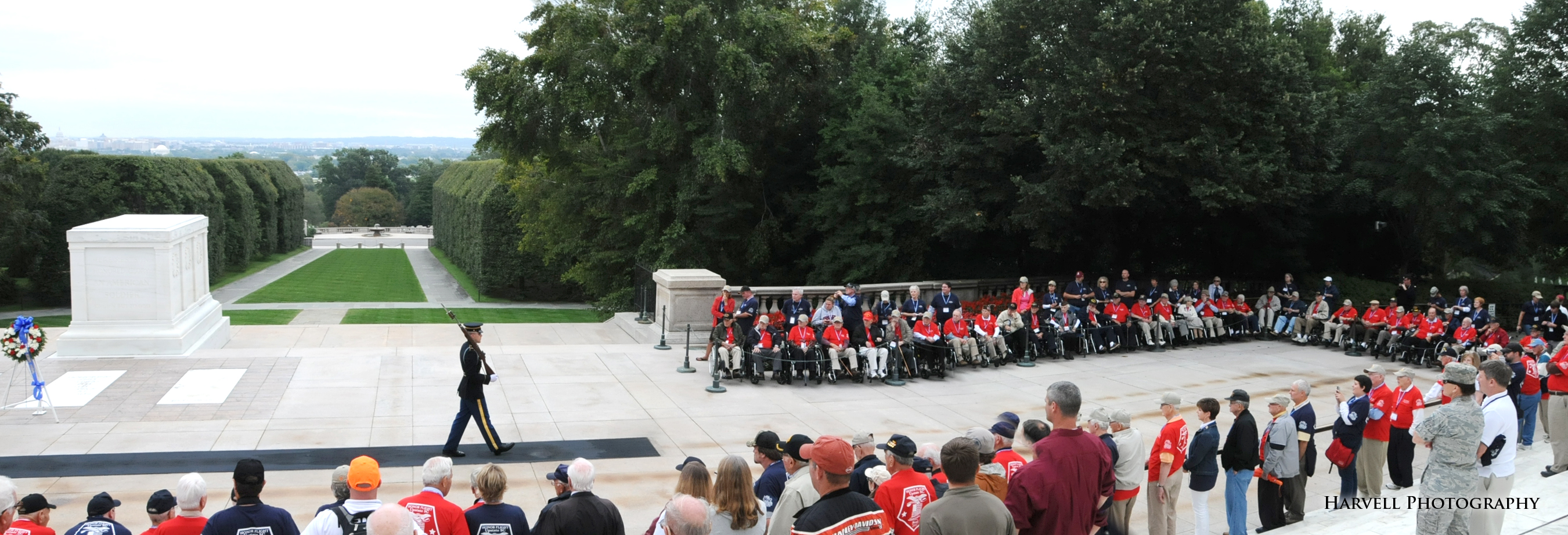
Their first stop in Washington is at the World War II monument, and next is the Korean War Memorial. Their chartered buses then travel to Arlington National Cemetery where they view the changing of the guard at the tomb of the Unknown Soldier.

HFU Pic Arlington


Following this, they go to the Marine Corps Memorial and the Air Force Memorial before they return to Reagan Airport.

These veterans were met with cheers, waving flags, balloons, handshakes, and hugs. Here us a video of a few minutes of celebration.

https://www.facebook.com/search/top/?q=cathie%20childers%20cheatham

My dad served in the Army during World War II. On this evening, we waited to see a friend of his return from this trip to Washington back to Spartanburg. Some of the Greatest Generation were in wheelchairs; others walked on their own steam. The stars of this event wore blue T shirts, and we shouted “Welcome Home” and “Thank You” to the top of our lungs. Smiles were on all the faces there.

In the crowd from the Daniel Morgan Chapter SAR were three men dressed in Colonial clothes, representing the first veterans in our country. As I watched them salute and stand at attention when the National Anthem was played, it touched my heart. Whether a descendant of a patriot who fought during the Revolutionary War or a veteran of a twentieth century war, we know that freedom is not free. Honoring those who have fought for our country must continue, because we are here because they fought.

As President Harry Truman said, “America was not built on fear. America was built on courage, on imagination and an unbeatable determination to do the job at hand.”

Thank you for your service!

The Charleston Library Society

Established December 28th, 1748 by nineteen young gentlemen of various trades and professions wishing to avail themselves of the latest publications from Great Britain, these men wished not only to keep abreast of the intellectual issues of the day but also to “save their descendants from sinking into savagery.” Ten pounds sterling bought their first order.


The initial group consisted of nine merchants, two lawyers, a schoolmaster, a physician, two planters and a peruke maker (wig-maker):
• Alexander Baron, schoolmaster from Scotland
• Morton Brailsford, merchant
• Samuel Brailsford, merchant
• Robert Brisbane, merchant
• John Cooper, merchant and distiller
• James Grindlay, lawyer
• William Logan, merchant
• Alexander McCauley, peruke (wig) maker
• Dr. Patrick McKie, physican
• Thomas Middleton, planter
• John Neufville, merchant
• Thomas Sacheverell, planter
• John Sinclair, merchant
• Charles Stevenson, merchant
• Peter Timothy, printer
• Joseph Wragg, merchant
• Samuel Wragg, merchant

First, they ordered pamphlets and magazines from London that had been printed the year before. Then they started ordering books; copies of classical books were a priority. The society was “in a large measure, a social club,” and by 1750 had about 160 members. Leaders in Charleston’s society coveted membership.

As Ralph Waldo Emerson said, “If we encounter a man of rare intellect, we should ask him what books he reads.”

This organization paved the way for the founding of the College of Charleston in 1770; a goal of the membership was to promote education. By purchasing scientific instruments and providing regional exhibits, they promoted the study of the regional natural history.

This also was the origins for the founding of the Charleston Museum (the first in America) in 1773. The collection was quite mobile. At first, elected librarians safeguarded the Library’s materials in their homes. In 1755, William Henderson was elected librarian of the Society, and collecting he moved the collections into the Free School (of which he was headmaster) on Broad Street. From 1765 until 1778, it resided in the upstairs of Gabriel Manigault’s liquor warehouse. In 1792, the collection was transferred to the upper floor of the Statehouse, currently the County Courthouse at Broad and Meeting.

Henry Wadsworth Longfellow collection in the Archives.
From 1835 until its 1914 move to the current King Street location, the Charleston Library Society occupied the Bank of South Carolina building at the corner of Church and Broad Streets. For their building fund, they sold “brick” memberships to the public.

This video takes us up the steps and inside the Library.

https://www.facebook.com/dialog/share?href=https%3A%2F%2Fvimeo.com%2F105079334%3Fref%3Dfb-share&display=popup&app_id=19884028963&redirect_uri=http%3A%2F%2Fplayer.vimeo.com%2Fshare_confirmation

Open for luncheons, author events, weddings, research, meetings, and whiling away a morning in the middle of another world, the Library is a popular venue in Charleston today. The newspaper collection dates back to 1732. The materials housed in the Library Society’s Archives and Special Collections contain more than 14,500 rare books, 5,000 rare and semi-rare pamphlets, 400 manuscript collections, and 470 maps and plats.

Aren’t we grateful that those 19 young men who believed in the importance of reading?

EVENTS AND PROGRAMS
Louis L’Amour put it this way, “For one who reads, there is no limit to the number of lives that may be lived, for fiction, biography, and history offer an inexhaustible number of lives in many parts of the world, in all periods of time.”

President Herbert Hoover and the 150th Anniversary of the Battle of Kings Mountain

Image result for Battle of King's MountainThis past Friday, October 7, 2016, about 500 men, women, and children met on the top of Kings Mountain, SC. It was a rainy day, and the celebration of the 236 Anniversary was under tents. Some were dressed in Revolutionary War attire, and others were in their Sunday clothes.

On the 150th Celebration of this pivotal battle in the Southern Campaign of the Revolutionary War, President Herbert Hoover spoke. His words plainly tell us the significance of this battle to our country.

Image result for photos of king's mountain reenactment

“My fellow countrymen:

This is a place of inspiring memories. Here less than a thousand men, inspired by the urge of freedom, defeated a superior force entrenched in this strategic position. This small band of patriots turned back a dangerous invasion well designed to separate and dismember the united Colonies. It was a little army and a little battle, but it was of mighty portent. History has done scant justice to its significance, which rightly should place it beside Lexington and Bunker Hill, Trenton and Yorktown, as one of the crucial engagements in our long struggle for independence.

The Battle of Kings Mountain stands out in our national memory not only because of the valor of the men of the Carolinas, Georgia, Tennessee, Kentucky, and Virginia, who trod here 150 years ago, and because of the brilliant leadership of Colonel [William] Campbell, but also because the devotion of those men revived the courage of the despondent Colonies and set a nation upon the road of final triumph in American independence.

No American can review the vast pageant of human progress so mightily contributed to by these men without renewed faith in humanity, new courage, and strengthened resolution.

My friends, I have lived among many peoples and have observed many governments. Each has its own institutions and its own ideals, its own spirit. Many of them I have learned to respect and to admire. It is from these contrasts and these experiences that I wish to speak today-to speak upon the institutions, the ideals, upon the spirit of America.

Image result for Battle of King's Mountain

In the time since the Battle of Kings Mountain was fought our country has marched from those struggling Colonies on the Atlantic seaboard to the full sweep of the Pacific. It has grown from fewer than 3 million people to more than 120 million. But far more inspiring than its growth of numbers has been the unfolding of a great experiment in human society. Within this land there have been build up new and powerful institutions designed of new ideas and new ideals in a new vision of human relations. Through them we have attained a wider diffusion of liberty and of happiness and of material things than humanity has ever known before. Our people live in a stronger security from enemies abroad and in greater comfort at home than has ever before been the fortune of a nation. We are filled with justifiable pride in the valor, the inventions, the contributions to art and literature, the moral influence of our people. We glow with satisfaction at the multitude of activities in the Nation, the State, the local community, which spread benefits and blessings amongst us. We may be proud of our vast economic development over these 150 years, which has secured to the common man greater returns for his effort and greater opportunity for his future than exist in any offer place on the Earth.

In the large sense we have maintained open the channels of opportunity, constantly refreshing the leadership of the Nation by men of lowly beginnings. We have no class or caste or aristocracy whose privilege limits the hopes and opportunities of our people. Science and education have been spread until they are the universal tools of the common man. They have brought to him the touch of a thousand finer things of life. They have enlarged the horizon of our vision into the inspiring works of God.

Image result for Battle of King's Mountain

This unparalleled rise of the American man and woman was not alone the result of riches in lands or forests or mines; it sprang from ideas and ideals, which liberated the mind and stimulated the exertion of a people. There were other parts of the world even more easily accessible to new invasion by man, whose natural resources were as great as those of the United States, yet their history over this 150 years presents no achievement parallel to the mighty march of the United States. But the deadening poverty of other lands was in the absence of the stirring ideas and ideals which have lightened the path of the whole American people. A score of nations have borrowed our philosophy from us, and they have tempered the course of history in yet a score of others. All have prospered under them.

These ideas and these ideals were in the hearts and inspired the souls of the men who fought the Battle of Kings Mountain. They had spurred the migration of their fathers from the persecutions and restricted opportunities of Europe, had been sustained by their religious faith, had been developed in their conflict with the wilderness, and had become the spirit of the American people, demanding for man a larger mastership of his own destiny. Our forefathers formulated them through the Declaration and the Constitution into a new and practical political and social system unique in the world. Devoted generations have secured them to us.

Image result for Battle of King's Mountain

It is never amiss for us to review these principles, that we uphold our faith in them, that we search our fidelity to them, that by stretch of our vision over the vast pageant of our accomplishment we should gain courage to meet the difficulties of the day.

Our political system was a revolt from dictatorship, whether by individuals or classes. It was rounded upon the conception that freedom was inalienable, and that liberty and freedom should rest upon law, and that law should spring from the expressed wisdom of the representatives of the majority of the people themselves. This self-government was not in itself a new human ideal, but the Constitution which provided its framework, with the checks and balances which gave it stability, was of marvelous genius. Yet of vastly more importance than even the machinery of government was the inspired charter of the rights of men which it guaranteed. Under them we hold that all men are created equal, that they are equal before the law, and that they should be safeguarded in liberty and, as we express it latterly, in equality of opportunity to every individual that he may achieve for himself and for the community the best to which his character, his ability, and his ambition entitle him.

No student of American history can fail to realize that these principles and ideals grew largely out of the religious origins and spiritual aspirations of our people. From them spring at once the demand for free and universal education, that the door of opportunity and the ladder to leadership should be free for every new generation, to every boy and girl. It is these human rights and the success of government which has maintained them that have stimulated the initiative and effort in each individual, the sum of which has been the gigantic achievement of the Nation. They are the precious heritage of America, far more important, far more valuable, than all the riches in land and mines and factories that we possess. Never had these principles and ideals been assembled elsewhere and combined into government. This is the American system.

We have lived and breathed it. We have seldom tried even to name it. Perhaps we might well abandon efforts to define it–for things of the spirit can be little defined. Some have called it liberalism, but that term has become corrupted by political use. Some have called it individualism, but it is not an individualism which permits men to override the equal opportunity of others. By its enemies it has been called capitalism, and yet under its ideals capital is but an instrument, not a master. Some have called it democracy, yet democracy exists elsewhere under social ideals which do not embrace equality of opportunity.

Ours is a system unique with America–an expression of the spirit and environment of our people–it is just American.

Parallel with us, other philosophies of society and government have continued or developed and new ones have come into the world, born of the spirit of other peoples and other environments. It is a function of freedom that we should search their claims with open mind, but it is a function of common sense that we should reject them the moment they fail in the test. From experiences in many lands I have sometimes compared some of these systems to a race. In the American system, through free and universal education, we train the runners, we strive to give to them an equal start, our Government is the umpire of its fairness. The winner is he who shows the most conscientious training, the greatest ability, the strongest character. Socialism or its violent brother, Bolshevism, would compel all the runners to end the race equally; it would hold the swiftest to the speed of the most backward. Anarchy would provide neither training nor umpire. Despotism or class government picks those who run and also those who win.

Whatever the merits or demerits of these other systems may be, they all mean the destruction of the driving force of equal opportunity, and they mean the destruction of our Constitution, for our political framework would serve none of them and many of its fundamental provisions are the negation of them. They mean the abandonment of the Nation’s spiritual heritage.

It is significant that some of these systems deny religion and seek to expel it. I cannot conceive of a wholesome social order or a sound economic system that does not have its roots in religious faith. No blind materialism can for long engage the loyalties of mankind. Economic aspiration, though it strongly marks the American system, is not an end in itself, but is only one of many instruments to accomplish the profound purposes of the American people, which are largely religious in origin. This country is supremely dedicated, not to the pursuit of material riches, but to pursuit of a richer life for the individual.

It would be foolish for me to stand here and say that our political and social system works perfectly. It does not. The human race is not perfect yet. There are disheartening occurrences every hour of the day. There are always malevolent or selfish forces at work which, unchecked, would destroy the very basis of our American life. These forces of destruction vary from generation to generation; and if we would hand on our great inheritance to our children, we must successfully contend with them.

While we cannot permit any foreign person or agency to undermine our institutions, yet we must look to our own conduct that we do not, by our own failure to uphold and safeguard the true spirit of America, weaken our own institutions and destroy the very forces which upbuild our national greatness. It is in our own house that our real dangers lie, and it is there that we have need to summon our highest wisdom and our highest sense of public service.

We must keep corruptive influences from the Nation and its ideals as we would keep them from our homes. Crime and disobedience of law are the very incarnation of destruction to a system whose basis is law. Both pacifism and militarism court danger from abroad, the one by promoting weakness, the other by promoting arrogance. Failure of many of our citizens to express their opinions at the ballot box is at once their abandonment of the whole basis of self-government. Manipulation of the ballot is a denial of government by the people. Corruption or even failure of moral perceptions in public office defiles the whole spirit of America. Mere destructive criticism destroys leadership and substitutes weaklings.

Any practice of business which would dominate the country by its own selfish interests is a destruction of equality of opportunity. Government in business, except in emergency, is also a destruction of equal opportunity and the incarnation of tyranny through bureaucracy. Tendencies of communities and States to shirk their own responsibilities or to unload them upon the Federal Government, or of the Federal Government to encroach upon the responsibilities of the States, are destructive of our whole pattern of self-government. But these evils cannot shatter our ideals or subvert our institutions if we hold the faith. The knowledge of danger is a large part of its conquest.

It is the first duty of those of us who believe in the American system to maintain a knowledge of and a pride in it, not particularly because we need fear those foreign systems, but because we have need to sustain ours in purity and in strength.

The test of our system of government and of our social principles and ideals as compared to others may in part be interpreted by the practical results of the 150 years of growth that have brought to us the richness of life which spreads through this great Nation. I can give you some measurement both of our standards and of our social progress. In proportion to our population, we have one-fourth more of our children in grade schools than the most advanced other country in Europe, and for every thousand of our young people we have six and one-half times as many in colleges and universities. And I may add that today we have more of our youth in institutions of higher learning than all the rest of the 1,500 million people of the world put together.

Compared with even the most advanced other country in Europe, we shall find an incomparably greater diffusion of material well-being. We have twice the number of homes owned among every thousand people that they have; we consume four times as much electricity and we have seven times as many automobiles; for each thousand people we have more than four times as many telephones and radio sets; our use of food and clothing is far greater; we have proportionately only one-twentieth as many people in the poorhouse or upon public charity.

There is a profound proof, moreover, that the doors of opportunity have indeed been kept open. The posts of leadership in our country, both in government and in other activities, are held by men who have risen to command. A canvass of the leading administrative officials of our Federal Government, of our industries, and of our professions, shows that 90 percent of them started life with no financial inheritance. Despite the misrepresentations of demagoguery, there are today more chances for young men to rise, and for young women too, than there were 30 years ago.

We shall not have full equality of opportunity until we have attained that ultimate goal of every right-thinking citizen–the abolition of poverty of mind and home. Happily for us we have gone further than others on this road and we make new gains every decade.

But these tangible things which we can reduce to statistics and comparisons are but a part of America. The great intangibles of the spirit of a people are immeasurable–our sense of freedom, of liberty, of security, our confidence of future progress, our traditions of past glory and sacrifice, the example of our heroes, the spiritual enrichment of our people these are the true glories of America.

The world about us is tormented with the spiritual and economic struggles that attend changing ideals and systems. Old faiths are being shaken. But we must follow our own destiny. Our institutions are a growth. They come out of our history as a people. Our ideals are a binding spiritual heritage. We cannot abandon them without chaos. We can follow them with confidence.

Our problems are the problems of growth. They are not the problems of decay. They are less difficult than those which confronted generations before us. The forces of righteousness and wisdom work as powerfully in our generation as in theirs. The flame of freedom burns as brightly in every American heart. There need be no fear for the future of a Republic that seeks inspiration from the spirit of the men who fought at the Battle of Kings Mountain.”

The President spoke at 2:30 p.m. to an estimated crowd of 30,000 assembled at the battlefield site in Kings Mountain, S.C. The National Broadcasting Company and Columbia Broadcasting System radio networks carried his message.

Before the Overmountain men left their homes to stop Major Patrick Ferguson from attacking their homes and land, as he threatened to do. Reverend Samuel Doak prayed over those frontiersmen and ended his prayer with,” Oh, God of Battle, arise in Thy might. Avenge the slaughter of Thy people. Confound those who plot for our destruction. Crown this mighty effort with victory, and smite those who exalt themselves against liberty and justice and truth. Help us as good soldiers to wield the SWORD OF THE LORD AND GIDEON. AMEN.

Image result for Battle of King's MountainMajor Patrick Ferguson

The citizen soldiers in the Patriot militia from Kentucky, Tennessee, North Carolina, South Carolina, and Georgia fought against a group of Tory militia led by Major Patrick Ferguson. It was Americans fighting Americans. In a one hour battle, the Patriots drew a line in the sand to the British army and King George.

Image result for Battle of Kings Mountain

The Patriots meant business. The sovereignty of England was not a sure thing. Civil liberty, freedom to worship, owning land were worth fighting four. These first settlers, after months of fighting proved they could defeat the strongest army in the world. This decisive victory gave new heart and pride to the Patriots; this was the first major defeat in the south.

The Overmountain men made sure their 250 mile walk was worth each step.

As Thomas Paine wrote, “These are the times that try men’s soul’s. The summer soldier and the sunshine patriot will, in this crisis, shrink from the service of his country; but he that stands it now, deserves the love and thanks of man and women.”

Yes, thank you, for your service to our country!


Festifall at Walnut Grove

“The benefits of education and of useful knowledge, generally diffused through a community, are essential to the preservation of a free government.” Sam Houston

No automatic alt text available.“T

This Revolutionary War Festival has been introducing visitors to life during these early times for 23 years. Reenactors make butter, baskets, and corn husk dolls. They craft wooden buckets and brooms, farm implements from molten iron, pottery vases, and cooking implements. It is fascinating to watch these creations from their beginnings to the finished products.

Image may contain: 1 person , outdoor

Men, women, and children camp out in tents for two nights, and they wear the clothes of the late 18th century. The militia recreate the battle for the house against a group of Tories led by Bloody Bill Cunningham.

Image may contain: one or more peopleThis gentleman was sharing the skills of surveying during the 18th Century. President George Washington was a surveyor.
No automatic alt text available.

These past two days I enjoyed meeting new friends, talking about the women during the Revolutionary War, and signing books. Two visitors shared stories with me that touched this author’s heart.

A former third grade teacher and her grandson stopped by my table, and she said she read “Courageous Kate” in her classroom every year until retirement. Then she passed the book on to her daughter for her to read to her third graders. Another family stopped by, who I have met at different historical events through the years; they home school their children. One of their daughters told me she had read “Courageous Kate” times! I bet she has it memorized by now.

Thank you, readers, for continuing to support my writing. It is so much fun to talk to you about our nation’s history and how we must continue to share the stories with the next generation, as well as each other.

October Events:

October 1-2 – Festifall at Walnut Grove

October 13 – DAR chapter at Myrtle Beach

October 15 – Patriots in Petticoats at Musgrove Mill

Design a site like this with WordPress.com
Get started