Yummy Hot Chocolate Day

Image result for pictures of hot chocolate

This sweet treat dates back almost 2,000 years to the Mayan people.

The Mayans of Central America are believed to be the first to discover cocoa as early as 900 AD. They learned that the beans inside the cocoa pods could be harvested and made into a liquid that would become a treasured Mayan treat. They traded three pods for one pumpkin.

Image result for pictures of hot chocolate

Mayan chocolate was very different than the chocolate we know today. It was a liquid made from crushed cocoa beans, chili peppers, and water. (There was no sugar in Central America.) They poured the liquid from one cup to another until a frothy foam appeared on top. In fact, the word ‘chocolate’ is said to come from the Mayan word ‘xocolatl’ which means ‘bitter water.’

Image result for pictures of hot chocolate

It may have been bitter water, but it was held in such high esteem that Mayans called it the “food of the gods.” Cocoa was so revered that images of cocoa pods were painted on the walls of stone temples and Mayan artifacts have been found that show kings and Mayan gods drinking chocolate. Cocoa was often consumed during religious ceremonies and marriage celebrations. All Mayans could enjoy cocoa, regardless of their social status.

Cocoa beans were very valuable. The Aztecs used them as money, and were very protective of their beans. They paid for food, clothes, taxes, gifts, and offerings to their gods using cocoa beans. Having a pocket full of beans was like having a wallet full of cash. As far as the Aztecs were concerned, money really did grow on trees.

Chocolate arrived in Florida on a Spanish ship in 1641. It’s thought the first American chocolate house opened in Boston in 1682. By 1773, cocoa beans were a major American colony import and chocolate was enjoyed by people of all classes. Chocolate pots became a rage.

Image result for pictures of hot chocolate pots

Unsurprisingly, Benjamin Franklin himself was in on the early American chocolate craze, and even sold chocolate out of his printing shop in Philadelphia.

During the Revolutionary War, chocolate was provided to the military as rations and sometimes given to soldiers as payment instead of money. This chocolate came from the West Indies. Because of its caffeine and high calorie content, it was a reliable source of energy for soldiers on the front. Chocolate consumption among Americans dates back to colonial times—George Washington and the Continental Army during the Revolutionary War would have consumed chocolate as a hot beverage, for example.

Chocolate cups, like this one owned by George and Martha Washington, were typical of the colonial era. Most chocolate cups had two handles, on opposing sides, while tea cups of the period had no handles at all. Image credit: George Washington’s Mount Vernon Estate, Museum, and Gardens’ 2012 annual Colonial Chocolate Society meeting presentation.Chocolate cups, like this one owned by George and Martha Washington, were typical of the colonial era. Most chocolate cups had two handles, on opposing sides, while tea cups of the period had no handles at all. Image credit: George Washington’s Mount Vernon.

Chocolate was also provided as K rations to soldiers during World War II.

K-ration; original outer green color cardboard box contains: waxed cardboard box shell with “CHESTERFIELD” cigarette pack, toilet paper packet, one stick of gum, and eight biscuits, confectionery chocolate D bar, bouillon powder packet, can of pork loaf; manufactured by the Kellogg Company; World War II era.

In fact, the U.S. War Department collaborated with chocolate manufacturers to produce Ration D bars, especially suitable for extreme temperatures sometimes encountered on the front. A mixture of chocolate, sugar, powdered milk, oat flour, and vitamins provided 600 calories per serving and made a very effective survival food.

Box for U.S. Army Field Ration D (

The Ration D chocolate bar was designed to withstand extreme temperatures and provide substantial energy for troops.

Brown, yellow, and blue wrapped “Hershey’s Tropical Chocolate” bar. Small print on the top reads, “REG. U.S. PAT. OFF”. Small print on the side of bar reads, “MANUFACTURED BY HERSHEY CHOCOLATE CORPORATION, HERSHEY, PA.” The top left corner of the wrapper is torn, revealing the inner foil wrapping. Another variant of the Ration D bar was Hershey’s Tropical Bar, used commonly in the Pacific Theater.

Studies have shown chocolate contains antioxidants that can reduce the risk of heart disease and lower blood pressure. Chocolate contains many vitamins, minerals, antioxidants and biochemical compounds—all of which help give our body a satisfying health boost. Hot chocolate even increases the microcirculation in your skin. Who knew a hot chocolate obsession could be so good for our health?

Also, it’s a mood booster. When we drink hot chocolate, its chemical compounds signal the brain to release endorphins and serotonin, which elicit our feelings of calmness. These neurotransmitters work to reduce pain and stress, keeping us worry-free and happy! Hot chocolate is clearly happiness in a cup.


So the decision for today is how many cups of chocolate are needed to celebrate National Hot Chocolate Day. Enjoy!
Image result for pictures of hot chocolate


Sitting Up With the Dead, an Appalachian Custom

Image result for appalachian mountains photo

The word Appalachia is an old Indian word, and it means “endless mountain range.” The Cherokee Indians who lived there thought the Appalachian Mountains went on forever and ever. Covering thirteen states today, gazing out the windows of a car or stopping at a look-out site give the same sense of forever to these mountains. Their beauty is breath-taking.

Image result for appalachian mountains photo


Pioneer Ulster Scots and Scots-Irish settled the mountains of Appalachia during the 18th century. Proudly, they brought their heritage with them, which included an allegiance to family, friends, and faith, the Presbyterian faith. Gravitating to the rocky terrain, so like their homeland of Scotland, they sought new lives. Independent and self-reliant to the core, they also were protective of each other. Their helping hands reached out to kith and kin.

Image result for appalachian mountains photo

Sitting up with the dead, also called a wake, is one of the ways they stuck close to each other. It showed respect for the person and his life. It might have been adopted from the Jewish tradition of sitting with a dead body until burial. Called in Hebrew shemira, which means guarding or watching.

Related image


Their lives were hard, and a home funeral brought comfort to the bereaved. These wakes could last for days, as mourners traveled from many hollers. Generally, the guests paid their respects to the dead, then went into another room for sandwiches, coffee and a long visit. Some pulled up chairs beside the handmade coffin or leaned against the walls.

The women in the family prepared the body. It was an open casket, and usually a handmade quilt covered the body, along with flowers and sweet-smelling herbs. The body was dressed in the Sunday-best clothes, which might have been clean overalls and never left alone.

In describing the Appalachian people, John Muir said “You are not in the mountains, the mountains are in you.” When my husband’s family left the mountains of Erwin, Tennessee, to take jobs in the cotton mills of South Carolina, they brought their culture with them.

Just like their Appalachian forebearers, wakes were still part of the grieving process into the twentieth century.

Oliver Edward Ingle, my husband’s father, passed away on December 6, 1968 at the Wallace Thompson Hospital in Union, South Carolina. Though embalming was the funeral home’s job then to prepare the body, the family still held a wake at his home. In the living room, John and his brothers greeted their father’s siblings, cousins, and neighbors all through the night, while their mother slept sedated, overcome with the shock. They pulled the sofa in front of the fireplace, because it was the only heat in the house, and brought in the solid oak, kitchen chairs for extra seating.

The percolator kept them plied with coffee, and the women of Allen Memorial Baptist had filled the table with food. Emotions were high, as the reality of loss crept in the door. There were times during the night that only the sons sat steadily before the fire. These stoic brothers, still in shock from their father’s sudden death that day, passed the night sharing memories, tears, stories, and laughter.

For almost twenty-four hours, Tom, John, Buck, and Jim Ingle kept a vigil in the house their father had built.

When a ship moves across the water, it leaves a wake in its path. It is a concrete sign that shows the ship’s passage, and it can be followed. Sometimes it spreads out and touches other ships or a shoreline.

Image result for the wake behind a boat


At a funeral wake, people talk about how they have been touched by a life, remember stories about the person, and even think about how different life will be without that person. Sharing these memories affirms a life and what has been left in his wake. And even though we can’t see them anymore, we won’t and can’t forget.

As Navy veterans, the Ingle sons celebrated the wake of their father’s life that night and into the days that followed.

“I thank my God in all my remembrance of you.” Philippians 1:3 ESV


One Look at Bravery

One of my choices for the new year is to read and write more. In looking at our home with a modicum of reality, we might be called “book poor.” I tend to describe it as “book rich.”

Yes, there are stacks of books in every room of our home, as well as in attic boxes. Five book shelves are packed two deep with others on layered on top. Baskets of books are in all the rooms, including the kitchen with my well-loved recipe books. (I treasure those that my grandmothers used.)

I am in total agreement with Erasmus when he said, “When I have a little money, I buy books; and if I have any left, I buy food and clothes.”

Two new books were part of my Christmas, and I am halfway through Louise Penny’s new book,  Kingdom of the Blind. And, as usual, this Canadian author had me hooked in only a few pages.

I believe I have to agree with Jane Austen in Pride and Prejudice, “I shall be miserable if I have not an excellent library.”

Many eighteenth century women lived on the fringes of written records. Their exploits of tending hearth and home were not the tales of warriors on the battlefield or politicians changing America. Few letters or diaries recount their daily lives of survival, and portraits are even more rare.

My first four books were about Revolutionary War heroines in South Carolina. I immersed myself in that period of history. The role of women, as not only homemakers but vigilant defenders of their turfs themselves, continues to amaze me.

Elizabeth Hutchinson Jackson left her home and parents for the colonies, survived early widowhood, and successfully raised three sons. Life-altering events raised havoc in her life, but she refused to be defeated.

With her two youngest sons, Robert and Andrew, confined in the filthy Camden jail by the British, Elizabeth demanded a prisoner exchange.

Read how this might have worked out in the spring of 1780….

“My Lord, I beseech your pardon for my two sons, Robert and Andy Jackson. Word has it that a prisoner exchange is being discussed, and I beg you to add their names to the list. The youngest has only turned fourteen, and Robert is sixteen. I will take responsibility for their future actions,” spoke the seemingly composed, though bedraggled, mother.

Her lilting Irish accent caught Lord Rawdon unawares. Yes, the men in his regiment from Ireland still spoke with their Irish brogue, but the soft and feminine inflections of Elizabeth’s speech obliged him to think of home and his family.

Rawdon did not immediately reply. Looking through the stack of papers on his desk, Rawdon found the list he sought. It was this morning’s registry of those prisoners afflicted with smallpox. Quickly scanning the record, he saw both Robert and Andy Jackson’s names.

A glint in his eye appeared, as he thought how to satisfy the Patriot mother and also protect his men. Allowing the exchange of these sick boys would take the dreaded disease to their home and community and also rid his prison of two with the revolting disease.

Looking up into Elizabeth’s expectant eyes, Rawdon finally answered the silent mother.

“It appears that both your sons have contracted smallpox. I believe it will be best for them to be part of our trade for prisoners. You may pick them up tomorrow.”

I can imagine her quaking heart as she walked in where angels feared to tread, but I admire her bravery and resolve to achieve her sons’ freedom that day and the way she faced all her trials and ordeals. After you have read her story, I believe you will agree.

Brave Elizabeth


“You can never get a cup of tea large enough or a book long enough to suit me.” – C.S. Lewis

Do you agree?


Wreathes Across America, 2018


1215181215.jpg

REMEMBER the Fallen. . . HONOR those who Serve. . . TEACH our children the value of Freedom.

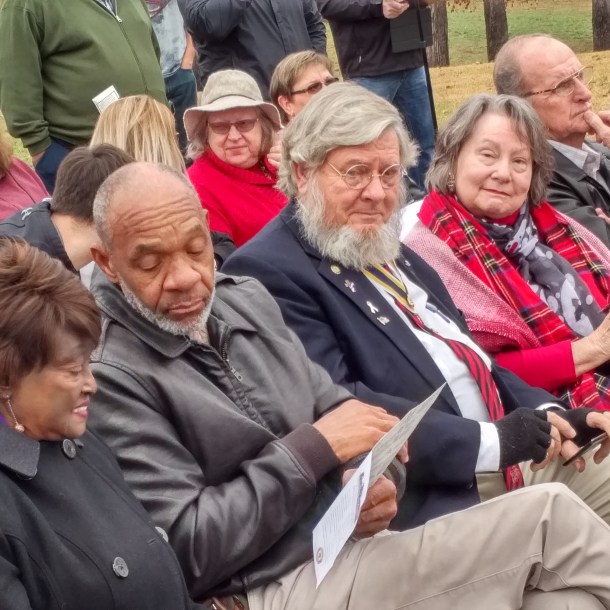
On Saturday, December 15, 2018 at 12:00 PM, Wreaths Across America was at Buck Creek Baptist Church Cemetery to Remember and Honor veterans through the laying of Remembrance wreaths on the graves of our country’s fallen heroes and the act of saying the name of each and every veteran aloud. Fifty wreaths were placed on all the veteran graves at this cemetery.

IMG_20181215_1157303.jpg

The American Legion is the nation’s largest organization of US wartime veterans. Post 48 in Chesnee, SC was chartered in 1936, and this is the third year they have sponsored a Wreaths Across America ceremony. They plan to continue this tradition.

1215181156.jpgFranklin Wall welcomed about 100 family members and friends at 12:00. He is a fourth generation veteran. His father is buried in this cemetery. In his prayer, he set the tone and intent of the service with his words, “Help us to be salt and light to the world.”

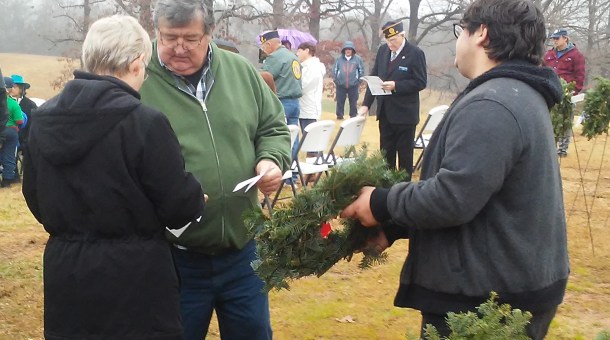
Chesnee High School JROTC posted and retired the colors. Two young women and two young men were in the color guard, and the guidon was one of the girls. Her voice carried through the audience, as she directed their movements.

1215181156a.jpg

All eyes were on the flags. Hats and caps were removed. Right hands were placed over hearts. Most stood straight and tall as the marchers moved to their places. After the group’s singing of the “Star Spangled Banner,” people formed a line to pick up a wreath.

1215181221a.jpg

Then the walk began to the appointed spot.

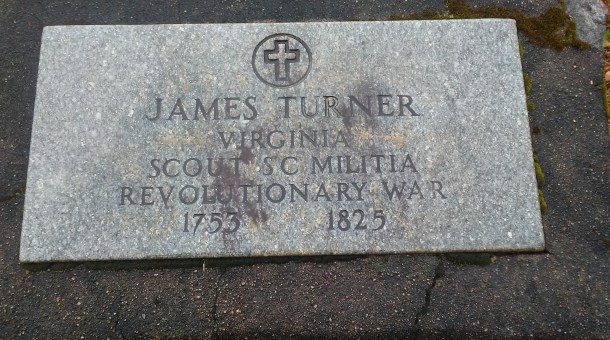
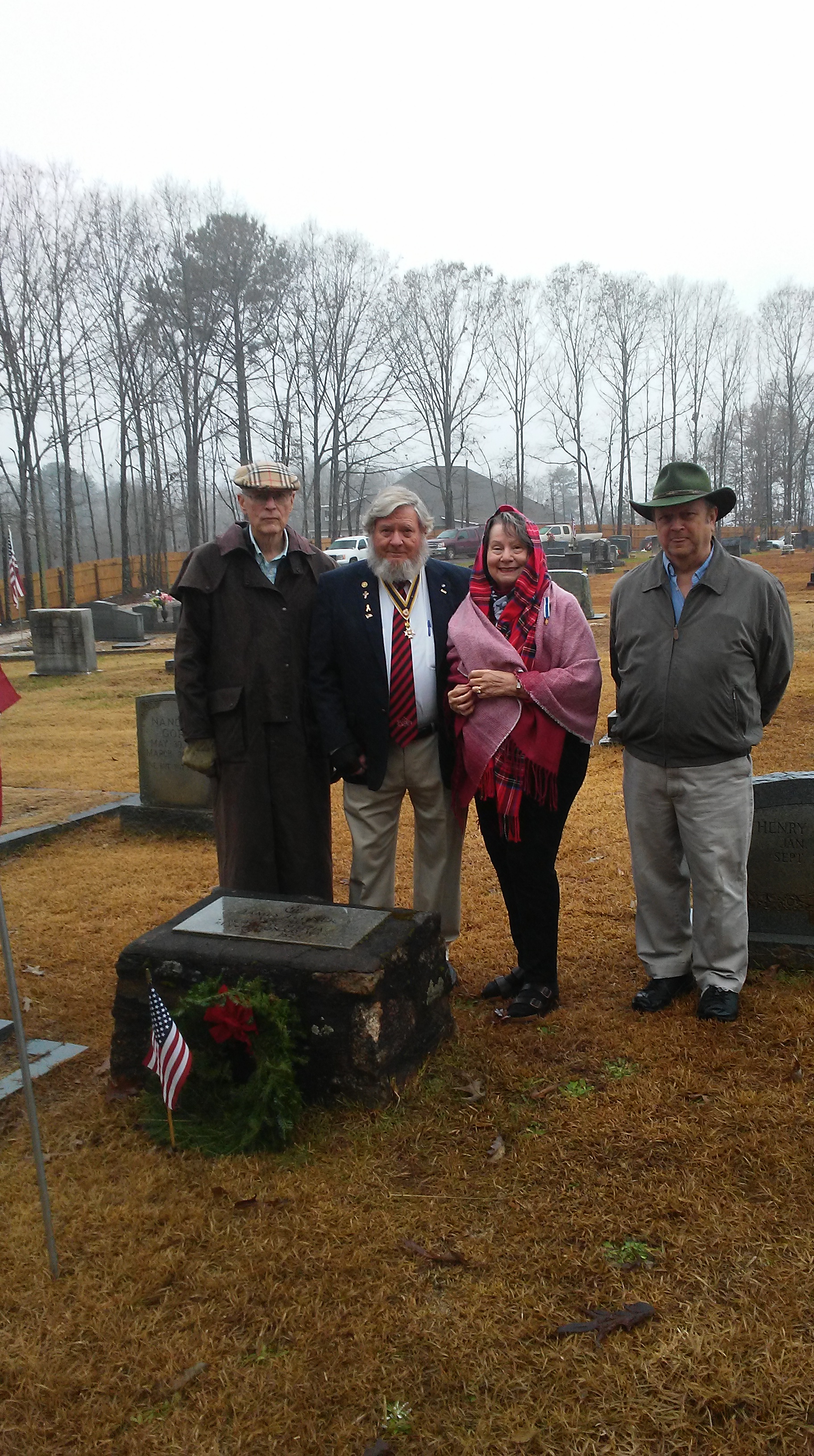
Five members of the Daniel Morgan Chapter, President John Hoyle, Clark Smith, Mike Rock, Colby Alexander, and my husband John Ingle were there to place a wreath on Revolutionary War veteran, James Turner Sr. Representing the Kate Barry Chapter in Spartanburg, I joined them.

1215181233_Burst01.jpg

Born in Virginia in 1753, James Turner served one hundred thirty-four days in the South Carolina militia during 1779, 1781 and 1782 under Capt. Turner and Col. Winn. After the fall of Charleston, he was under Col. Brandon.  Like his father, James Turner was also one of the 2500 men listed has having served with the “Swamp Fox,” General Francis Marion.

J.B.O. Landrum tells the following story of how Turner escaped death at the hands of Tories in his book, History of Spartanburg County:

“One time he was taken prisoner by a band of Tories, who were preparing to kill him at once; but as fortune would have it, one of the Tories said, ‘The first man that hurts Jimmie Turner I will kill him.’ Turner had done this Tory a kindness heretofore, and so his life was saved.”

After the war, he bought land and settled near the Pacolet River.

1215181234.jpg

Being part of this ceremony was memorable. Even though a misty rain fell during most of the time, no one left. It was an honor to be there to remember our veterans.

In 2017, with the help of thousands of corporate/civic sponsors and volunteers, over 1,5000,000 wreaths were donated and placed at over 1400 participating cemeteries. I wonder how many there were yesterday?

Let’s choose not to forget those who have fought for the freedom of our country.

“Freedom is never more than one generation away from extinction. We didn’t pass it to our children in the bloodstream. It must be fought for, protected, and handed on for them to do the same, or one day we will spend our sunset years telling our children and our children’s children what it was once like in the United States where men were free.”

President Ronald Reagan

40th president of US (1911 – 2004)

No to “Bah, Humbug”

A long time ago, I committed to memory the last stanza of Samuel Taylor Coleridge’s “The Rime of the Ancient Mariner” that reads,

He prayeth best, who loveth best
All things both great and small;
For the dear God who loveth us,
He made and loveth all.

The converted Ancient Mariner is concerned about how Christians live and challenges the readers to love our neighbors as ourselves.

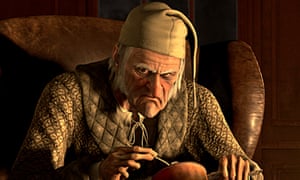
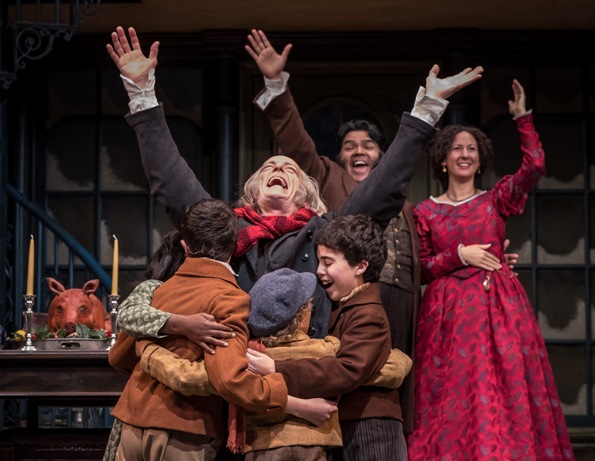
In one of my favorite Christmas books, A Christmas Carol, Charles Dickens paints the character of Scrooge as one who has lost the ability to love, but is converted on Christmas Eve. Scrooge’s covetousness takes a 180 degree shift to compassion and generosity. Jacob Marley’s Ghost is only the beginning of a one-night journey that topples Scrooge to his knees.

Image result for marley's ghost scrooge

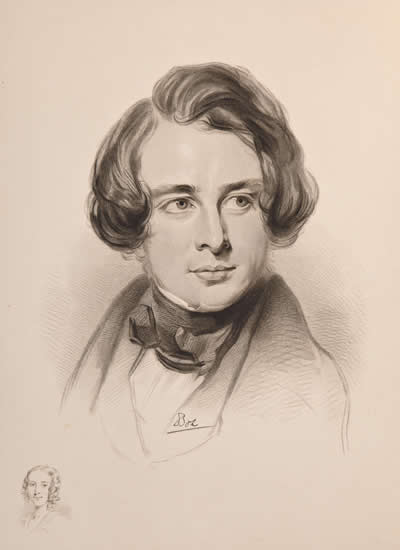
175 years ago, A Christmas Carol was written in six weeks and published in October, 1843. Once Dickens had the idea for this novella, he walked the streets of London at night figuring out the details. Dickens’ biographer, John Forster, wrote that the story gripped Dickens. “He wept over it, and laughed, and wept again, and excited himself to an extraordinary degree.”

Sketch of Charles Dickens in 1842

Charles Dickens in 1842

And what a story it is! Ebenezer Scrooge is the epitome of a selfish, money-grubbing miser. Scrooge and his dead partner Marley value money above all else.  They have no love or care for anyone, and their stories are a warning to others that might choose their paths. Dickens’ challenge is to honor the spirit of Christmas all year long.

Image result for a christmas carol pictures

The transformation is dramatic. At the onset, Scrooge says, “Every idiot who goes about with ‘Merry Christmas’ on his lips, should be boiled with his own pudding, and buried with a stake of holly through his heart.”

After his ghostly night, his words reflect a significant change. “He became as good a friend, as good a master, and as good a man, as the good old city knew, or any other good old city, town, or borough, in the good old world.”

Image result for happy scrooge pictures

To make his point clear, Dickens said,  “I have endeavoured in this Ghostly little book, to raise the Ghost of an Idea, which shall not put my readers out of humour with themselves, with each other, with the season, or with me. May it haunt their houses pleasantly, and no one wish to lay it.”

Image result for happy scrooge pictures

There are quite a few movie versions of  A Christmas Carol, and I look forward to watching them all. This parable challenges and reminds me to keep my eyes open and not turned inward. Perhaps it also speaks to you.

In agreement with Scrooge who proclaims his change of heart, “I will honour Christmas in my heart, and try to keep it all the year.”

What a privilege it has been to serve as the board chair of Children’s Cancer Partners of the Carolinas for the past two years. Our mission is to stand in the gap for families who have children diagnosed with cancer, as we help them with getting their children to treatment centers and doctor visits and other family needs to survive this dreaded diagnosis.

We are in Raleigh, North Carolina, today to host a Christmas party for many of our children. John is playing Santa again this year, as he also will next Sunday at our other party in Spartanburg. What a privilege it is to be part of an organization that works hard to make lives easier all through the year for these hurting families. As Tiny Tim said, “God bless them everyone!”

“Silent Night, Holy Night”

Image result for shepherd and sheep in Israel


And there were in the same country shepherds abiding in the field, keeping watch over their flock by night.

And, lo, the angel of the Lord came upon them, and the glory of the Lord shone round about them: and they were sore afraid.

10 And the angel said unto them, Fear not: for, behold, I bring you good tidings of great joy, which shall be to all people.

11 For unto you is born this day in the city of David a Saviour, which is Christ the Lord.

12 And this shall be a sign unto you; Ye shall find the babe wrapped in swaddling clothes, lying in a manger.

13 And suddenly there was with the angel a multitude of the heavenly host praising God, and saying,

14 Glory to God in the highest, and on earth peace, good will toward men. Luke 2: 8-14

A group of actors was going town-to-town through the Austrian Alps in 1818. They made their way to Oberndorf, a village near Salzburg. On December 23, they were to perform the story of the first Christmas at a small church called the Church of St. Nicholas.

Preview

The church organ was broken. Some say mice had invaded it; others put the malfunction to rust. But the organ could not be repaired before Christmas. So the actors presented their play in a home.

Joseph Mohr
Joseph Franz Mohr (1792-1848)

Assistant Pastor Josef Mohr was captured once again by the miracles of the story, as he watched the play. He took the long path toward home and ended up on a hill looking over the village. The snow-covered landscape brought to his mind a poem he had written a couple of years before. It was about the angels announcing the birth of Jesus to the shepherds. Then the pastor thought about putting the words to music for his congregation.

Franz Gruber Franz Xaver Gruber (1787-1863)

The next day Mohr went to see his friend, the church organist Franz Xaver Gruber, and asked him to compose a melody to compliment the poem. By that evening, the words of the poem had been put to music played by a guitar.

Image result for joseph mohr's guitars

Above is Mohr’s guitar, now in the Waggerl Museum set up a permanent exhibit — Joseph Mohr – Vicar of Wagrain. In Austria, Stille Nacht is considered a national treasure. Traditionally, the song may not be played publicly before Christmas Eve.

This brand new carol had its premier on Christmas Eve, 1818. After the mass, the two men and the congregation stood in front of the Nativity for the carol’s first performance. Now it has been translated into over 140 languages and is a favorite all over the world. The original manuscript has been lost over time, but the hope of “Silent Night, Holy Night” transcends time.https://www.youtube.com/watch?v=5BRVkgaIcaE


“Come, Ye Thankful People, Come”

Image result for thanksgiving dinner photos

There was always food-a-plenty on my mother’s table on Thanksgiving. Traditional dishes and family favorites vied for the attention of the hungry troop that went through her buffet line. Our grandparents were there, as well as Aunt Mamie. Daddy’s blessing was much longer than his daily one, and the “good” china and silver graced the dining room table.

All day we focused on each other and spending time together. Family stories were shared again, and each one of us had our own spot at the table. Mine was to Daddy’s right. I can picture that table and my family; it is a good, good memory.

For a couple of weeks before this holiday, we sang Thanksgiving hymns that were all about gratitude for what God had blessed us with. One of my favorites was “Come, Ye Thankful People, Come.”

Come, ye thankful people, come,
Raise the song of harvest home;
All is safely gathered in,
Ere the winter storms begin;
God our Maker doth provide
For our wants to be supplied;
Come to God’s own temple, come,
Raise the song of harvest home.

All the world is God’s own field,
Fruit unto His praise to yield;
Wheat and tares together sown,
Unto joy or sorrow grown;
First the blade, and then the ear,
Then the full corn shall appear:
Lord of harvest, grant that we
Wholesome grain and pure may be.

For the Lord our God shall come,
And shall take His harvest home;
From His field shall in that day
All offenses purge away;
Give His angels charge at last
In the fire the tares to cast;
But the fruitful ears to store
In His garner evermore.

Even so, Lord, quickly come,
Bring Thy final harvest home;
Gather Thou Thy people in,
Free from sorrow, free from sin,
There, forever purified,
In Thy garner to abide;
Come, with all Thine angels come,
Raise the glorious harvest home. 

During the month of September in England, English churches celebrated the Harvest Home. There would be a thanksgiving service held in the church when parishioners would bring the bounty of their harvests. A display of pumpkins, autumn leaves, and the food be the decoration, and then the bounty was given to the needy. It was all about the gratitude for the provision of God, just like the Pilgrims celebrated in 1621.

Henry Alford and George J. Elvey wrote this hymn wa in rural England in the mid-nineteenth century, when the life of the village during the winter depended on the bounty of the autumn harvest. While the first stanza of this hymn rejoices over the harvest, the last three stanzas expound on the reminder this image gives of the Parable of the Wheat and the Weeds in Matthew 13. The hymn concludes with a prayer that the final harvest at His Second Coming would happen soon.

President Franklin D. Roosevelt described this truly American holiday.

“Almighty God, who hast given us this good land for our heritage; We humbly beseech Thee that we may always prove ourselves a people mindful of Thy favor and glad to do Thy will.”

Listen to the majesty and gratitude of the Mormon Tabernacle Choir singing this hymn.

Make Me a Blessing

Image result for kindness photos

The month of November is about being thankful and being a blessing. Most Christians look for ways to help needy families during this time of Thanksgiving. Whether it is packing food boxes for the community or dropping off a pie to a shut-in, our hearts tend to just reach out to others. The scripture encourages us to “Be kind, tenderhearted, forgiving one another, even as God, for Christ’s sake has forgiven you.” Ephesians 4:32

It is funny how this works. Planning to go out of our way for our family, friends, or strangers can change our attitude in a hurry. It takes the focus off ourselves and puts it on another.

Kindness notices needs.

Image result for kindness photos


In Luke 10:30, Jesus says, “A Jewish man was traveling on a trip from Jerusalem to Jericho, and he was attacked by bandits. They stripped him of his clothes and money, beat him up, and left him half dead beside the road.” The despised Samaritan saw this man’s needs and saw to those needs. This is what a kind person does; he puts aside his own desires and helps others. Even if kindness interrupts my life, I want to be a good Samaritan. Don’t you?

Charles D. Meigs wrote a poem about kindness.

Lord, help me live from day to day,

In such a self-forgetful way,

That even when I kneel to pray,

My prayer will be for others.

Others, Lord, yes others,

Let this my motto be,

Help me live for others.

That I might live like Thee,

Help me in all the work I’d do,

To ever be sincere and true,

And know that all I’d do for you,

Must needs be done for others.

Image result for kindness photos of scarves for the homeless

Last Friday, John’s car ran into some difficulty with overheating. After filling it with more antifreeze, the same scenario happened. He ended up in a parking lot in between Tractor Supply and I Hop. After calling AAA, he called me for a ride home.

As we waited for the tow truck, a young man came walking down the hill and asked, “You folks in trouble?” John told him we were waiting on AAA. “Glad you didn’t hit each other,” he said with a smile.

About ten minutes later, a mother and her small child got out of a battered truck across the way. She called, “Do you need some help?” John told her the predicament, and I waved thank you.

We talked for a while about the two Good Samaritans that had reached out to us. Yes, we were all strangers. John and I are in our seventies, and the Samaritans were probably in their twenties. We probably had little in common. I noticed the large bag she toted on her shoulder when she headed back to the truck from Tractor Supply. I don’t remember ever doing anything like that. The man sported cowboy boots, a flannel shirt, and was chewing, as he climbed into his old truck. That’s not my hubby’s usual attire, but I do think he could handle it. I was driving our CRV, not a truck.

There were others in the parking lot that either drove or walked by us, but these two weren’t going to be like the priest and the Levite in Jesus’ story. These strangers were willing and wanted to help. They wanted to get involved.

Last night there was another shooting at a bar in California. Thirteen people died, including the policeman that went in to protect others. He, also, wanted to help, and he slowed down the shooter by taking bullets aimed at others.

One of my favorite hymns is “Make Me a Blessing” by Ira B. Wilson. We have to only open our eyes to those around us to see their needs and then choose to help.

In Matthew 10:32, Jesus says, “And if anyone gives even a cup of cold water to one of these little ones who is my disciple, truly I tell you, that person will certainly not lose their reward.”

“No act of kindness, no matter how small, is ever wasted,” said Aesop. Let’s don’t waste any of those cups of cold water: let’s find someone to give them to!


An October Party

“I’m so glad I live in a world where there are Octobers,” said Anne of Green Gables. With her enthusiasm for life and adventures, the fall colors, beautiful sunsets, and the wind change energized her.

Image result for october photos

Light jackets or sweaters are pulled out. Talk of fires and marshmellows begins. Henry Ward Beecher wrote, “October is the opal month of the year. It is the month of glory, or ripeness. It is the picture month.”

Image result for october photos

Apples, pumpkins, and gingerbread are the foods that remind me of October. Smells from the first fire of the season and hot cider on the stove are perfect on any chosen day. Cinnamon toast is a favorite for breakfast, and hot chocolate is for Sunday nights.

Image result for pumpkin patch photos

On porches and in the yards are pumpkins of all sizes. Orange is the color that brightens the scenery. Pumpkin pies, cookies, and breads tantalize us with their rich smells in the markets. And it seems that Pumpkin Spice is the “flavor du jour” in just about everything. You can make your own blend from cinnamon, nutmeg, ginger, and cloves.

Apple bobbing also called bobbing for apples, is a game often played on Halloween usually by children. The game is played by filling a tub or a large basin with water and putting apples in the water. Because apples are less dense than water, they will float to the surface. Players then try to catch one with their teeth without using their arm. This was one of the games we played at our school carnival. It was exciting then: I wonder how children today would view it.

Related image

There are some childhood memories that I hoard. Kicking leaves up in the air used to be fun. I smile remembering those huge leaf piles that my brother and I raked and then jumped into until they had to be raked again. Football, whether watching or playing, was entertainment in October. Fun was always at the fair, carnivals at school, hay rides, and trick-or-treating.

Image may contain: cloud and text


Boredom is not to be found during this month; unexpected happenings and parties were and are always around the corner. Enjoy your October!

October’s Party
“October gave a party;
The leaves by hundreds came –
The Chestnuts, Oaks, and Maples,
And leaves of every name.
The Sunshine spread a carpet,
And everything was grand,
Miss Weather led the dancing,
Professor Wind the band.

The Chestnuts came in yellow,
The Oaks in crimson dressed;
The lovely Misses Maple
In scarlet looked their best;
All balanced to their partners,
And gaily fluttered by;
The sight was like a rainbow
New fallen from the sky.

Then, in the rustic hollow,
At hide-and-seek they played,
The party closed at sundown,
And everybody stayed.
Professor Wind played louder;
They flew along the ground;
And then the party ended
In jolly “hands around.”
― George Cooper


This and That

John and I enjoyed a cup of peach cider on the porch this afternoon. With the light fall breeze waving the back door to and fro, the respite was peaceful. Holding the warm mug and savoring the tart, yet sweet, flavors was made better only by the ginger snaps I dunked in the mug.

Image result for 18th century ginger snaps

English colonists introduced gingerbread to America. “We ate gingerbread all day long,” wrote the Virginia diarist William Byrd in 1711, referring to a day he spent training for the local militia. Germans who emigrated to Pennsylvania added Lebkuchen to the American gingerbread repertoire; Moravians in North Carolina rolled gingerbread dough paper-thin to make delicious crisp cookies; and Swedish settlers brought along their recipes for pepparkakor, which are the cookies we now call gingersnaps.

Eighteenth-century Americans also developed a fondness for soft, cakelike gingerbread. Mary Ball Washington, George’s mother, created such a confection, studded with raisins and orange rind, in her kitchen. When General Lafayette paid her a visit in 1784, she served him some, accompanied by a mint julep—and the gingerbread cake came to be known as Lafayette Gingerbread.

The Raleigh Tavern in Williamsburg, Virginia serves a delicious ginger cake. I have fond memories of walking the streets with a mug of cider in one hand and one of those cookies in the other. Served warm, they are fragrant, as well as delicious.

Image result for colonial williamsburg ginger cakes photos

Cider was most often drunk by all ages during the eighteenth century.

Image result for peach cider

One recipe/receipt gives these simple instructions for Hot Spiced Cider.

“Pour a gallon of cider into your kettle. Drop two cinnamon sticks and eight cloves into cider. This may be heated hearth side. You may wish to add one quart of scuppernong wine for extra flavor.”

As I inhaled the flavors from my cup, I realized that the combined smell of fruit and spices would have also beckoned everyone to the fireplace in every one room cabin.

Related image

Good things in life don’t change, but we need to remember to choose them. A safe harbor of fellowship can be found on a porch or around a fireplace; the century doesn’t matter. It’s the people we are making the memories with who are the most important. My Nanna taught me the added bonus of dunking ginger snaps to savor cider or hot tea.

Author Beverly Lewis says, “Growing up around Amish farmland, I enjoyed the opportunity to witness firsthand their love of family, of the domestic arts – sewing, quilting, cooking, baking – as well as seeing them live out their tradition of faith in such a unique way.”

Hope you can taste that cup of cider or tea now, and don’t forget the ginger snaps.


Design a site like this with WordPress.com
Get started