Sue Monk Kidd in The Secret Life of Bees wrote, “The month of August had turned into a griddle where the days just lay there and sizzled.”
I believe August had a head start this year by starting in June with its summer heat. But this is the South. If you have lived here for a while, you know that we, not only talk about the hot temps during the summer, but also enjoy them.
With the hurricane Debbie headed for South Carolina, thoughts of hurricanes come to mind. Hurricanes are a part of Charleston’s history. In 1700, the Rising Sun hit Charles Town with its destructive force. Edward Hyme wrote a letter describing it to his wife in England. Obviously, the damage from hurricanes has changed little.
“On Tuesday Septemb: 3d [that’s September 14 on the modern Gregorian calendar] here happened a most terrible Storm of Wind or Hurricane wth continual Rain; wch has done great Damage to ye Country. Thousands of Trees have been torn up by ye Roots; many Houses blown down & more damnified; much Rice Corn &c. spoiled, but ye greatest Mischeif fell amongst ye Shipping of which about a Dozen Sail (of all Sorts) were riding at Anchor before ye Town, some of wch were driven on Shoar & broke all in Pieces, some were carryed a great Way up into the Marshes & One (a Brigantine of about 80 Tons) driven clear over ye Point of Land wch parts ye Two Rivers into Ashley River [that is, over what is now White Point Garden], in her way breaking down a Pair of Gallows on wch 8 Pirat[e]s at once were hanged since my com[i]ng here)[.] Some [vessels] were turn’d Bottom upwards & lost. [Captain] Bell lost all his Masts & was turn’d Bottom upwards, but they have got her to rights again, & I believe she will be ye next Ship for England. . . . Being Spring Tides ye Water was very high & raging, so that if ye Wind had not shifted as it did about 2 Hours before high-Water, it is thought the best & greatest part of ye Town would have been washed down into ye River, as One or 2 Houses were & others very near.”
“The greatest and most deplorable loss of all was that of a great Scot ship called the Rising Sun, which … was riding at anchor [outside the] bar, with design to come in here and refit…. The storm rose and she foundered at anchor, the captain and all the Scots on board, being about 100, miserably perishing.”
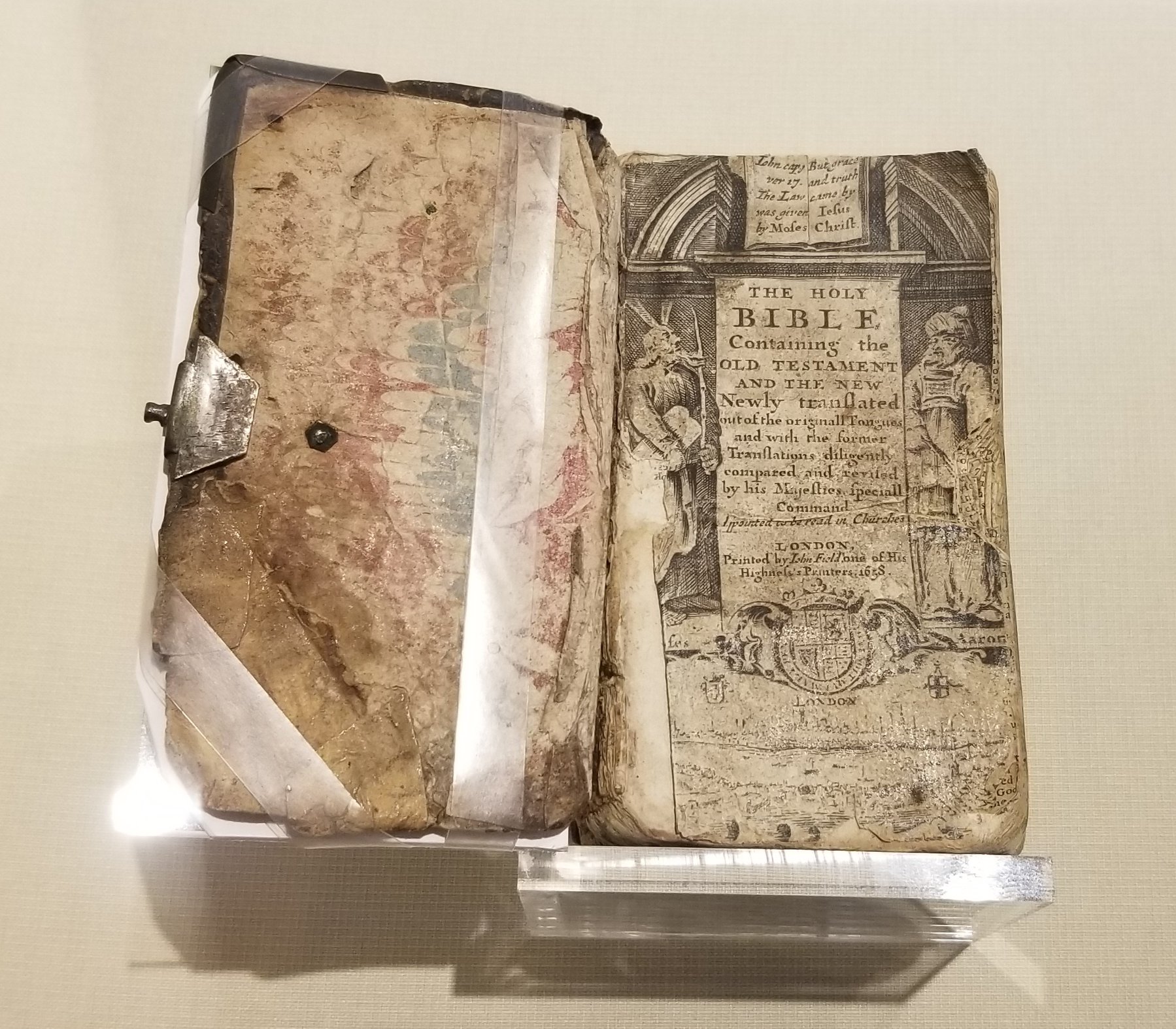
Saved from that ship is this Bible, which belonged to the Reverend Archibald Stobo, founding patriarch of the Presbyterian church in South Carolina. You can see this at the South Carolina Historical Society Museum. Reverend Stobo had been invited into town to preach at the White Meeting House (now Circular Congregational Church). He, his wife, and a small group from the ship were saved.
I was born in Charleston. My dad used to tell me that I slept through my first hurricane the year I was born. Of course, Hugo continues to be talked about. My brother and his family left the Holy City for the upstate, along with thousands of others. When they went back, it was to a destroyed city. Today, the rain sounds like it is going to pommel Charleston once again.

Folly Beach after Hugo
One of my early memories is of a quick meeting with the President of the United States. When I was around four, I met President Dwight D. Eisenhower. In a long line of people, my parents and I were outside a church in Augusta, Georgia. (Since then, I have found out that it was the Reid Memorial Presbyterian Church, where the President attended in that city.) I can still remember that it was Daddy, then Mother, then me standing beside the sidewalk. As the President walked by, he shook Daddy’s hand and then smiled and patted me on the head. It makes no sense that I can still visualize this occasion, but I do. I guess I am supposed to have this one in my memory bank.
Both my grandmothers and mother made jelly and preserves every summer. They started the spring season with strawberry preserves, following that with peach and blackberry preserves, and ending with apple jelly in the fall. I saw that it was hot work, as they all dealt with the steam from the jars boiling and the fruit being brought to a boil. But it wasn’t long after I married that I chose to follow in their footsteps. There really isn’t much enjoyment from the process, but there certainly is in eating the finished product. I, also, enjoy sharing them with friends and watching their eyes light up with anticipated pleasure. If I could only bake biscuits, like those three ladies, to go with those preserves, I would be truly following in their footsteps. (In case you didn’t know it, Mary B biscuits are a delicious second choice!)

As I continue to say, we need to share our stories. I hope, as you may have had extra time with family, that you have regaled another generation about your younger years.
To quote Sue Monk Kidd again, “Stories have to be told or they die, and when they die, we can’t remember who we are or why we’re here.”












 Sheila Ingle